1st Grade Opposites Printable Worksheets for ELA Practice
1st grade opposites printable worksheets give teachers a concrete, low-prep way to build relational vocabulary — the early understanding that words carry meaning in relation to each other, not just in isolation. Each worksheet in this set targets a specific task format so teachers can match the activity to where students actually are.
The Specific Skills These Worksheets Build
Word-relationship knowledge at Grade 1 is sensory and immediate. Students at this stage understand opposites most reliably when the concept is grounded in something they can see or act out — a door swinging open, a glass filling up, a clock moving fast or slow. The worksheets stay in that concrete zone while gradually moving students toward reading and writing the pairs independently.
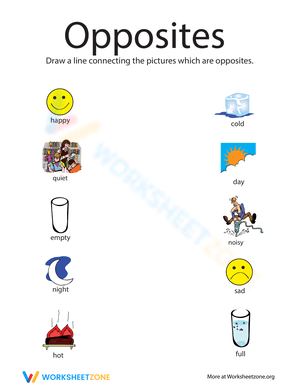
- Picture-to-picture matching: Students draw lines between images that show opposite ideas — a full bucket paired with an empty one, an open hand beside a closed fist.
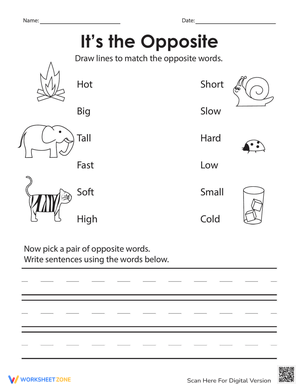
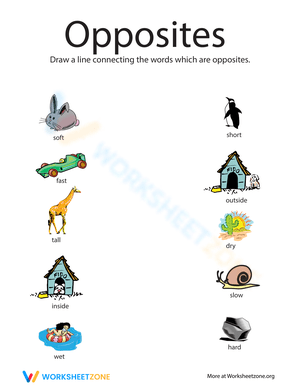
- Word-to-picture connections: A printed word on one side, an illustration on the other; students mark which picture shows the opposite meaning.
- Cut-and-paste sorting: Learners cut individual cards and physically place opposite pairs together, adding a kinesthetic element to what might otherwise be a passive task.
- Draw the opposite: One image is given; students sketch the opposing idea. This format checks comprehension without imposing any reading or writing demand.
- Sentence completion with a word bank: A simple sentence missing the opposite word; students select from a short list of choices and write it in.
Word pairs across the set stay concrete and familiar: big/small, hot/cold, up/down, open/closed, wet/dry, fast/slow, full/empty, day/night. Teachers introduce three or four pairs at a time, then return to the same vocabulary in a later worksheet so students encounter the words in a different context — which is more durable than drilling them repeatedly in one sitting.
Frequent Student Errors Worth Catching Early
The most predictable error in opposite-word work is not a reading problem — it's a semantic one. Some word pairs have more than one defensible answer depending on context. A first grader who writes "young" as the opposite of "old" is not wrong; neither is the child who writes "new." But when a task shows a picture of a man and asks for the opposite of "old," that context signals "young," and students who write "new" are applying a schema from objects rather than people. Watching for this pattern in student work tells you whether a child needs more oral modeling with context-specific examples, not simply more worksheet repetition.
A second error worth noting: students who identify opposites correctly during discussion — shouting "cold!" when you hold up a picture of ice — sometimes circle the wrong answer on paper because they mark the first option they see without reading the second. This is a test-taking habit, not a vocabulary gap. A brief classroom norm of "read both options before you mark" cuts these errors more reliably than re-teaching the word pairs themselves.
Why This Format Works for This Skill at This Grade
Young learners build vocabulary most durably when they encounter words through multiple modes — seen, heard, and used in context — before they're expected to apply them independently. The task sequence across these worksheets follows that logic: picture matching asks students to process meaning visually, cut-and-paste sorting asks them to commit to a decision physically, and sentence completion asks them to retrieve and apply the word in a new context. That progression moves from recognition to production without skipping stages.
Cognitive load matters here too. When a worksheet carries heavy decoding demands — long directions, small print, multi-word answer choices — first graders spend working memory on reading rather than on the vocabulary concept. Keeping items short and visual preserves that capacity for the actual skill being practiced. This is especially true in the first weeks of a unit, before the word pairs have become automatic.
How to Work These Worksheets Into Your Weekly Routine
These worksheets run best as part of a short teaching cycle rather than as stand-alone tasks. On the first day, introduce three opposite pairs using real classroom objects — hold a big book next to a small sticky note, fill a cup and pour it out, open and close the classroom door. Then distribute a picture-matching worksheet so students connect the paper task to something they just experienced. The 10-minute sequence between mini-lesson and independent work is where vocabulary actually lands for Grade 1 learners.
1st grade opposites printable worksheets also translate well into literacy centers. A picture-matching or cut-and-paste worksheet, a pair of scissors, and a glue stick is a complete center with no additional prep. After students finish, a partner-read step — both students say the opposite pairs aloud together — adds oral language practice without any extra materials. For Monday morning work, picture-based tasks with four to six items give students a calm, achievable start before the day shifts into higher-demand activities. Later in the week, sentence-completion tasks work as a Friday formative check: who can retrieve the word on their own, without any picture cue?
Standard Alignment
These worksheets address CCSS.ELA-LITERACY.L.1.5, which requires Grade 1 students to demonstrate understanding of word relationships and nuances in word meaning, with adult guidance and support. Antonym work sits squarely within that standard's intent: students who can sort, identify, and use opposite pairs are building exactly the relational word knowledge the standard describes. Within a unit sequence, these worksheets serve the guided and independent practice phases — not the initial introduction, which should always begin with oral modeling and concrete demonstration before any paper task is introduced.
Adjusting the Worksheets for Different Learners in the Same Room
Not every first grader arrives at the same place with print or vocabulary, and these worksheets absorb that variation without requiring completely different activities for each group.
- For students still developing print concepts: Use picture-only matching worksheets with four to six items and large illustrations. Remove any tasks that require writing, and consider reading directions aloud before students begin.
- For students learning English alongside peers: Preview each word pair orally before the worksheet, demonstrate with a gesture or a physical object, and keep the word bank visible throughout seatwork. Pairs like hot/cold and big/small carry strong visual anchors that reduce language load significantly.
- For on-level students: Word-and-picture worksheets with six to eight pairs and a short word bank for sentence completion tasks work well without additional support structures.
- For students ready for more: After completing any worksheet, ask them to write one original opposite pair — words not on the sheet — and use both in a sentence. This shifts the task from recognition into generative vocabulary use.
A practical move for mixed-ability pairs: have the stronger reader read the word aloud while the other student marks or places the answer. Both students handle the vocabulary knowledge; only the reading demand is shared. 1st grade opposites printable worksheets lend themselves to this kind of cooperative structure without requiring separate materials for each level.
Frequently Asked Questions
How many opposite pairs should appear on a single worksheet?
Four to six pairs work well for most independent tasks at this grade. When the activity involves cutting and pasting or drawing, four pairs is often enough — the physical steps take more time, and attention fatigue sets in faster than it does on a matching task. For partner work or fast-finisher pages, six to eight pairs is reasonable.
Are these worksheets appropriate for advanced kindergarten students?
Picture-based matching and draw-the-opposite tasks work well for kindergarteners who understand the concept orally but are still solidifying letter-sound knowledge. Sentence completion tasks are better reserved for students who can decode simple CVC words reliably on their own, regardless of grade placement.
Can these worksheets serve as informal assessment?
A short picture-matching or sentence-completion worksheet functions well as a quick formative check at the end of a vocabulary lesson. Look for students who consistently choose the same wrong answer rather than making random errors — that pattern points to a specific misconception, often the context-dependency issue with words like old, rather than simple inattention. 1st grade opposites printable worksheets in sentence-completion format are especially useful for this purpose because they show whether students can retrieve a word independently, not just recognize it when it's placed next to its pair.
Clear All