Complete sentences worksheets printable for 1st grade give teachers a clear entry point into one of the trickiest shifts in early literacy: the moment students move from writing individual words to writing thoughts that actually hold together. These worksheets address that transition directly, building the mechanical habits — capital letters, end punctuation, subject-predicate structure — before those habits have a chance to calcify into errors.
The Specific Skills These Worksheets Build
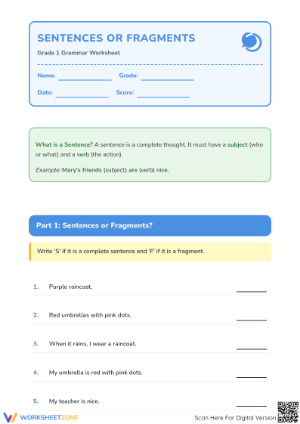
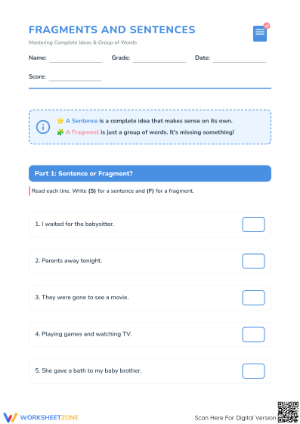
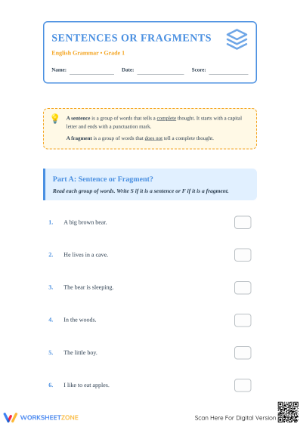
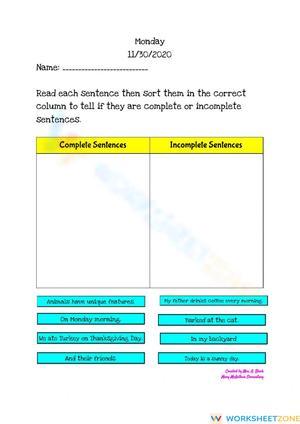
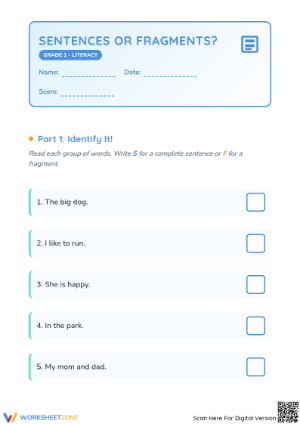
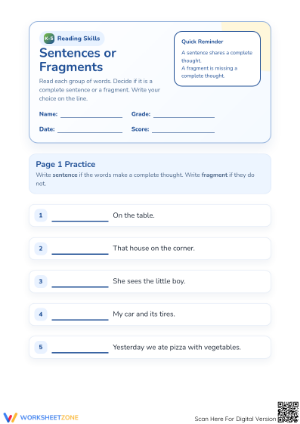
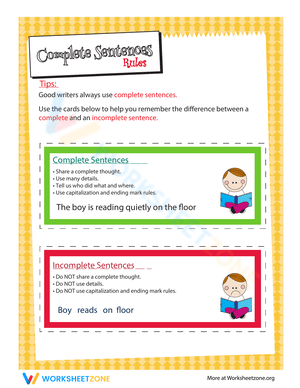
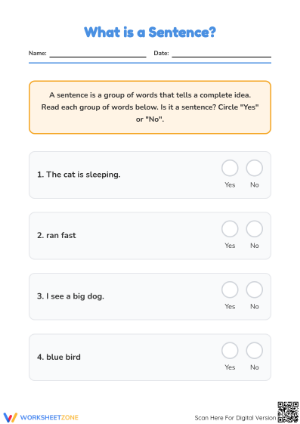
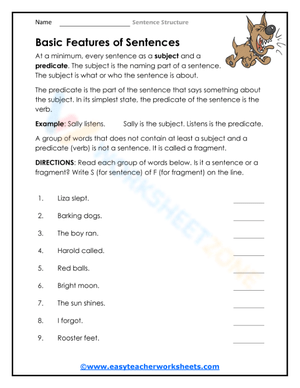
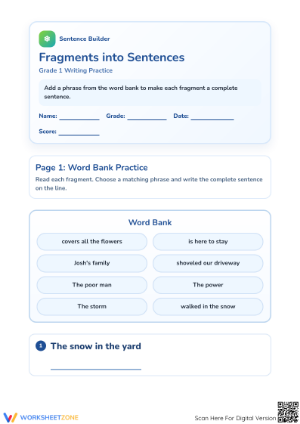
Four task types appear across this set, each targeting sentence structure from a different angle. Fragment vs. complete sentence sorting asks students to read word groups and decide whether each one answers both "who" and "what happened." The discriminating work is reading for meaning, not grammar terminology. Subject and predicate match-up presents naming parts and telling parts in two columns; students draw lines between logical pairs. The visual format makes the two-part structure of a sentence concrete before students have to hold it in working memory while writing independently.
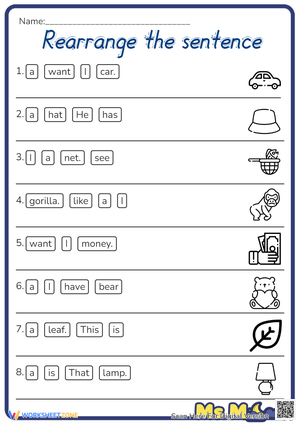
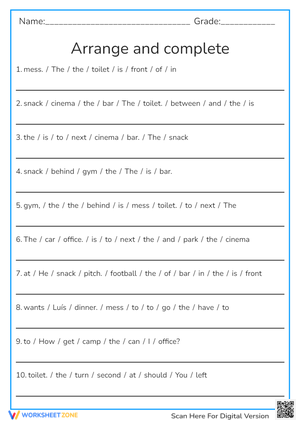
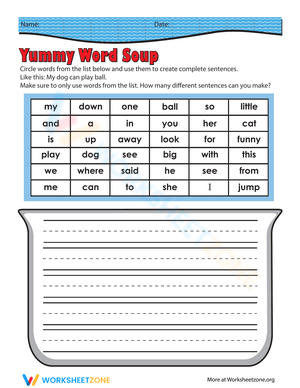
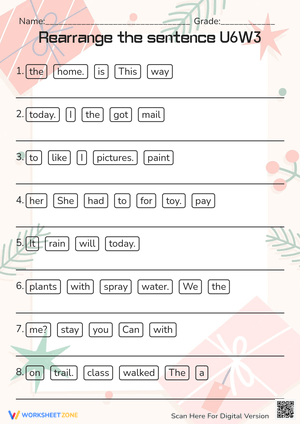
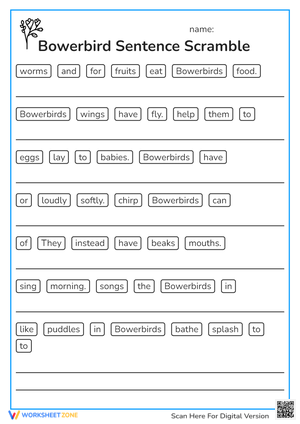
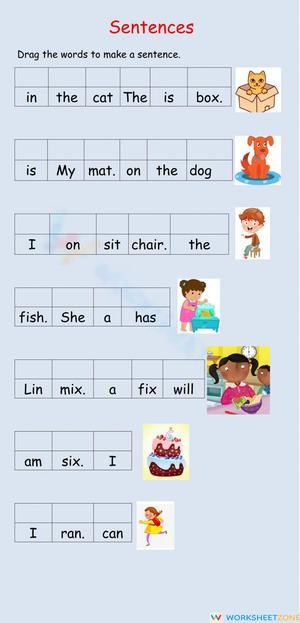
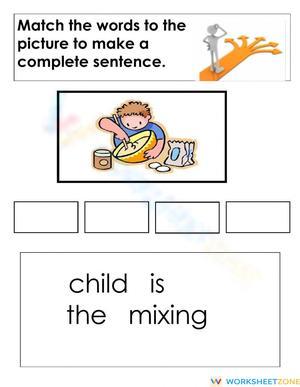
- Scrambled sentence unscrambling: Students arrange randomly ordered words into a readable sentence. The skill is learning to look for capitalization clues at the start and punctuation clues at the end rather than guessing at word order.
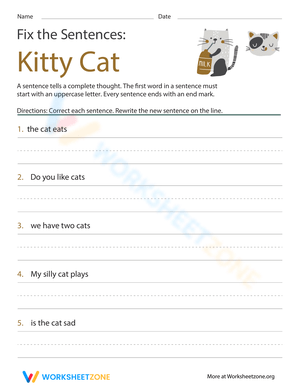
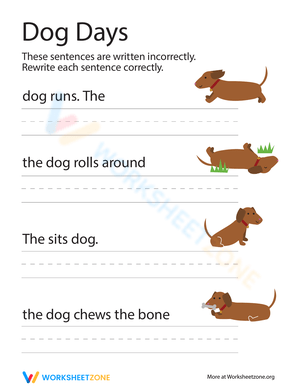
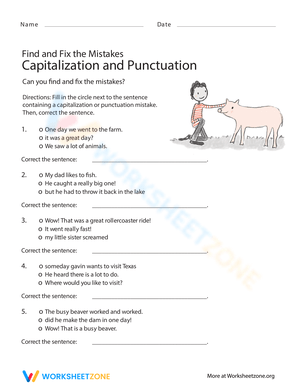
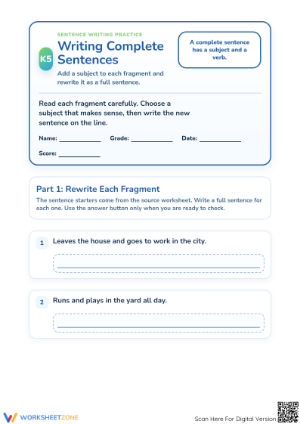
- Sentence fix-it editing: Short sentences appear with deliberate errors — missing capitals, absent or wrong end marks — and students rewrite them correctly. This format builds the editing reflex alongside the composing reflex.
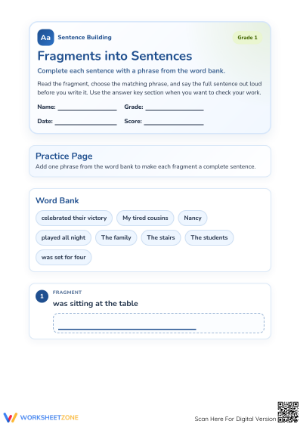
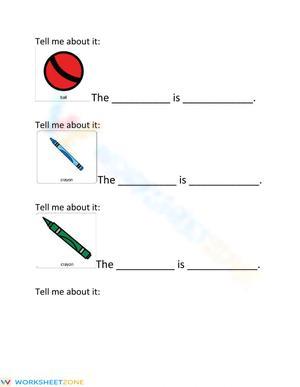
- Picture-prompt sentence frames: A drawing paired with a partial sentence (the frog on a log, the frame "The frog ___________") hands the student both subject and idea, which frees up cognitive attention for the mechanics rather than the content.
Frequent Student Errors Worth Watching For in This Work
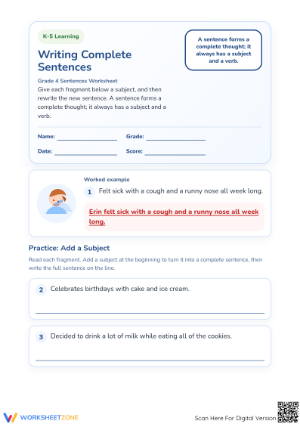
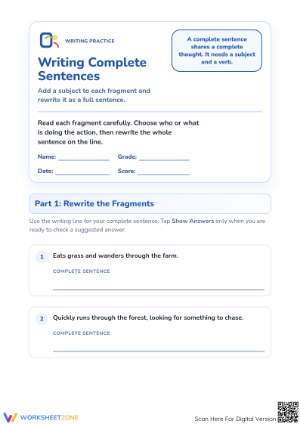
The most common fragment at this level isn't a random cluster of words — it's a predicate without a subject. Students write "Ran to the swings." because they're picturing the action so clearly that the "who" feels obvious to them. The subject exists in their head; it just didn't make it onto the page. When a fix-it worksheet presents "Ran to the swings." with a visible gap where the naming part belongs, the missing piece becomes concrete in a way that oral correction alone rarely achieves.
Run-ons are the other dominant pattern. A first grader with something to say writes "The cat sat and the dog ran and then the cat ran too and they played." Each clause is grammatically intact; the trouble is the unbroken chain of "and." These worksheets won't eliminate run-ons — that's a longer developmental arc — but the match-up tasks begin establishing that one complete thought has a natural stopping point before the next begins.
Punctuation errors split into two distinct types: students who omit end marks entirely, and students who drop a period on every sentence regardless of whether it's a question or exclamation. Worksheets that ask students to choose among all three end marks based on sentence meaning address the second group directly, since those students have learned that sentences end — they just haven't learned that the mark carries information about meaning and tone.
Standard Alignment
These worksheets address CCSS ELA-Literacy L.1.1j, which requires first graders to produce and expand complete simple and compound sentences in response to prompts. In classroom terms, that standard plays out across two phases of the year. Fall instruction concentrates on simple sentences with clear naming and telling parts — the two-column match-up and fragment-sorting worksheets live here. By late winter and into spring, the expectation extends to compound sentences: two independent clauses joined by a conjunction. The more advanced worksheets in this set reflect that arc by introducing "and," "but," and "so" as connectors students practice using to link two complete thoughts without losing either one.
Building These Worksheets Into Your Weekly Lesson Plans
The fragment-vs.-sentence sorting worksheet works especially well as a Monday warm-up, before students have generated much writing of their own and while attention is still fresh. The task takes most students fewer than eight minutes, but the discussion it generates is where instruction actually happens. When a student argues that "The big, hungry bear" is a complete sentence because it sounds like one, that's the exact misconception worth surfacing in front of the whole class — and worth returning to when it reappears in their independent writing later in the week.
For literacy center rotations, the scrambled sentence worksheets run nearly independently once students understand the format. One practical move: have students cut the word cards apart and arrange them on the table before writing anything. That tactile step lets you scan the room from across the space and spot syntax errors while they're still correctable, rather than discovering them after a full sentence has been written and needs erasing. Fix-it editing worksheets fit well in the wind-down minutes before a transition — the task is bounded, there's a clear right answer, and students who finish early can write their own broken sentence on the back for a partner to repair.
Differentiating These Worksheets Across Ability Levels
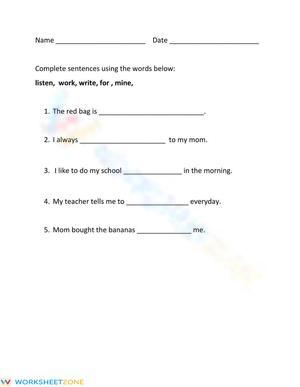
For students who find the physical act of writing demanding, sentence frames are the most effective support structure in this set. The frame handles the grammatical architecture; the student supplies only the missing piece. A frame like "The _______ runs to the _______." keeps subject-verb agreement intact no matter what nouns the student chooses — which means even a student working below grade level produces a mechanically correct sentence and gets to experience that. That experience matters more than it might seem; students who feel early success with sentence structure tend to transfer that confidence into their journal writing.
Students who are ready to move beyond simple sentences benefit from the compound sentence tasks. The challenge for this group usually isn't the conjunction — they grasp "and," "but," and "so" quickly. The sticking point is knowing where one complete thought ends before the conjunction arrives. Having them read their compound sentences aloud and pause at the conjunction tends to make the structure clearer than any written explanation.
Complete sentences worksheets printable for 1st grade also adapt naturally to partner work for mid-level students. One partner reads the word group aloud; the other decides whether it's a fragment or a complete thought before they discuss. Hearing "On the big blue mat." spoken aloud triggers recognition faster than reading it silently, because the ear catches the hanging incompleteness in a way the eye sometimes skips.
Frequently Asked Questions
How do I explain what a fragment is without using grammar terms a 6-year-old won't understand?
The clearest approach is to treat the fragment as a response to a question. Write "Jumped over the fence." on the board and say: "Someone told me this. Can you picture who?" Students immediately feel the absence of information. Contrast it with "The rabbit jumped over the fence." — now the picture is complete. The concept lands without the word "fragment" ever being necessary.
When in the year should I introduce question marks and exclamation points, rather than just periods?
Most teachers find that question marks make sense to introduce once students are solid on the period — typically six to eight weeks in. Exclamation points usually follow quickly because students already have an intuitive sense of emphasis; they just need permission to use a mark that matches it. The worksheets that present all three end marks work best as consolidation tasks after each mark has been introduced and practiced in isolation first, not as the initial instruction.
Do these worksheets work for students who are reading below grade level?
For the sorting and match-up tasks, reading level matters — a student who can't decode the word groups can't sort them accurately. Reading the word groups aloud during small-group time, or using phonics-controlled vocabulary on those specific worksheets, keeps the task accessible without changing what it assesses. The picture-prompt sentence frames in complete sentences worksheets printable for 1st grade are the most accessible entry point for students whose decoding is still developing, since the image supplies most of the meaning and the student focuses on producing the written form.
How often should first graders practice at the sentence level?
Short daily practice — five to ten minutes — builds automaticity faster than longer weekly sessions. The complete sentences worksheets printable for 1st grade work best woven into the existing daily structure rather than treated as a standalone writing event: morning warm-up, a center rotation, or the closing minutes of a language arts block all work. The goal is repetition frequent enough that checking for a capital letter and an end mark becomes a reflex, not a checklist item students have to consciously remember.