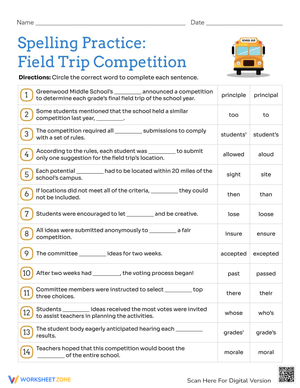
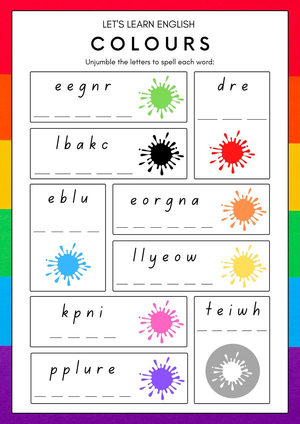
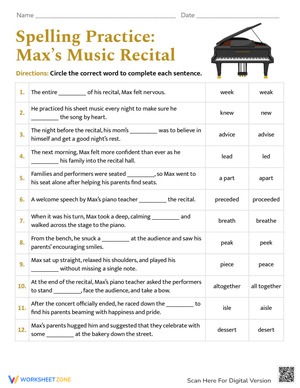
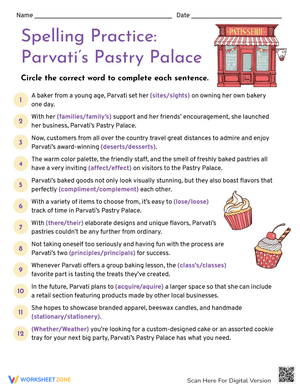
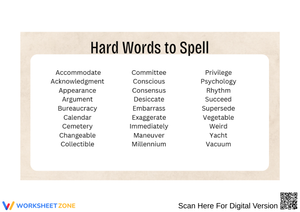
These irregular spelling words worksheets give K–2 teachers a structured practice resource for the words that phonics instruction alone doesn't reach — words like said, was, of, and enough that students encounter in every line of beginning text but can't decode through standard letter-sound correspondence. Each worksheet pairs visual recognition practice with handwriting reinforcement, so students encounter these words through multiple channels in a single focused activity.
What the Set Covers
The worksheets address high-frequency irregular words across the typical K–2 sequence — starting with the foundational 25 to 50 words most curricula introduce in kindergarten and extending through the irregulars that consistently trip up early second graders: friend, again, because. Activities across the set include reading the word from a visual prompt, tracing it, writing it from memory, and placing it in a short sentence frame. That last task matters more than it might seem. Students who can trace because accurately will still write becuz in a journal entry if they've only ever practiced the word with a model visible in front of them.
Several worksheets use a visual cueing approach drawn from the Heart Word method — students mark the letter or letter cluster that breaks the expected phonics pattern. In said, the s and d behave according to standard phonics; the ai producing a short /e/ sound does not. Identifying the irregular portion lets students use their existing phonics knowledge to anchor the exception rather than treating the whole word as arbitrary. Orthographic mapping research supports this: the brain stores words more durably when it can attach phoneme-to-grapheme connections, even partial ones, rather than relying on whole-word visual memory alone.
Frequent Errors Worth Catching Before They Calcify
The most persistent problem is transfer failure. A student reads said correctly every time it appears on a word wall or a decodable reader, then writes sed or sead in independent composition. Recognition and production are separate cognitive acts, and practice that stops at reading doesn't close that gap. The write-from-memory tasks in this set are placed after — not alongside — the tracing portion. That small structural choice forces retrieval rather than copying, which is where real consolidation happens.
Was and saw produce reversals well into first grade, and not only because of directionality confusion. Students who have internalized the phonics pattern for saw (vowel + w making the /aw/ sound) misapply that logic and write waws for was. Putting those two words on the same worksheet actually helps — the contrast forces attention to the specific letter sequence rather than a general shape. Watching where students stumble during independent work tells you a great deal about where they actually sit in their phonics development, which a finished worksheet alone won't reveal.
Smart Ways to Work These Worksheets Into Your Week
Word Work station rotations are the most natural home for this kind of practice. While a teacher runs a small guided reading group, a rotating group of three or four students completes one worksheet at the spelling station. The predictable task sequence holds up well here — students don't need to ask what to do next, which keeps the room quiet and the guided group uninterrupted. Each worksheet takes most students in the K–2 target band about seven to ten minutes, which fits cleanly inside a standard 15-minute rotation without leaving a dead-air gap at the end.
Monday morning arrival work is another reliable slot. Starting the week with a word introduced the previous Friday keeps recently taught irregulars from fading over the weekend gap, and students get an immediate win before the day's instruction begins. One practical note: avoid using the same worksheet as both classroom practice and a send-home assignment. When students complete it in class first, home practice becomes copying rather than retrieval. Reserve the downloadable irregular spelling words worksheets for one context per word cycle so that each exposure demands genuine recall.
Adapting These Worksheets Across a Range of Student Readiness Levels
For students working below grade level, narrowing the word list matters more than modifying the worksheet format. Use the same activity structure but limit it to two or three target words rather than five or six. Students overwhelmed by a long list tend to rush through everything superficially; fewer words practiced more thoroughly produces better long-term retention. A small sticky note covering the lower half of a worksheet while a student works through the top words is a low-effort adjustment that costs nothing in prep time and removes a real source of anxiety.
Students who have already secured the grade-level irregular word list benefit from a production-only version of the practice — skip the tracing column entirely and work only from dictation, writing each word in a sentence rather than in isolation. You can adapt any irregular spelling words worksheets in the set this way by covering the word bank before dictation begins. This raises the cognitive demand without requiring a separate resource. For students receiving Tier 2 support, the standard worksheet format works well, but pairing it with brief teacher modeling of the Heart Word analysis — pointing to the irregular letter cluster before the student attempts the task — closes the gap faster than independent practice alone.
Standard Alignment
These worksheets align with CCSS RF.K.3c (read common high-frequency words by sight) and RF.1.3g (recognize and read grade-appropriate irregularly spelled words). In classroom terms, RF.K.3c work lives in the first half of kindergarten, running alongside early phonemic awareness and letter-sound instruction — not after it. Irregular word practice is concurrent with phonics, not a later add-on. By first grade, RF.1.3g extends to a longer target list and the expectation shifts from basic recognition to fluent, automatic recall in both reading and writing. These worksheets address that progression and fit the sequencing used in most structured literacy programs and basal readers without requiring teachers to remap the word order.
Frequently Asked Questions
Why do students recognize irregular words on worksheets but misspell them in writing?
Recognition and spelling draw on different memory pathways. A student who sees enough and reads it correctly has a strong visual representation but has not practiced retrieving it cold. During independent writing, no visual prompt exists. If every prior exposure provided the word as a model to look at, the student has never actually practiced pulling the spelling from memory — which is what writing requires. Including at least one write-from-memory task in each practice session builds the retrieval strength that transfers to composition.
How many new irregular words should students work on per week?
Three to five is the range most primary teachers land on, and experience backs it up. Introducing more than five in a week leaves students with shallow exposure to many words rather than deep exposure to a few. Three words practiced across four or five different contexts — read, trace, write, build, use in a sentence — stick. Twelve words traced once each do not. Consistency of depth matters more than the length of the list.
Can these worksheets replace direct instruction on irregular words?
An irregular spelling words worksheets works best as the practice layer that follows instruction, not a substitute for it. Introducing a new irregular word means briefly analyzing it with students — identifying the regular parts, naming the tricky part, and reading it in a sentence — before anyone writes it independently. Worksheets then provide the repeated exposures that consolidate what instruction introduced. Handing students a worksheet cold, without that brief analysis, produces slower results, particularly for students who are still building their phoneme-grapheme understanding.
How often should previously taught words reappear in practice?
Spaced retrieval is the principle: words should come back after a gap, not the very next day, but not three months later either. A word introduced in week one benefits from a brief review task in week three and again in week six. Many teachers build this in by including two or three review words on each new worksheet alongside the current week's targets. Students rarely notice the difference in format, but the retrieval gap is doing real memory consolidation work that massed practice — seeing the same word five days in a row — does not.












 Interactive Worksheet Maker
 Quiz Maker
 Word Search Maker
 Crossword Puzzle Maker
 Word Scramble Generator
 Sentence Scramble Generator
 Handwriting Worksheet Generator
 Name Tracing Generator
 Fill In The Blank Generator