


























Views
Downloads

Grade 4 /k/ and /kw/ Phonics — Printable No-Prep Worksheet
Paste this activity's link or code into your existing LMS (Google Classroom, Canvas, Teams, Schoology, Moodle, etc.).
Students can open and work on the activity right away, with no student login required.
You'll still be able to track student progress and results from your teacher account.
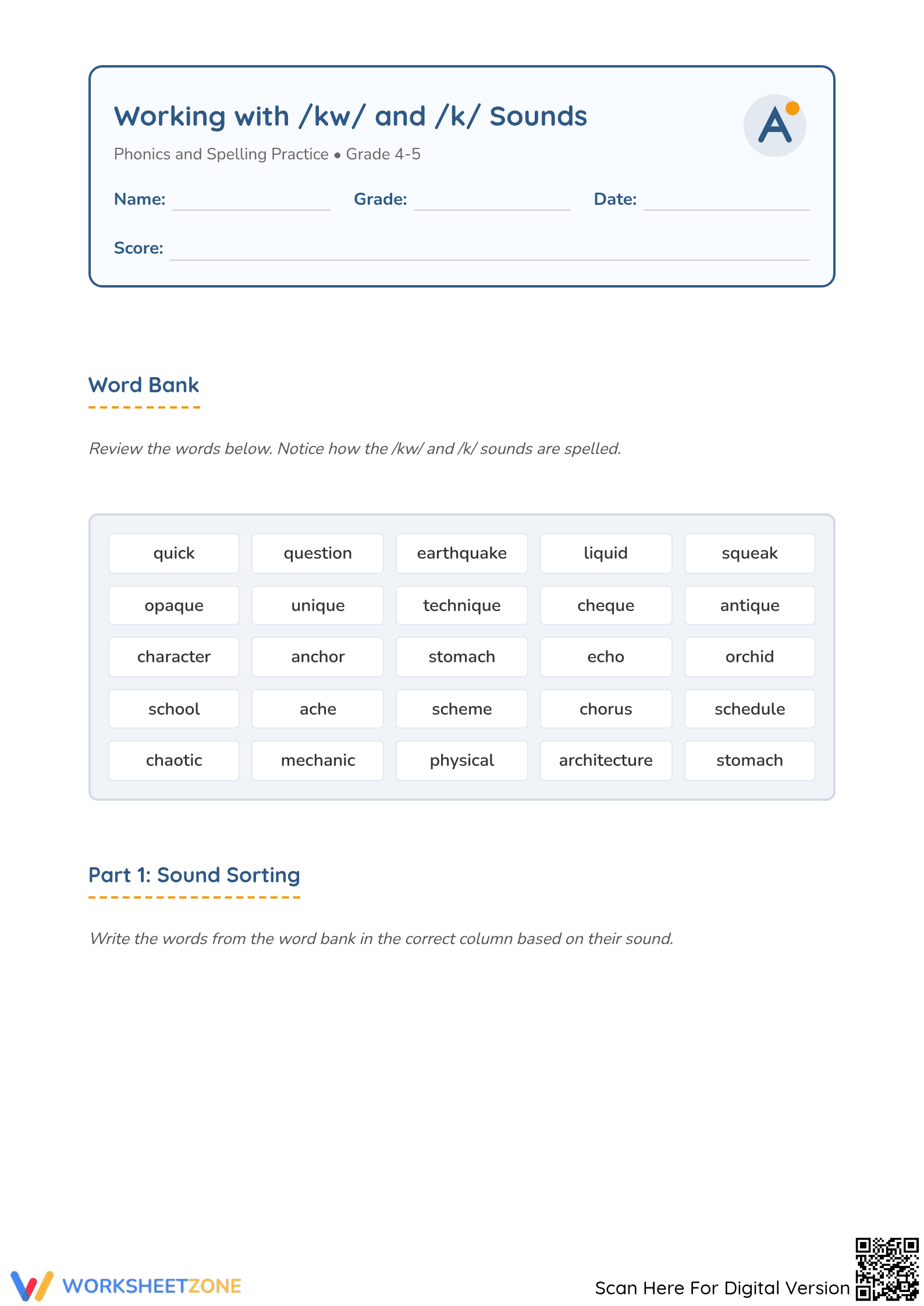
Strengthen student orthographic awareness with this comprehensive Grade 4 and 5 phonics resource focused on the /k/ and /kw/ sounds. By explicitly teaching the relationship between phonemes and their diverse graphemic representations—including 'qu', 'ch', 'que', and 'c'—this worksheet ensures students develop the precision required for high-level spelling and reading fluency.
At a Glance
- Grade: 4–5 · Subject: English Language Arts
- Standard:
L.4.2.D— Spell grade-appropriate words correctly using spelling patterns and generalizations- Skill Focus: Phonics /k/ and /kw/ sounds
- Format: 3 pages · 34 problems · Answer key included · PDF
- Best For: Independent practice and phonics reinforcement
- Time: 25–30 minutes
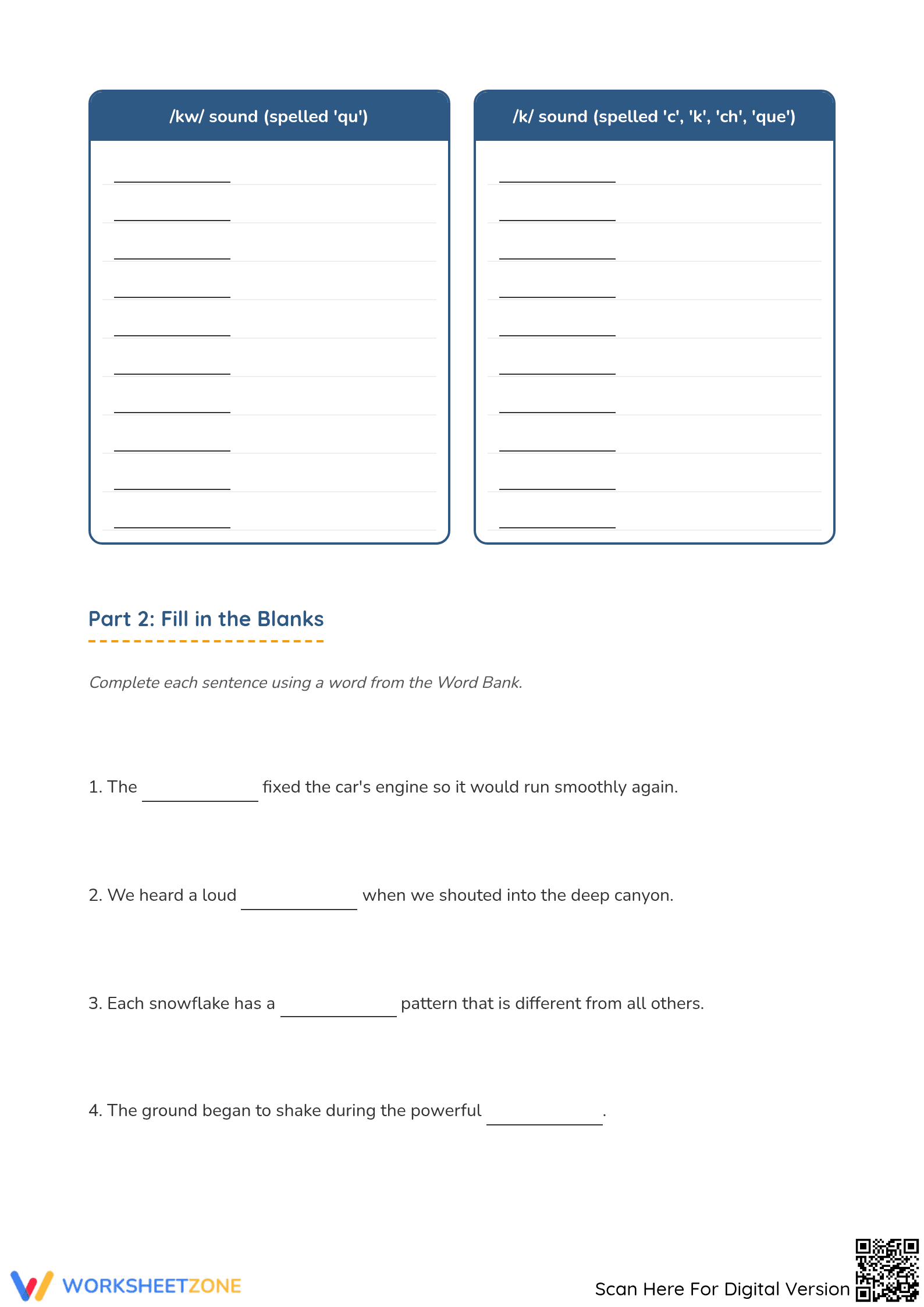
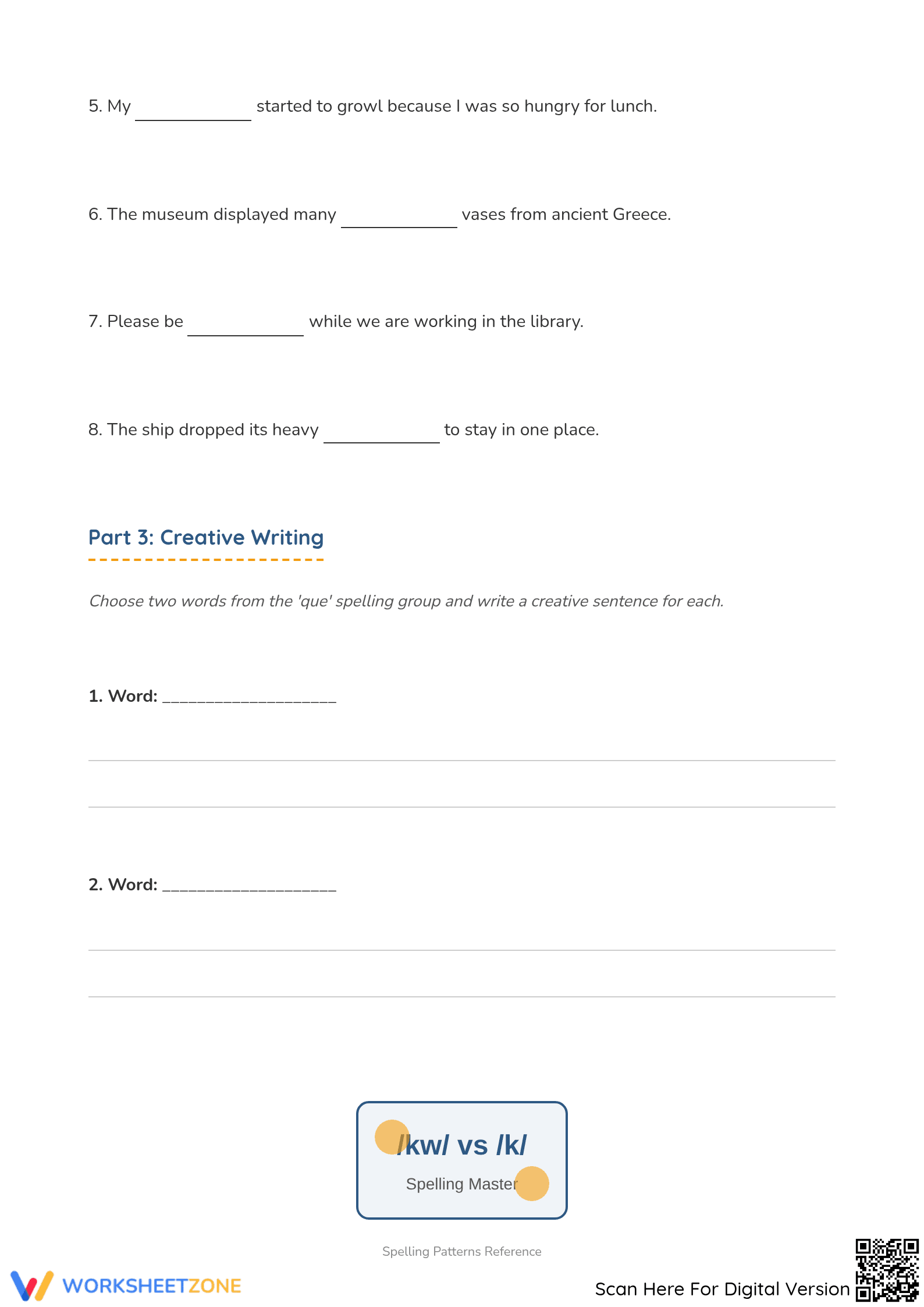
This three-page PDF is structured to move students from recognition to application. It features a robust 24-word bank containing academic vocabulary such as 'architecture,' 'chaotic,' and 'technique.' The worksheet includes a categorical sound sorting table, eight context-based fill-in-the-blank sentences, and a creative writing section to ensure students can use these complex spelling patterns in original compositions.
Zero-Prep Workflow
This resource is designed for immediate classroom integration. First, print the three-page set for each student (less than 1 minute). Next, distribute the materials as an independent desk task or a center activity (30 seconds). Finally, use the included answer key to review results with the class or perform quick-check grading (under 2 minutes). This efficient design makes it a perfect choice for substitute folders or emergency lesson plans.
Standards Alignment
The primary focus is CCSS.ELA-LITERACY.L.4.2.D, which requires students to spell grade-appropriate words correctly by consulting references as needed. It also supports L.5.2.E by reinforcing complex spelling patterns that are common in academic texts. Both standard codes can be copied directly into lesson plans, IEP goals, or district curriculum mapping tools to demonstrate rigorous alignment with national literacy frameworks.
How to Use It
This worksheet serves as an excellent formative assessment after a direct instruction lesson on irregular spelling patterns. Assign the first two pages during independent work time to observe how students categorize sounds based on spelling clusters. Use the creative writing section on the final page as an exit ticket to evaluate mastery. Students typically complete the 34 tasks within a 25-minute instructional block.
Who It's For
This resource is optimized for Grade 4 and 5 students who are transitioning from foundational phonics to complex academic spelling. It provides necessary scaffolding for English Language Learners who may struggle with the multiple sounds of 'ch' and 'qu.' Pair this worksheet with a shared reading passage containing similar vocabulary to provide a high-utility literacy experience for all learners.
According to an EdReports 2024 analysis, systematic phonics instruction in upper elementary grades remains a critical component of literacy development as students encounter more complex multi-syllabic words. This worksheet targets the phonological awareness of /k/ and /kw/ sounds, which often present challenges due to irregular orthographic patterns such as 'que' and 'ch'. By engaging in 34 distinct tasks—ranging from categorical sorting to context-rich sentence construction—learners internalize these spelling generalizations through active cognitive processing. This alignment with CCSS.ELA-LITERACY.L.4.2.D ensures that students are not merely memorizing lists but are instead developing a functional understanding of how phonemes translate to graphemes in diverse linguistic contexts. The inclusion of academic vocabulary such as 'architecture' and 'chaotic' further supports secondary vocabulary acquisition goals, making it a robust tool for improving overall reading fluency and writing accuracy in Grade 4 and 5 classrooms.


