


























Views
Downloads

Grade 4 Story Review — Printable No-Prep Worksheet
Paste this activity's link or code into your existing LMS (Google Classroom, Canvas, Teams, Schoology, Moodle, etc.).
Students can open and work on the activity right away, with no student login required.
You'll still be able to track student progress and results from your teacher account.
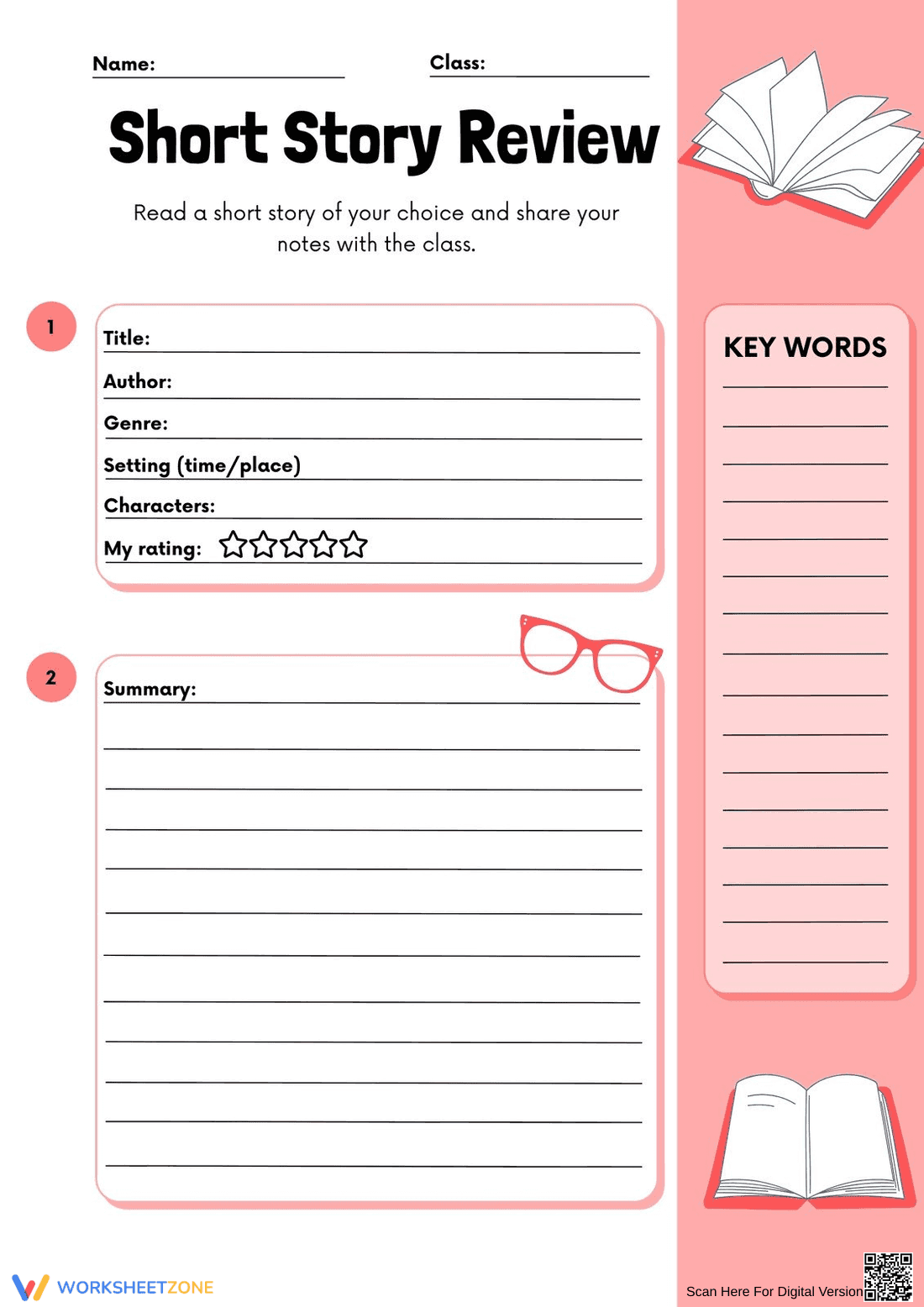
This Grade 4 short story review worksheet prompts students to analyze key literary elements and summarize their reading. By identifying the setting, characters, genre, and main plot points, learners actively process text structure. The open-ended format works with any fiction book, making it a highly versatile tool for independent reading accountability.
At a Glance
- Grade: 4 · Subject: ELA
- Standard:
CCSS.ELA-LITERACY.RL.4.2— Summarize a text and determine its theme- Skill Focus: Story elements and summarizing
- Format: 1 page · 8 fields · Open-ended · PDF
- Best For: Independent reading response
- Time: 15–20 minutes
This single-page graphic organizer features three sections to capture comprehension. The top panel requires basic details, including title, author, genre, setting, and characters, alongside a five-star rating scale. The middle section provides lined space for a plot summary. Finally, a side column prompts students to record key words, reinforcing vocabulary acquisition.
Zero-Prep Workflow
This resource is designed for immediate classroom implementation with minimal teacher friction.
- Print (1 minute): The single-page layout is highly ink-efficient and requires no double-sided formatting.
- Distribute (1 minute): Hand out the sheets as students transition into their independent reading block.
- Review (3 minutes): Quickly scan the completed summaries to check for basic comprehension and plot sequencing.
Total teacher prep time is under two minutes. Because it pairs with any short story, it serves as an excellent emergency sub plan or a permanent fixture in a literacy center.
Standards Alignment
This resource aligns with CCSS.ELA-LITERACY.RL.4.2: Determine a theme of a story, drama, or poem from details in the text; summarize the text. It also supports character and setting analysis by requiring students to isolate these specific narrative components before drafting their summary. Both standard codes can be copied directly into lesson plans, IEP goals, or district curriculum mapping tools.
How to Use It
Deploy this worksheet during independent reading time to hold students accountable for their self-selected texts. It functions perfectly as a weekly reading log alternative, requiring deeper engagement than a simple signature. Alternatively, use it after a whole-class read-aloud to guide a shared summarizing activity. As a formative assessment tip, check the "Key Words" column to see if students are identifying thematic vocabulary or just random words from the text. Expected completion time ranges from 15 to 20 minutes depending on the length of the story.
Who It's For
This graphic organizer is primarily designed for fourth-grade students developing their summarizing skills. The structured fields offer built-in differentiation for learners who struggle with blank-page writing assignments, breaking the review process into manageable chunks. It pairs exceptionally well with classroom libraries, leveled reading passages, or direct instruction lessons on narrative story arcs.
Effective reading comprehension instruction requires students to actively synthesize information rather than passively consume it. Aligning with CCSS.ELA-LITERACY.RL.4.2 to summarize a text and determine its theme, this worksheet provides the necessary cognitive scaffolding for young readers. According to Fisher & Frey (2014), utilizing structured graphic organizers during independent reading significantly increases student retention of core narrative elements like character development and setting. By separating the identification of key words and basic story facts from the more complex task of writing a cohesive summary, educators can isolate specific areas where a student might need intervention. This targeted approach ensures that learners build a strong foundation in literary analysis, ultimately improving their ability to tackle more complex texts in subsequent grade levels while fostering a genuine appreciation for storytelling.


