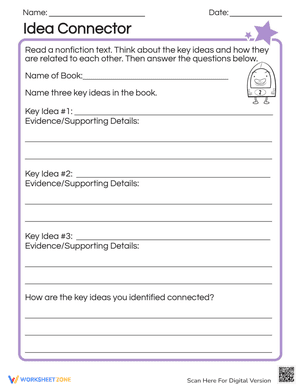
These making connections in nonfiction worksheets give students a structured way to move past passive reading and actually interrogate informational text — recording where a fact triggered a memory, where it echoed something from another source, or where it linked to something happening outside school. That act of writing down the connection matters more than most teachers expect: articulating a connection requires retrieval, and retrieval is what moves information from working memory into something that lasts.
The Specific Skills Targeted
The set builds all three connection types — text-to-self, text-to-text, and text-to-world — but frames each one specifically for informational reading, which shifts the work considerably from how connection-making gets introduced through fiction. Students identify where in a passage a connection arises, name the type, and then complete the harder step: explaining how that connection changes or confirms their understanding of the content. That final explanatory sentence is what separates real comprehension practice from rote worksheet completion.
- Text-to-self: Students connect factual content to personal experience — not just noting a similarity, but explaining how the memory clarifies what the text is saying. A student who has seen a river flood does more than recall that event; they use it to process a passage about water table saturation.
- Text-to-text: Students compare the current piece to another article, book, or document they have encountered, attending closely to how different authors frame the same information. This comparison is sharpest in science and social studies, where reading across multiple sources is standard practice.
- Text-to-world: Students situate what they are reading inside a larger context — a recent event, a historical pattern, a natural phenomenon they have witnessed. This is the most cognitively demanding type and the one students most often complete at a surface level without direct support.
Frequent Student Errors Worth Watching For
The most persistent problem is the decorative connection — the one that popped into a student's head but did not actually help them understand the text. A student reads a passage about desert ecosystems and writes "This reminds me of when we went to Arizona last summer." That might be a genuine response, but it tells you nothing about whether the student understood adaptation, water conservation, or nocturnal behavior. The follow-up prompt built into these worksheets — "How does this connection help you understand the text?" — is exactly where that error gets exposed. Students who leave that line blank usually have not made a real comprehension connection at all.
In text-to-text work, a different pattern appears: students default to the most recent text they remember rather than the most relevant one. A student connecting across a unit on ecosystems will reach for last Tuesday's article about frogs when the better comparison would be the biome reading from three months ago. Building the habit of asking "Is this actually a useful comparison?" takes repeated practice — but it is the habit that eventually produces genuine synthesis across sources.
Getting the Most From These Worksheets in Your Lesson Plans
The strongest placement is immediately after a shared read-aloud or close reading, while the passage is still on the table. Teachers who send the connection worksheet home tend to get thinner responses — students fill in something plausible rather than something they actually noticed during reading. During a guided reading block, most worksheets take 8 to 12 minutes when students have already read the passage; the remaining block time works well for a pair-share where students compare connection types and debate whether each other's connections are decorative or functional.
For upper elementary, the making connections in nonfiction worksheets that focus on text-to-text comparison work well as a unit entry point. Before students encounter the anchor text, they fill in the first organizer column with what they already know from prior reading. After reading, they return to complete the comparison. That before-and-after structure makes prior knowledge visible to both student and teacher — and it tends to surface misconceptions while there is still instructional time to address them.
Standard Alignment
These worksheets align most directly with CCSS ELA-Literacy RI.4.9, which asks students to integrate information from two texts on the same topic in order to write or speak about it knowledgeably. The grade-band equivalents — RI.3.9 at the direct comparison level, RI.5.9 and RI.6.9 moving toward full synthesis across several texts — map to different worksheets within the set as organizer complexity increases. The text-to-self and text-to-world worksheets also support the Reading Informational Text anchor standard R.10, which requires independent reading of complex informational texts across grade levels. Teachers working with state-level frameworks that diverge from CCSS will find these resources align closely with the parallel "integration of knowledge and ideas" strand present in most state documents.
Differentiating These Worksheets for a Range of Learners
For students who struggle to initiate, the most effective adjustment is narrowing the connection type rather than piling on more sentence starters. Restricting those students to text-to-self connections keeps the task within knowledge they already hold, which lowers the retrieval demand without removing the comprehension thinking. Once they write with some fluency, adding the text-to-text requirement becomes manageable. Open-ended tasks with extra support structures often produce longer blank lines, not better responses.
Advanced students benefit from a single constraint: require them to quote the specific sentence that sparked the connection and justify why that moment in the text — rather than any other — was the trigger. That requirement moves the work from recall into close reading. English Language Learners often do better with making connections in nonfiction worksheets that use small visual icons to mark the three connection types — a person silhouette for self, two books side by side for text-to-text, a globe for world. The visual cue reduces the language demand of identifying the task category, which frees attention for the actual comprehension work.
Frequently Asked Questions
What grade levels do these worksheets target?
The set spans roughly grades 2 through 6. Worksheets at the lower end use more visual organizers and shorter prompts; those at the upper end ask students to cite text evidence and evaluate whether their connections are genuinely relevant. Teachers sometimes pull worksheets from lower in the range for intervention groups at higher grade levels — the organizer structure can still be appropriate for a struggling fifth grader even when paired with a more demanding passage.
Do these require specific texts, or can I use them with anything?
They work with any informational text — science articles, social studies passages, current events excerpts, nonfiction read-alouds. The organizers are passage-neutral; students write the title and subject at the top. The text-to-text worksheets work best when students have already read at least one other piece on a related topic, so plan for that sequencing when you map out your weekly reading rotation.
How do I distinguish a strong connection from a superficial one?
Look at the explanatory sentence, not the connection itself. "This reminds me of a news story about flooding" is an association. "That story helps me understand why the author says wetlands slow water movement downstream" is comprehension. The making connections in nonfiction worksheets in this set include a self-assessment line where students mark whether their connection changed their understanding of the text — that line functions as a quick formative checkpoint before whole-group discussion, and it is usually more revealing than the connection statement itself.
Can these be used in digital classrooms?
Yes. The PDF format uploads cleanly to most learning management systems, and students can annotate using any standard digital markup tool. The visual organizers translate well to screens because the layout is straightforward — no small checkboxes or cramped columns that become difficult to interact with on a tablet.















 Interactive Worksheet Maker
 Quiz Maker
 Word Search Maker
 Crossword Puzzle Maker
 Word Scramble Generator
 Sentence Scramble Generator
 Handwriting Worksheet Generator
 Name Tracing Generator
 Fill In The Blank Generator