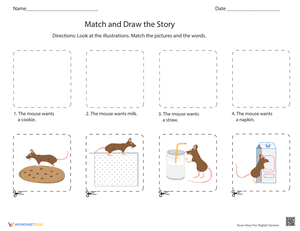
These making connections in fiction worksheets give students a structured way to move past surface-level reading and build genuine engagement with narrative text. The set covers all three connection types — Text-to-Self, Text-to-Text, and Text-to-World — and works across grades 3 through 6, where this strategy typically enters formal instruction as a named comprehension technique.
What Students Practice Across the Set
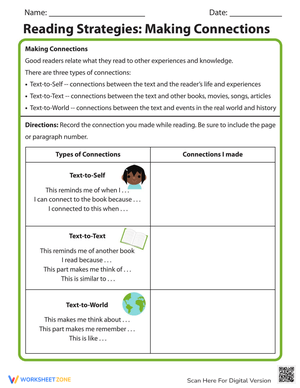
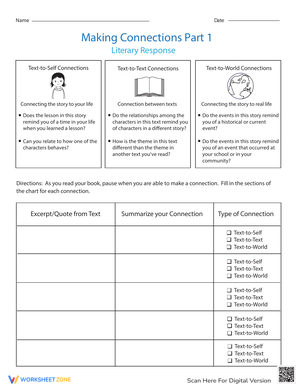
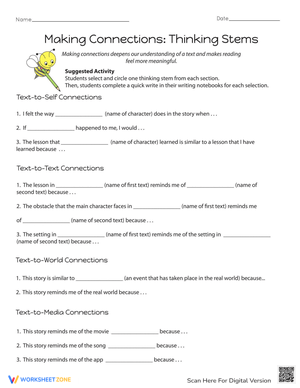
The three connection types look similar on the surface but ask for very different cognitive moves. Text-to-Self prompts ask students to identify a moment in the story — a character decision, an emotion, a setting detail — and describe a parallel from their own experience, then explain how that link changes or deepens their reading. The critical word is explain: each worksheet pushes past "this reminds me of my vacation" toward a complete thought about what the connection reveals about the character or the situation.
Text-to-Text work requires students to name a second story, poem, or film and identify a shared theme, structural element, or character type. When a student notices that both Charlotte's Web and Because of Winn-Dixie open with a lonely child who finds an unexpected animal companion, they're starting to read for pattern — which is the foundation of genre study in middle school. Each worksheet in this category requires a specific example from the second text, not a general claim about what it was "about."
Text-to-World connections link a story event to a real-world situation: a historical period, a social issue, a community experience. These are the hardest for students to execute at this level, so the prompts use a step-by-step response format that anchors students to specific story evidence before they move outward. The goal is to prevent the classic Text-to-World slide into vague social commentary.
Frequent Errors Worth Catching Before They Calcify
The most consistent problem across all three connection types is that students make the connection and stop. A third grader writes "This reminds me of when I moved to a new school" and considers the task finished. What's missing is the return trip: how does recalling that experience change the way they read this paragraph? Every worksheet includes a two-part prompt that requires both the personal link and the analytical payoff.
Text-to-Text work produces a different error — students reach for media rather than literature, and the comparison stays shallow. "This is like Frozen because both have a girl as the main character" is not a literary connection in any useful sense. Requiring students to cite a specific passage or scene from the second text makes this kind of surface observation harder to sustain.
With Text-to-World prompts, the error runs the other direction. Students overgeneralize into social commentary without staying grounded in the story — "this book shows that pollution is bad" tells us nothing about what the student understood. The prompts address this by requiring students to name a specific story detail first, then move outward to the real-world parallel.
Building These Worksheets Into Your Literacy Block
The most effective entry point is a think-aloud during read-aloud, before any worksheet changes hands. Model the process by stopping mid-chapter, naming the connection type, and — crucially — evaluating whether that connection is helping you understand the story or just triggering a tangential memory. That distinction between a useful connection and an associative distraction takes two or three explicit modeling sessions before most students internalize it.
Making connections in fiction worksheets fit naturally into small-group reading rotations. When four students work through the same short story and complete the same Text-to-Self worksheet, their responses will diverge — two people can draw opposite connections from the same paragraph and both be defensible. That divergence is the discussion. Compare responses, trace them back to the text, and students start to see why the return trip matters.
For independent reading units, a staged approach works well: assign the Text-to-Self worksheet during early chapters, the Text-to-Text worksheet at the midpoint, and hold the Text-to-World worksheet until the book is finished. This keeps the cognitive demand manageable and gives the final discussion a built-in structure. You don't need a separate discussion guide when students arrive with three completed worksheets that already represent their thinking.
Adjusting the Set for a Range of Readers in the Same Room
Students who struggle with this strategy need one connection type at a time and a text the whole class knows well. The Text-to-Self worksheet is the right starting point — the connections are more immediate, and the student doesn't need to hold a second text in memory while analyzing the first. Using making connections in fiction worksheets on a recently completed class read removes the word-by-word decoding load and lets students focus entirely on the reasoning.
For students working above grade level, the challenge is depth rather than coverage. These students tend to generate connections quickly and correctly, but the connections are often thin. Requiring them to pull a direct quote from each text to support a Text-to-Text comparison raises the analytical demand considerably without changing the worksheet format.
Students who are still building English fluency often find Text-to-World the most accessible entry point — counterintuitively. When the world they're connecting to is their home country, community, or cultural experience, the task draws on knowledge they genuinely possess. That's worth keeping in mind when choosing which worksheet to introduce first for a given student.
Standard Alignment
Text-to-Text work directly supports CCSS.ELA-LITERACY.RL.4.9 and RL.5.9, which require students to compare and contrast stories by how they approach similar themes and topics. These are the standards most teachers associate with genre study, and Text-to-Text connection-making is the underlying analytical move those standards depend on. In practice, a student who cannot yet articulate why two stories feel similar is not ready to approach RL.4.9 with any real depth.
Text-to-Self connections align with RL.3.3 and RL.4.3, which ask students to describe characters in depth and draw on specific story details to explain motivations. The connection becomes analytical when students link their own experience to a character's decision and ask whether they would have chosen differently — which is exactly the kind of evidence-based reasoning those standards require in written form.
Frequently Asked Questions
Do these worksheets work with any fiction text, or are they written for specific titles?
All prompts are text-agnostic. Each worksheet gives students a structure for recording and analyzing their connections without referencing a specific book. That means they work with a class novel, a short story from an anthology, a picture book used in a mini-lesson, or a student's independent reading selection. Teachers using a workshop model have used making connections in fiction worksheets alongside six or seven different titles simultaneously without any logistical confusion.
At what grade level does this strategy typically enter formal instruction?
Most students encounter the Text-to-Self, Text-to-Text, and Text-to-World labels in second or third grade, but the strategy often receives shallow treatment before fourth grade — students learn the vocabulary without being pushed to complete the full analytical move. This set assumes students have seen the terminology and are ready to do something rigorous with it. The resources are most effective in grades 3 through 6.
Can these worksheets function as formative assessment?
Yes — and that's where they're most useful. A completed Text-to-Text worksheet shows quickly whether a student is making a genuine analytical comparison or just naming surface similarities. That distinction is easy to miss during a class discussion, where a student can offer a vague comment that sounds like comprehension. Written responses don't disappear, and the two-part prompt structure makes it straightforward to see exactly where the reasoning breaks down.












 Interactive Worksheet Maker
 Quiz Maker
 Word Search Maker
 Crossword Puzzle Maker
 Word Scramble Generator
 Sentence Scramble Generator
 Handwriting Worksheet Generator
 Name Tracing Generator
 Fill In The Blank Generator