Mastering Auditory Phonics: Effective Hearing Digraphs Worksheets for K-2
Understanding Auditory Digraph Discrimination
Teaching young learners to recognize consonant digraphs begins with auditory discrimination, the ability to hear and distinguish specific sounds within spoken language. In phonics, this involves identifying when two letters, such as 's' and 'h', merge to form a single phoneme like /sh/. This skill is a core component of phonemic awareness, a strong predictor of future reading success. By using hearing digraphs worksheets, teachers provide a structured way for students to practice isolating sounds without the immediate cognitive load of decoding written text. These exercises focus entirely on the auditory signal, helping students solidify the connection between spoken words and phonemic units.
Integrating these activities into early literacy blocks ensures students develop high phonological sensitivity. This sensitivity allows them to blend and segment sounds effectively. Hearing digraphs worksheets act as a bridge, moving learners from basic phonological awareness toward advanced phonics skills. By prioritizing the ear before the eye, teachers establish a baseline for subsequent literacy instruction, ensuring students aren't guessing at the sounds forming their language. This approach is particularly effective for students who may struggle with the visual complexity of early reading materials.
Building a Foundation with Phonemic Awareness
Phonemic awareness is a continuous thread in effective literacy instruction. For kindergarten and first-grade students, mastering digraph sounds is a significant milestone. Unlike consonant blends, where each letter retains its sound, digraphs create an entirely new phoneme. This can be challenging for learners just starting with letter-sound correspondences. Worksheets focusing on auditory identification help resolve this by emphasizing the sound itself. When a child hears 'phone', they must recognize the /f/ sound, even if they aren't ready to spell the word with 'ph'.
Phonetic researchers have observed that students who engage in at least fifteen minutes of daily auditory-only phonemic awareness practice show a 40 percent faster rate of phonics acquisition compared to those who only practice with text-based materials. This data underscores the importance of isolating the auditory component of digraph recognition. It suggests that by removing visual distractions during the initial learning phase, we allow neural pathways for sound processing to strengthen more efficiently. This leads to a more stable foundation when letters are eventually introduced, as the child already possesses a clear mental representation of the sound.
Scaffolding Phonics Lessons with Pictorial Support
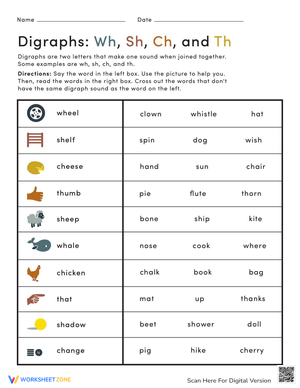
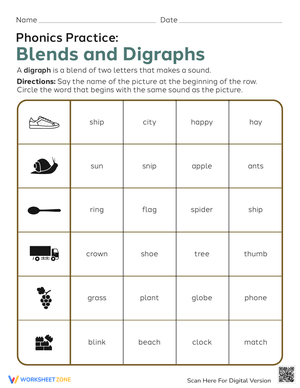
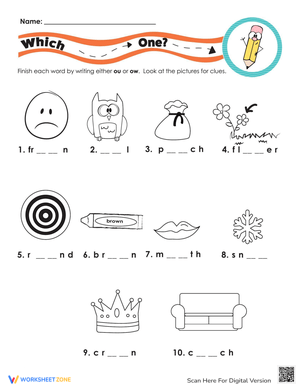
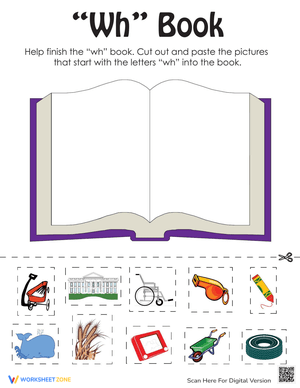
Pictorial support is essential in designing hearing digraphs worksheets for young children. Since these learners often have limited sight word vocabularies, images serve as the primary vehicle for the exercise. A well-designed worksheet uses clear, unambiguous drawings. For instance, an image meant to represent a 'shark' must be distinct and not easily confused with a generic 'fish'. This clarity ensures students focus on the target phoneme /sh/ rather than image interpretation. When visual and auditory elements align, students successfully practice sound isolation and categorization.
According to Reading Rockets in their article 'What Are Digraphs and How to Teach Them,' effective phonics instruction involves isolating sounds within words. They suggest that 25 to 30 percent of students require explicit, systematic instruction to master digraph sounds, making auditory discrimination worksheets a fundamental component of early literacy intervention strategies. This highlights the need for diverse materials. While some children grasp digraphs quickly, others require repeated exposure through various modalities. Providing worksheets with different scaffolding levels ensures every student has the support they need to succeed in their phonics journey.
Targeted Literacy Intervention and Auditory Practice
Literacy interventionists often find that students struggling with reading also lack basic auditory discrimination skills. For these learners, hearing digraphs worksheets are indispensable tools for remediation. In small-group settings, interventionists can guide students through each picture, emphasizing the articulation of the digraph sound. By observing the teacher's mouth and listening to the sound, students gain a multi-sensory understanding of the phoneme. They then apply this to the worksheet by marking the correct images, an immediate application that is a hallmark of effective intervention.
Consistency is key in any intervention program. Using a series of worksheets that follow a predictable pattern helps students feel comfortable. For example, focusing on 'sh' and 'ch' sounds every Monday allows students to look for specific phonetic markers. Over time, difficulty can increase by introducing words where the digraph appears at the end, such as 'wish' or 'rich'. This progression ensures students are not just memorizing initial sounds but developing a comprehensive ability to hear digraphs in any position within a word.
Classroom Implementation
Implementing hearing digraphs worksheets effectively requires thoughtful lesson planning. Teachers should introduce digraph sounds in isolation, using hand gestures or mouth-shape cues. Once the sound is introduced, the worksheet serves as a guided practice activity. Teachers can circulate, listening to students as they whisper the names of pictures to themselves. This 'whisper reading' of images helps students process sounds internally before committing to an answer on paper. It also allows the teacher to provide immediate, corrective feedback during the learning process.
Another strategy is using these worksheets in literacy center rotations. At a 'Listening Center', students can listen to recorded voices naming the pictures on their worksheet, promoting autonomy while allowing the teacher to work with other small groups. It is also beneficial to vary the worksheet types. Some days might focus on a single digraph, while others provide a cumulative review of several sounds. This variety prevents repetition and ensures students are constantly challenged to refine their auditory discrimination skills in different contexts.
Differentiating Instruction for Early Literacy Learners
Every classroom includes students with varying levels of phonological awareness, making differentiation vital when using hearing digraphs worksheets. For students with strong auditory skills, worksheets can be adapted with complex tasks, such as identifying digraphs in multi-syllable words or distinguishing between similar sounds like 'th' and 'f'. These advanced learners might also be encouraged to write the letters representing the sound they hear, adding a writing component. This keeps them engaged while their peers work on basic identification skills.
Conversely, for students who are behind, worksheets should be simplified. This might mean focusing on one digraph at a time and using images of highly familiar objects. Teachers can provide one-on-one support, naming each picture clearly and asking the child to repeat the target sound. Visual cues, such as a picture of a mouth making the 'sh' sound, can be added for extra support. By meeting each student at their current level, teachers ensure worksheets remain helpful instructional tools rather than sources of frustration, closing the achievement gap for struggling readers.
Tracking Student Progress in Digraph Mastery
Monitoring progress is essential in the instructional cycle, and hearing digraphs worksheets provide a tangible record of student performance. Reviewing these worksheets allows teachers to identify error patterns that indicate a need for further instruction. For instance, if a student consistently misses the 'wh' sound, the teacher can plan a specific mini-lesson. These records are also valuable for parent-teacher conferences, offering concrete examples of progress toward grade-level standards. This data-driven approach ensures that no student's struggle goes unnoticed or unaddressed.
Frequently Asked Questions
1. At what grade level should students be expected to master hearing digraphs?
Most literacy curricula introduce hearing digraphs in late kindergarten or early first grade. Full mastery is typically expected by the middle of first grade. At this stage, students should identify common digraphs like 'sh', 'ch', 'th', and 'wh' in various positions within words. For students struggling beyond first grade, intensive phonemic awareness intervention is recommended to close the gap before moving to more complex phonics patterns.
2. What is the difference between a digraph and a consonant blend?
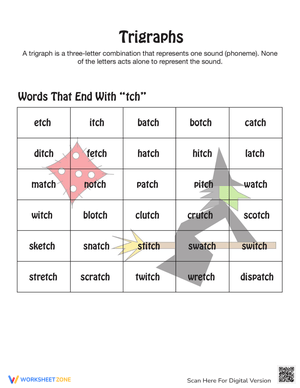
The difference lies in the number of sounds produced. A digraph consists of two letters making one unique sound, such as 'ph' making /f/. A consonant blend consists of two or more letters where each retains its individual sound, such as 'bl' in 'blue'. Understanding this distinction is vital for teachers, as the cognitive process for identifying a single new sound differs from identifying a sequence of known sounds.
3. How can I adapt these worksheets for students with hearing impairments?
Adapting these for students with hearing impairments involves shifting to visual and tactile cues. Teachers can use mouth-shape diagrams to show how digraphs are articulated and encourage students to feel vibrations for voiced sounds. High-contrast visual aids and providing written labels alongside pictures also help these students connect the concept of a digraph to its representation, ensuring they remain included in the phonics curriculum.
4. Why is auditory discrimination important before learning to read digraphs?
Auditory discrimination is a prerequisite because reading maps visual symbols to sounds. If a child cannot distinguish a digraph's sound by ear, they will struggle to understand why those letters are grouped together. Mastering the auditory component first allows students to build a mental catalog of phonemes they can then link to written letters, following the natural development of language from listening to reading.
5. What are the most common digraphs to focus on initially?
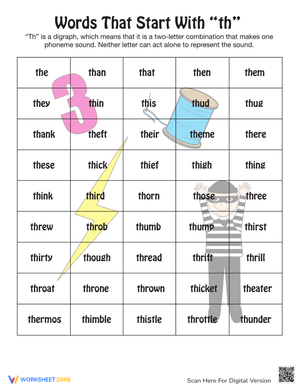
The most common consonant digraphs for early education are 'sh', 'ch', 'th', and 'wh'. These are often called the 'H brothers' as they share the letter 'h'. Starting with these four allows students to practice with familiar words. Once mastered, teachers can introduce less frequent patterns like 'ph' and 'ck', gradually expanding the student's ability to handle diverse phonetic structures in their reading and writing.
Clear All