Introducing Participles and Participial Phrases
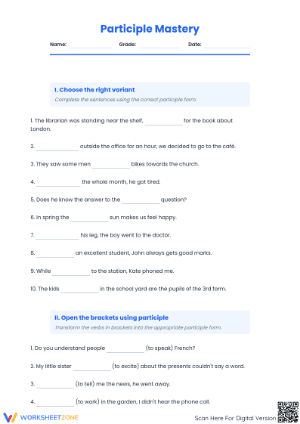
Unlike standard verbs that show action, a participle acts as an adjective, modifying nouns or pronouns. This shift in function can confuse students initially, but targeted instruction using participles printable worksheets can clarify the concept. Providing clear, ready-to-go resources allows teachers to isolate this grammatical structure, giving students the guided practice needed for mastery. A participial phrase consists of the participle along with its modifiers and complements, all working together to describe a subject. For instance, in the sentence "The athlete, sweating from the intense workout, drank a gallon of water," the phrase "sweating from the intense workout" modifies "athlete." By breaking down these complex sentence structures, teachers can help students elevate their writing beyond basic subject-verb-object patterns. Using printable worksheets with answer keys saves valuable planning time, ensuring that both ESL/EFL instructors and traditional classroom teachers have access to high-quality materials. These resources align perfectly with CCSS language standards that emphasize syntactic variety and descriptive precision.
Distinguishing Present and Past Participles
To fully grasp how these verbals function, students must learn to distinguish between the two main types: present and past. Present participles end in "-ing" and typically denote an ongoing or active state. Think of phrases like "the running water" or "the laughing child." While the spelling is straightforward, students sometimes confuse these with gerunds, making explicit instruction necessary. On the other hand, past participles signify a completed action or a resulting state. These usually end in "-ed," "-d," "-t," "-en," or "-n," such as "the broken vase" or "the completed assignment." Teaching past participles requires extra attention because of the numerous irregular verbs in the English language. When students encounter words like "sung," "written," or "burnt," they need practice to recognize them as descriptive elements rather than active verbs. Participles printable worksheets provide the repetition required to solidify these distinctions. By comparing present and past forms side-by-side in structured exercises, teachers can clarify how the timing of an action influences the description of a noun, ultimately leading to more sophisticated student writing and reading comprehension.
Addressing Dangling and Misplaced Modifiers
One of the most common syntax errors students make when experimenting with complex sentences involves misplaced or dangling modifiers. A dangling participle happens when the participial phrase describes the wrong subject, or when the intended subject is completely missing from the sentence. For example, "Walking down the street, the trees were beautiful" suggests that the trees were out for a walk. This structural error creates confusion and unintentional humor, distracting from the writer's actual message.
According to recent middle school writing assessments, dangling and misplaced modifiers account for nearly thirty percent of sentence-level structural errors in narrative compositions, highlighting a significant gap between recognizing a participle and placing it correctly within a clause. When students learn to anchor the modifying phrase immediately next to the intended noun, their writing becomes instantly clearer and more authoritative. Editing exercises that ask students to identify and fix these specific errors train their eyes to look for logical connections between phrases and subjects.
To support instruction in this area, many teachers turn to specific editing drills. Research from the Purdue OWL indicates that targeted practice with dangling modifiers helps students eliminate up to forty percent of syntax errors in their independent writing, emphasizing the need for structured revision exercises that train learners to anchor descriptive phrases directly next to the nouns they modify. Printable resources that feature these "Dangling Disaster" correction exercises give students a safe space to spot logical errors and rewrite sentences for clarity. This focused practice is essential for helping students meet advanced ELA standards.
Sorting Verbals: Gerunds versus Participles
A comprehensive grammar curriculum must include instruction on how to differentiate participles from other verbals, particularly gerunds and infinitives. Because both present participles and gerunds share the exact same "-ing" ending, students frequently mix them up. The distinction lies entirely in their function. A gerund always acts as a noun, serving as a subject, object, or object of a preposition. A participle always acts as an adjective. For example, in the sentence "Swimming is my favorite sport," the word "swimming" is a gerund. However, in "The swimming dog fetched the stick," the same word functions as a participle modifying "dog." Using a "Verb vs. Adjective" sort activity can make this abstract concept more concrete. By providing students with mixed sentence lists, teachers can challenge them to analyze the specific job a word is performing within the clause. Worksheets designed for this purpose help learners move beyond rote memorization, encouraging deep syntactic analysis that translates directly into stronger ELA skills.
Engaging Sentence Combining Activities
Grammar instruction does not have to be a series of dry, repetitive drills. Incorporating engaging activities into your lesson plans can capture students' interest and make learning more interactive. One effective approach is using "Sentence Squasher" exercises. In this activity, students receive two or three simple, choppy sentences and must combine them into a single, complex sentence using a participial phrase. For instance, "The dog was barking loudly. The dog chased the mailman" becomes "Barking loudly, the dog chased the mailman." This exercise directly translates grammar knowledge into improved composition skills. Another engaging strategy involves fill-in-the-blank stories, sometimes called a "Participle Party," where students convert base verbs into descriptive verbals to complete a narrative. This approach encourages creativity while reinforcing grammatical rules. Additionally, using picture prompts can generate excellent descriptive writing. Give students a compelling image and ask them to write five sentences about it, each starting with a participial phrase. These dynamic activities, supported by clear, printable worksheets, transform abstract grammar concepts into highly interactive learning experiences.
Classroom Implementation
Integrating participles printable worksheets into your daily instructional routine requires a strategic approach to maximize student engagement and retention. These highly versatile resources can be adapted for whole-group instruction, small-group intervention, or independent practice. For a whole-class introduction, project a worksheet onto your smartboard and work through the first few examples collaboratively. Model your thinking process out loud, showing students how you locate the verb, check its function, and determine which noun it describes. This explicit modeling sets a clear expectation for how they should approach independent work. For small-group intervention, use targeted worksheets to support students who are struggling to differentiate between verbals and main verbs. Grouping students based on formative assessment data allows you to provide customized support, focusing specifically on areas like irregular past participles or comma usage. These printables also serve as excellent bell ringers or "Do Now" activities. Providing a short, five-question review at the start of class keeps the concept fresh and builds student confidence over time. Having the answer keys ready allows for quick peer grading, giving learners immediate feedback.
Frequently Asked Questions
1. How is a participle different from a gerund?
While both present participles and gerunds end in "-ing," their functions within a sentence are completely different. A gerund acts as a noun and can serve as a subject, direct object, or object of a preposition. A participle acts as an adjective, modifying a noun or pronoun to provide descriptive detail. The best way to tell them apart is to look at the job the word is doing in that specific sentence.
2. Is a word like "broken" a verb or an adjective?
The word "broken" can be either, depending entirely on its use in the sentence. It is the past participle form of the verb "break." When used with a helping verb to form a perfect tense or passive voice, it acts as a verb (e.g., "The window was broken by the baseball"). When it is used to describe a noun without a helping verb, it functions as an adjective (e.g., "She swept up the broken glass").
3. What is a dangling participle and how do I fix it?
A dangling participle occurs when a participial phrase is placed in a sentence without a clear, logical noun to modify, or when it accidentally modifies the wrong noun. To fix this error, rewrite the sentence so the noun being modified is immediately adjacent to the phrase. For example, change "Barking loudly, the mailman ran away" to "Barking loudly, the dog chased the mailman."
4. Do all past participles end in -ed? What about irregular verbs?
No, not all past participles end in "-ed." While regular verbs follow the standard "-ed" or "-d" pattern, English has many irregular verbs that do not follow this rule. Irregular past participles can end in "-en," "-n," or "-t," or they might change their vowel structure entirely (e.g., "written," "sung," "burnt," "torn"). Providing students with a reference list of irregular verbs is highly recommended.















 Interactive Worksheet Maker
 Quiz Maker
 Word Search Maker
 Crossword Puzzle Maker
 Word Scramble Generator
 Sentence Scramble Generator
 Handwriting Worksheet Generator
 Name Tracing Generator
 Fill In The Blank Generator