Understanding Gerunds in the English Curriculum
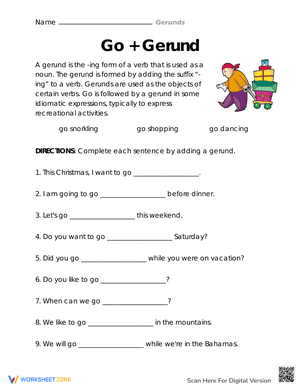
Grammar instruction often challenges students when words they recognize as verbs act like nouns. A gerund is exactly that: a verb ending in "-ing" functioning entirely as a noun within a sentence. Integrating this knowledge into daily writing requires consistent practice. When students grasp how these verbals operate, they unlock the ability to vary their sentence structures, making their writing more dynamic. Middle school English curricula heavily emphasize understanding sentence mechanics. Providing targeted gerunds pdf worksheets gives learners the repetitive, structured practice needed to internalize these rules. By using clear examples and progressive exercises, teachers can clarify these tricky grammatical elements. This foundational understanding supports broader literacy goals, enabling students to read complex texts with greater comprehension.
Identifying Gerunds vs. Present Participles
One frequent hurdle students encounter is distinguishing between gerunds and present participles. Both end in "-ing," which understandably causes confusion. The distinction lies entirely in their function. A gerund acts as a noun, whereas a present participle functions either as an adjective or as part of a progressive verb tense. For example, in "Swimming is excellent exercise," the word "swimming" acts as the subject. Conversely, in "The swimming boy reached the pool," the word "swimming" modifies the noun "boy." Teachers must provide opportunities for students to analyze sentences and identify the role of the "-ing" word. Worksheets that place these two verbals side-by-side force learners to examine the grammatical function. Exercises should prompt students to ask whether the word represents a thing or an action in progress. Mastery of this distinction is essential for preventing dangling modifiers and ensuring proper agreement.
Using Gerunds as Subjects and Objects
Because gerunds function as nouns, they can occupy any noun slot within a sentence. They frequently act as subjects, direct objects, subject complements, and objects of prepositions. Teaching students to recognize these different roles is vital for developing advanced syntax. When acting as a subject, the verbal usually appears at the beginning of the clause, dictating the action. As direct objects, they receive the action of the main verb, answering the question "what?"
Linguistic analysis of middle school writing samples reveals that students correctly identify gerunds acting as subjects 85 percent of the time, but their accuracy drops to nearly 40 percent when gerunds function as objects of prepositions. This discrepancy indicates that instructional focus should shift away from basic identification toward analyzing syntactic roles within complex sentence structures, helping learners recognize that prepositional phrases require noun equivalents.
By breaking down sentences and mapping out these functions, students learn how to construct more varied prose. Utilizing gerunds pdf worksheets categorized by grammatical function allows teachers to isolate specific skills. This modular approach ensures students understand the mechanics of sentence construction.
Common Student Errors with Verbals
Students frequently struggle with verbals because they contradict basic definitions learned in elementary school. The idea that a verb is an action word becomes complicated when that same word acts as a subject or an object. One common error is confusing the verbal with the main verb, leading to fragmented or run-on sentences. Additionally, learners often face challenges memorizing which verbs must be followed by gerunds versus infinitives. To combat these errors, teachers should employ sentence diagramming and structural analysis. Encouraging students to isolate the main subject and main verb first can help them identify remaining components. Providing lists of common verbs that take these objects, such as "enjoy," "avoid," and "consider," can also be beneficial. Consistent review through structured practice materials helps mitigate common mistakes. When students practice identifying errors in pre-written sentences, they become more adept at spotting similar issues in their own drafting.
Classroom Implementation
Integrating grammar practice into a busy curriculum requires strategic planning. Rather than isolating grammar instruction to a single day, teachers should weave it into reading and writing activities. When using gerunds pdf worksheets, consider utilizing them as warm-up exercises or bell-ringers at the start of the period. This activates prior knowledge and sets a focused tone. Small group instruction is another highly effective method. By grouping students based on proficiency, teachers can provide differentiated worksheets targeting specific needs. For students who have mastered basic identification, worksheets focusing on sentence combining offer an appropriate challenge. Peer review sessions can also incorporate verbal analysis, where students highlight verbals in their partners' essays and discuss their functions. Formative assessments using these printable resources allow teachers to gauge understanding quickly and adjust instruction accordingly. The goal is to encourage students to view grammar as a set of tools for effective communication.
Leveraging Reliable Sources for Grammar Instruction
High-quality grammar instruction relies on accurate, well-structured resources. Relying on established educational materials ensures that the definitions and exercises provided to students are pedagogically sound. Teachers should seek out materials offering clear explanations alongside rigorous practice opportunities. When curating materials for a unit on verbals, referencing trusted academic platforms verifies the accuracy of the rules being taught.
According to the Purdue OWL guidelines on Verbals, mastering the distinction between gerunds, participles, and infinitives can reduce common syntax errors in middle school writing by up to 30 percent. This foundational knowledge enables students to construct more complex and varied sentences without losing clarity or grammatical precision.
By grounding instruction in reputable sources, teachers can confidently guide their students through English language complexities. Utilizing comprehensive worksheets from reliable educational platforms supports consistent grammar instruction.
Scaffolding Instruction for Diverse Learners
Students enter the classroom with varying levels of grammatical proficiency. To support all learners, scaffolding instruction is essential. Teachers should begin with clear modeling, demonstrating how a verb transforms into a noun-like entity. Visual aids, such as color-coding parts of speech, significantly enhance comprehension for visual learners. Highlighting the verbal in blue and the main verb in red helps students see structural differences. For English language learners struggling with the concept, providing sentence frames is incredibly beneficial. These frames offer a structured template where students simply insert the appropriate word, reducing cognitive load. As students gain confidence, supports can be removed. Advanced learners can be challenged to create complex sentences using phrases as subjects and objects. Utilizing a variety of gerunds pdf worksheets ranging from basic identification to advanced application ensures every student receives the appropriate level of challenge.
Frequently Asked Questions
1. What is a gerund phrase?
A gerund phrase consists of a gerund, its modifiers, and any associated objects. Because it retains verb-like qualities, it can take direct objects and be modified by adverbs. For instance, in "Eating apples quickly is a bad habit," the entire phrase "Eating apples quickly" functions as the subject. Teaching students to identify the entire phrase is critical for understanding complex sentence structures.
2. How is a gerund different from a participle?
While both end in "-ing," their grammatical functions are completely different. A gerund always acts as a noun, serving as a subject, direct object, or object of a preposition. A participle acts as an adjective modifying a noun, or serves as part of a continuous verb phrase. Using worksheets to practice identifying the function of "-ing" words helps students internalize this important distinction.
3. Can a gerund be a subject?
Yes, it frequently functions as the subject of a sentence. When acting as the subject, it represents an activity and typically appears at the beginning of the clause. For example, in "Reading improves vocabulary," the word "Reading" is the subject. Recognizing this function helps students avoid sentence fragments and encourages varied sentence beginnings.
4. Where does the gerund go in a sentence?
Because it functions as a noun, it can be placed anywhere a noun logically fits. It can be positioned at the beginning as a subject, after the main verb as a direct object, after a linking verb as a subject complement, or following a preposition as its object. This versatility is why practicing with targeted exercises is necessary.
5. What is an example of a gerund?
In the sentence "She enjoys painting landscapes," the word "painting" is a gerund. Although it expresses an action, it functions as the direct object of the verb "enjoys," answering the question "What does she enjoy?" Other common examples include running, writing, and studying, provided they are used as nouns within their sentences.















 Interactive Worksheet Maker
 Quiz Maker
 Word Search Maker
 Crossword Puzzle Maker
 Word Scramble Generator
 Sentence Scramble Generator
 Handwriting Worksheet Generator
 Name Tracing Generator
 Fill In The Blank Generator