What Are the Primary Rules for Capitalizing Titles?
Understanding how to capitalize titles correctly is a fundamental skill in English Language Arts, typically introduced and refined between grades 2 and 6. At its core, title case capitalization follows a set of rules that distinguish major words from minor ones to give titles a professional and readable appearance. The most essential rule is that the first and last words of a title are always capitalized, regardless of their part of speech or length. For example, in the title The Cat in the Hat, both 'The' and 'Hat' are capitalized because they bookend the phrase.
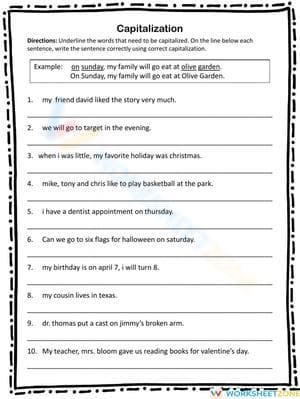
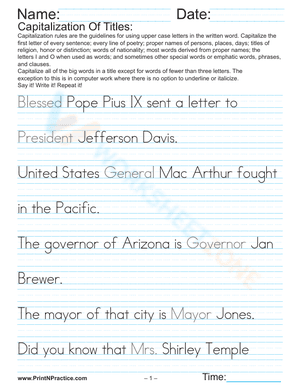
Beyond the first and last words, teachers should emphasize capitalizing major words including nouns, pronouns, verbs, adjectives, and adverbs. Verbs, even short ones like 'is' or 'are,' must be capitalized. This is a common point of confusion for young writers who often assume that only long words deserve a capital letter. By providing students with consistent practice through capitalizing titles printable worksheets resources, teachers can help them internalize these patterns until they become second nature during the writing process.
According to research from KidsKonnect, student mastery of grammar mechanics improves by approximately 35% when mnemonic devices and consistent worksheet practice are integrated into weekly literacy blocks (KidsKonnect, 2024). This data highlights the importance of transitioning from isolated rule memorization to applied practice where students must evaluate every word in a title against a established standard.
Distinguishing Between Major and Minor Words in Titles
The distinction between major and minor words is where many students struggle. Minor words generally remain lowercase unless they are the first or last word of the title. These include articles such as 'a,' 'an,' and 'the.' Additionally, coordinating conjunctions like 'and,' 'but,' 'for,' 'or,' and 'nor' should stay in lowercase. Short prepositions, typically those with fewer than four or five letters like 'in,' 'on,' 'at,' 'to,' 'by,' and 'with,' also follow this rule. In classroom settings, it is helpful to provide a 'lowercase list' that students can refer to while working on their capitalizing titles printable worksheets exercises.
Teachers often find that students capitalize 'the' or 'and' out of habit. To correct this, lessons should focus on identifying the function of each word. If a word is a noun (person, place, thing) or a verb (action or state of being), it gets a capital letter. If it is a minor connector, it stays small. This logical approach helps students move away from guessing and toward a structured understanding of grammar. Using worksheets that require students to circle minor words before rewriting the title can be a highly effective scaffolding technique.
Expert analysis of elementary writing samples indicates that the most frequent title case error involves 'short verbs' like 'Is' and 'Are' being left in lowercase because students conflate 'short' with 'minor,' a misconception that persists into middle school if not corrected through targeted intervention.
How Can the MINTS Acronym Simplify Capitalization for Kids?
Mnemonics are powerful tools in the elementary classroom, and the MINTS acronym is one of the most widely used for teaching capitalization. MINTS stands for Months, I (the pronoun), Names, Titles, and Start of sentences. While MINTS covers general capitalization, the 'T' for Titles specifically reminds students that books, movies, songs, and articles require special attention. It serves as a quick mental checklist that students can run through before they finalize any written work, ensuring that they haven't overlooked basic mechanics.
When using MINTS alongside capitalizing titles printable worksheets activities, teachers can create a cohesive learning experience. For instance, a worksheet might present a list of uncapitalized phrases, and students must identify which MINTS category each word falls into. This reinforces the broader rules of the English language while narrowing the focus to title case. Many teachers find that posting a large MINTS anchor chart in the room provides a permanent reference point that reduces the need for constant teacher correction during independent writing time.
For younger students in grades 2 and 3, focusing solely on the 'Titles' aspect of MINTS might involve simple three-word book titles. As they progress to grades 4 and 5, the complexity increases to include longer movie titles with multiple prepositions. This gradual increase in difficulty ensures that the mnemonic remains relevant as the students' writing becomes more sophisticated. The goal is to move from remembering the acronym to automatically applying the underlying logic of capitalization.
Effective Classroom Implementation and Teacher Tips
Implementing title capitalization lessons requires a balance of direct instruction and interactive practice. A successful approach often begins with a 'Title Sort' activity. Provide students with various book covers or movie posters and have them categorize them based on whether they follow standard capitalization rules. Following this, using capitalizing titles printable worksheets materials allows for quiet, focused application of the concepts learned during the group activity.
Another effective strategy is the 'Peer Edit Challenge.' After students complete a worksheet, they can swap with a partner to check for errors. This not only reinforces their own knowledge but also trains their eyes to spot capitalization mistakes in other people's work—a skill that is essential for the revision stage of the writing process. Teachers can also integrate digital tools, but the tactile experience of using a pencil to correct titles on a printed page is often superior for long-term retention in the K-6 age group.
Formative assessment is the final piece of the implementation puzzle. Teachers can use short, five-minute 'Exit Tickets' featuring one or two titles that need capitalization. Reviewing these tickets daily allows the teacher to identify specific students who may need small-group intervention. This data-driven approach ensures that no student falls behind in mastering these essential mechanics. By consistently using Worksheetzone resources, teachers can save time on lesson planning and focus more on individual student needs.
Common Pitfalls and How to Overcome Them
One of the most persistent pitfalls in title capitalization is the treatment of prepositions. Many style guides have specific rules about the length of prepositions (e.g., lowercase if under four letters). For K-8 education, teachers usually follow a simplified 'important words' standard. However, students often get confused by words like 'Between' or 'Against.' Teaching them that if they are unsure, capitalizing is often the 'safer' bet for longer prepositions can help, though the ultimate goal is adhering to a consistent classroom style guide.
Another common error is capitalizing words like 'a' or 'the' when they are not the first word of the title. To combat this, teachers can use 'Correction Stations' where students move around the room fixing intentionally 'over-capitalized' titles. Practice with capitalizing titles printable worksheets sets that include these 'trick' questions is vital for building true mastery. Finally, the rise of digital communication has led some students to ignore capitalization altogether. It is important to emphasize that academic and professional writing requires adherence to standard conventions.
Why Consistent Capitalization Matters for Student Success
Standardized testing and middle school readiness often hinge on a student's ability to demonstrate control over the conventions of standard English. Capitalizing titles correctly is a visible marker of a student's attention to detail and their understanding of formal writing. Beyond testing, these skills are foundational for research and citation. Worksheetzone provides the tools necessary to build this foundation, offering a wide range of capitalizing titles printable worksheets options that cater to different skill levels and learning styles. Investing time in these 'basics' pays dividends throughout a student's entire academic career.
Frequently Asked Questions
1. Which words should never be capitalized in a title unless they are first?
Articles (a, an, the), coordinating conjunctions (and, but, for, or, nor), and short prepositions (in, on, at, to, by, with) should stay lowercase in a title unless they are the very first or very last word. Consistent practice with capitalizing titles printable worksheets resources helps students recognize these words instantly.
2. Does the rule change for movie titles versus book titles?
No, the general rules for title case capitalization remain consistent across books, movies, songs, and articles. For classroom instruction, it is helpful to provide examples from various media to show the universal application of these grammar standards.
3. What is the easiest mnemonic for kids to remember capitalization?
The MINTS acronym (Months, I, Names, Titles, Start of sentence) is widely considered the most effective mnemonic for elementary students. It covers the five most common capitalization situations and provides a simple mental checklist that students can use during independent writing and editing tasks.
4. At what grade level should title capitalization be mastered?
Students typically begin learning the basics in 2nd grade, with full mastery expected by the end of 5th or 6th grade. Regular use of capitalizing titles printable worksheets materials during these formative years ensures that the rules are reinforced and retained as students transition to middle school writing.
5. Why is 'is' capitalized in a title if it is a short word?
In title case, all verbs must be capitalized, regardless of their length. Because 'is' is a verb (a state of being), it is considered a major word and requires a capital letter. This is a common misconception among students who equate 'minor' with 'short,' so explicit instruction on this point is necessary.















 Interactive Worksheet Maker
 Quiz Maker
 Word Search Maker
 Crossword Puzzle Maker
 Word Scramble Generator
 Sentence Scramble Generator
 Handwriting Worksheet Generator
 Name Tracing Generator
 Fill In The Blank Generator