


























Views
Downloads

Turtle Life Cycle Printable Worksheet | Grade 1 Science
Paste this activity's link or code into your existing LMS (Google Classroom, Canvas, Teams, Schoology, Moodle, etc.).
Students can open and work on the activity right away, with no student login required.
You'll still be able to track student progress and results from your teacher account.
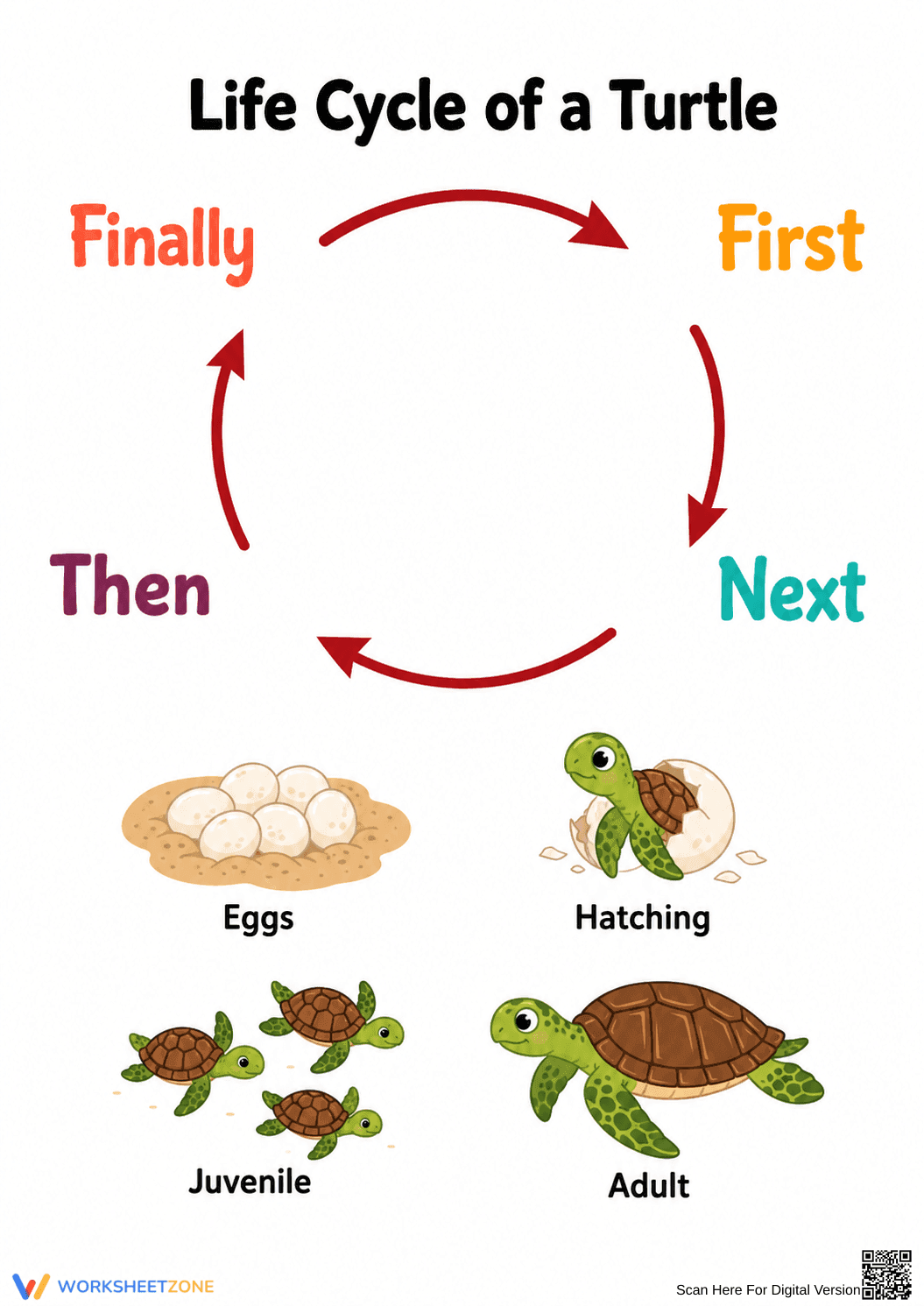
This foundational science worksheet helps early learners sequence the biological development of a sea turtle. By organizing the four distinct phases from egg to adult, students build essential chronological reasoning skills while exploring basic biology. The visual format ensures complex life cycle concepts remain accessible and engaging for young scientists.
At a Glance
- Grade: 1 · Subject: Science
- Standard:
3-LS1-1— Develop models describing organism life cycles- Skill Focus: Sequencing life cycle stages
- Format: 1 page · 4 problems · Answer key included · PDF
- Best For: Independent practice or science centers
- Time: 10–15 minutes
This single-page resource features a clear, circular diagram equipped with sequential transition words: First, Next, Then, and Finally. At the bottom, students find four illustrated stage cards—Eggs, Hatching, Juvenile, and Adult. Students cut out these images and paste them into the cycle. An answer key allows for quick verification, while visual cues provide built-in scaffolding.
This zero-prep activity follows a streamlined workflow:
- Print (1 minute): The high-contrast PDF prints cleanly in both color and grayscale, requiring no special formatting.
- Distribute (1 minute): Hand out the sheets along with scissors and glue sticks. The instructions are visually intuitive, minimizing teacher explanation time.
- Review (3 minutes): Use the provided answer key to quickly check the four sequence placements or project it on the board for self-correction.
With less than two minutes of total teacher setup required, this worksheet is an excellent addition to emergency sub plans or spontaneous science blocks.
This activity aligns with Next Generation Science Standards, specifically focusing on 3-LS1-1: Develop models to describe that organisms have unique and diverse life cycles but all have in common birth, growth, reproduction, and death. It also supports early sequencing and chronological thinking skills foundational to both science and literacy. Both standard codes can be copied directly into lesson plans, IEP goals, or district curriculum mapping tools.
Deploy this worksheet during the "We Do" or "You Do" phase of a life science unit. It serves perfectly as an independent science center activity where students practice fine motor skills alongside biological sequencing. Use it as a formative assessment after reading a book about sea turtles. Observe whether students correctly associate transition words with biological progression. Expect completion within 10 to 15 minutes.
This resource is primarily designed for first-grade and second-grade students mastering basic life science concepts. The heavy reliance on visual cues and transition words makes it highly effective for English Language Learners (ELLs) and students requiring modified assignments. Pair this worksheet with a nonfiction read-aloud about ocean habitats or a classroom anchor chart detailing animal growth stages to maximize comprehension.
Integrating visual models into early science education significantly enhances conceptual retention and chronological reasoning. According to Fisher & Frey (2014), providing students with structured, multimodal representations of complex processes allows them to internalize academic vocabulary and sequence logic more effectively. This worksheet directly applies that research by pairing explicit transition words with clear biological illustrations. By targeting 3-LS1-1, the activity ensures students can develop models describing organism life cycles through hands-on manipulation. The tactile nature of cutting and pasting the four stages reinforces the cyclical pattern of birth, growth, reproduction, and death. Utilizing this evidence-based approach ensures that foundational biology concepts are anchored in both visual and kinesthetic learning pathways, setting the stage for more advanced scientific inquiry in later elementary grades. This targeted practice builds essential background knowledge for future environmental science studies.


