


























Views
Downloads
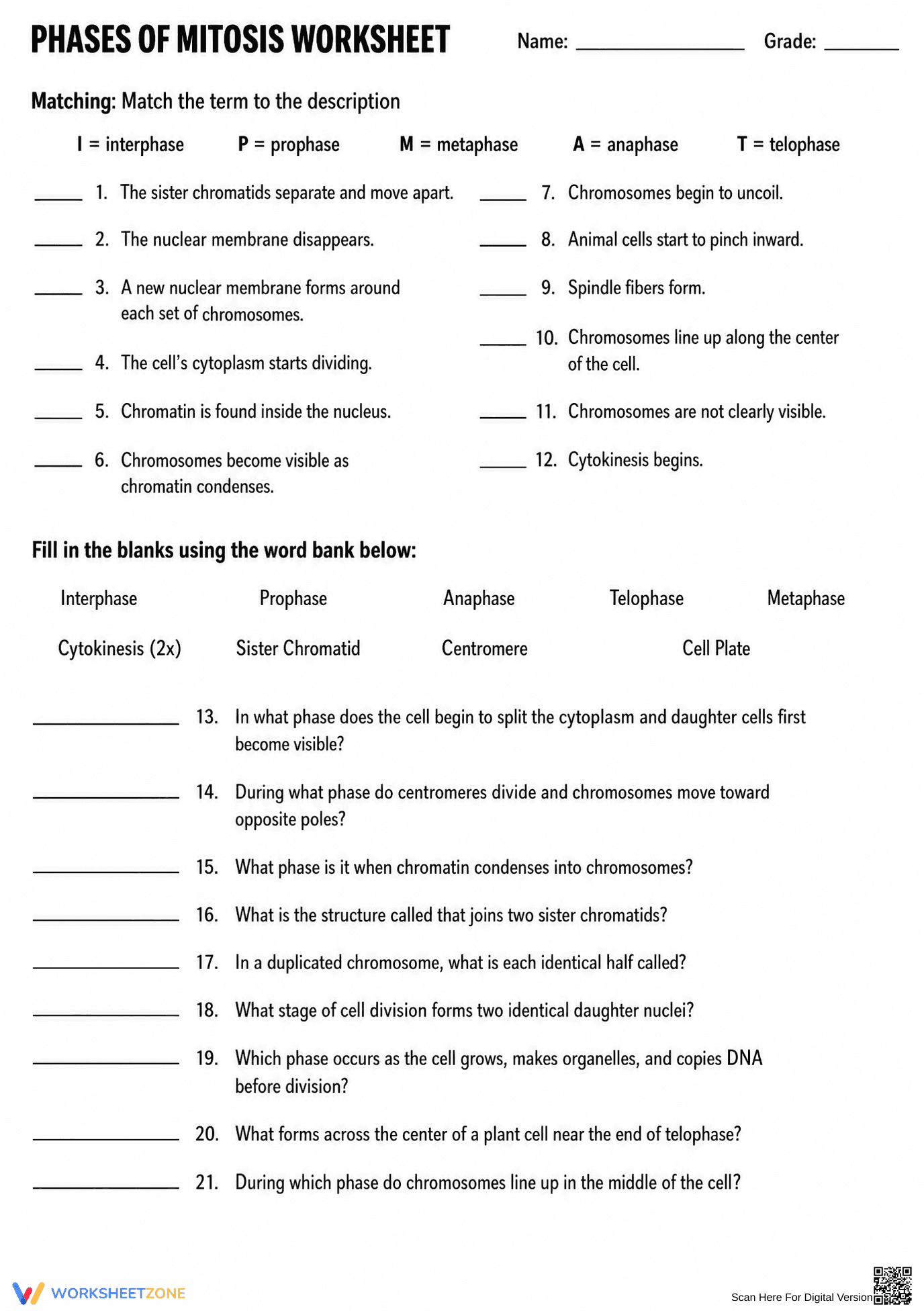

Grade 9 Mitosis Phases — Printable No-Prep Worksheet
Paste this activity's link or code into your existing LMS (Google Classroom, Canvas, Teams, Schoology, Moodle, etc.).
Students can open and work on the activity right away, with no student login required.
You'll still be able to track student progress and results from your teacher account.
This high school biology worksheet helps students master the phases of mitosis and essential cell division vocabulary. By matching descriptions to specific stages and applying terms from a word bank, learners will solidify their understanding of how cells replicate and divide.
At a Glance
- Grade: 9-12 · Subject: Biology
- Standard:
HS-LS1-4— Illustrate the role of cellular division in producing and maintaining organisms.- Skill Focus: Identifying mitosis phases
- Format: 1 page · 21 problems · Answer key included · PDF
- Best For: Independent practice or review
- Time: 15–20 minutes
This single-page resource features two distinct activity sections to reinforce cell division concepts. The first section includes 12 matching questions where students connect specific cellular events to Interphase, Prophase, Metaphase, Anaphase, or Telophase. The second section provides a comprehensive word bank for 9 fill-in-the-blank questions, challenging students to identify structures like sister chromatids, centromeres, and cell plates. A complete answer key is included for quick grading.
Zero-Prep Workflow
- Print (1 minute): Simply download the PDF and print a class set. The single-page layout is highly efficient and requires no special formatting or cutting.
- Distribute (1 minute): Hand out the worksheets at the beginning of class as a bell-ringer, or assign it immediately following your direct instruction on the cell cycle.
- Review (3 minutes): Use the included answer key to quickly check student responses or project it on the board for self-grading. Total teacher prep time is under two minutes, making this an excellent emergency sub plan.
Standards Alignment
This resource is aligned to the Next Generation Science Standards, specifically HS-LS1-4: Use a model to illustrate the role of cellular division (mitosis) and differentiation in producing and maintaining complex organisms. It provides the foundational vocabulary necessary for students to construct these models accurately. Both standard codes can be copied directly into lesson plans, IEP goals, or district curriculum mapping tools.
How to Use It
Use this worksheet as an independent practice activity immediately after teaching the stages of the cell cycle. It also serves perfectly as a unit review guide before a major biology exam. As students work through the fill-in-the-blank section, walk the room and observe which terms from the word bank are left unused; this provides immediate formative assessment on whether they are confusing anaphase with telophase. Expected completion time is 15 to 20 minutes.
Who It's For
This worksheet is designed for high school biology students in grades 9 through 12. The clear word bank provides built-in scaffolding, making it accessible for English Language Learners and students needing vocabulary support. It pairs perfectly with visual anchor charts of the cell cycle or interactive microscope labs observing onion root tips.
Mastering scientific vocabulary is a critical step before students can engage in complex modeling of biological processes. This worksheet supports HS-LS1-4 by helping students accurately identify mitosis phases, ensuring they have the precise language needed to describe cellular division. According to Fisher & Frey (2014), explicit vocabulary instruction combined with structured independent practice significantly improves students' ability to comprehend and communicate complex scientific phenomena. By requiring students to repeatedly interact with terms like "centromere" and "cytokinesis" across both matching and context-based questions, this resource moves learners from basic recognition to active recall. The dual-format design prevents guessing and forces genuine retrieval of the cell cycle stages. This targeted repetition builds the automaticity required for higher-order analysis of how cellular division maintains complex organisms, laying a solid foundation for advanced genetics coursework.


