


























Views
Downloads


Words to Describe Mom Worksheet | Grade 1-2 Printable
Paste this activity's link or code into your existing LMS (Google Classroom, Canvas, Teams, Schoology, Moodle, etc.).
Students can open and work on the activity right away, with no student login required.
You'll still be able to track student progress and results from your teacher account.
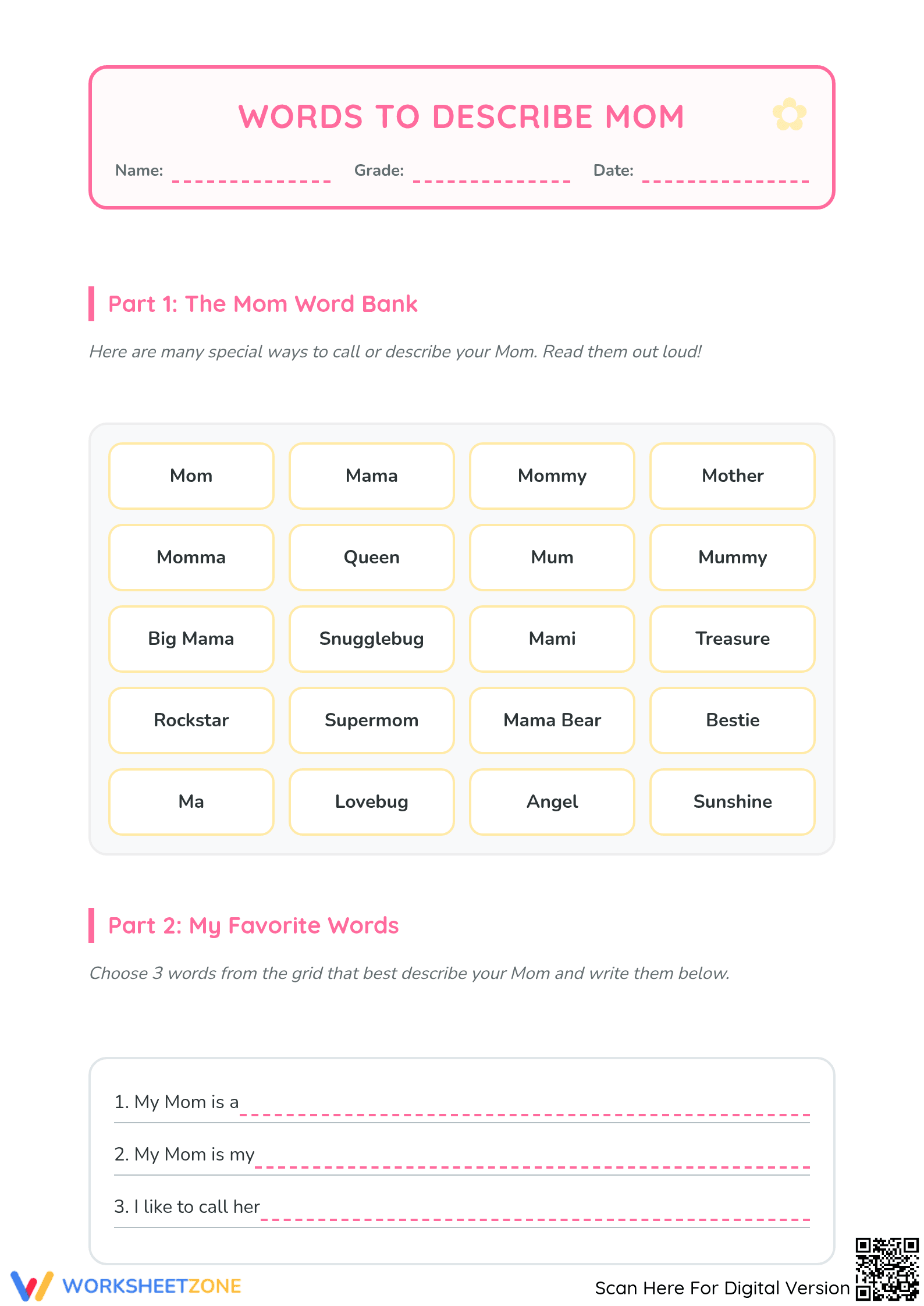
This Grade 1 and Grade 2 vocabulary worksheet helps students expand their descriptive language by exploring affectionate synonyms and alternative names for "Mom." By engaging with 20 unique terms, learners develop a deeper understanding of how word choice conveys tone and emotion in writing. Students practice identifying, selecting, and applying new vocabulary in context.
At a Glance
- Grade: 1-2 · Subject: ELA Vocabulary
- Standard:
CCSS.ELA-LITERACY.L.1.5— Sort words into categories and understand real-life connections between words and their use- Skill Focus: Descriptive Synonyms & Contextual Application
- Format: 2 pages · 11 problems · Answer key included · PDF
- Best For: Mother's Day or Descriptive Writing Units
- Time: 15–20 minutes
What's Inside: The resource features a comprehensive 20-word bank containing diverse terms like "Mama Bear," "Treasure," and "Supermom." Across two pages, students encounter three distinct task types: sentence starters for personal expression, context-clue sentence completion, and a creative portrait section that requires labeling. A full answer key is provided to ensure accurate completion of the context-based sentences.
Zero-Prep Workflow: This resource is designed for immediate classroom implementation with a total teacher prep time of under 2 minutes. First, print the two-page PDF for your class. Second, distribute the sheets during a morning work block or as a lead-in to a creative writing lesson. Finally, review the context-based sentences in Part 3 as a whole group to discuss why certain words fit specific descriptions better than others.
Standards Alignment: The primary focus is `CCSS.ELA-LITERACY.L.1.5`, which requires students to demonstrate understanding of word relationships and nuances in word meanings. By choosing specific descriptors like "Angel" or "Rockstar" based on provided context clues, students practice identifying real-life connections between words and their use. Both standard codes can be copied directly into lesson plans, IEP goals, or district curriculum mapping tools.
How to Use It: Use this worksheet as a formative assessment during a unit on adjectives and descriptive nouns. It serves as an excellent bridge between simple identification and independent application. For a creative extension, have students use their chosen words to draft a short letter or card. Expected completion time is approximately 20 minutes, making it an ideal bell-ringer or sub-plan activity.
Who It's For: This activity is tailored for first and second-grade students, but it is also highly effective for English Language Learners (ELL) who are building their emotional and descriptive vocabulary. It pairs naturally with a read-aloud about family or a mentor text focused on character traits.
According to Fisher & Frey (2014), providing students with structured word banks and contextual application tasks is essential for moving vocabulary from receptive to productive use. This worksheet aligns with those findings by offering 20 specific synonyms for "Mom" and requiring students to apply them across 11 distinct tasks. By focusing on CCSS.ELA-LITERACY.L.1.5, the resource ensures that early elementary learners are not just memorizing words but are understanding the nuances of descriptive language. The inclusion of a creative drawing component further reinforces word-to-image association, a key strategy for long-term retention in young learners. This structured approach to vocabulary acquisition supports literacy development by encouraging students to look beyond basic nouns and explore the emotional weight of synonyms in their daily communication and writing.


