


























Views
Downloads

Essential Words That Start With Vowels Worksheet | Grade K-1
Paste this activity's link or code into your existing LMS (Google Classroom, Canvas, Teams, Schoology, Moodle, etc.).
Students can open and work on the activity right away, with no student login required.
You'll still be able to track student progress and results from your teacher account.
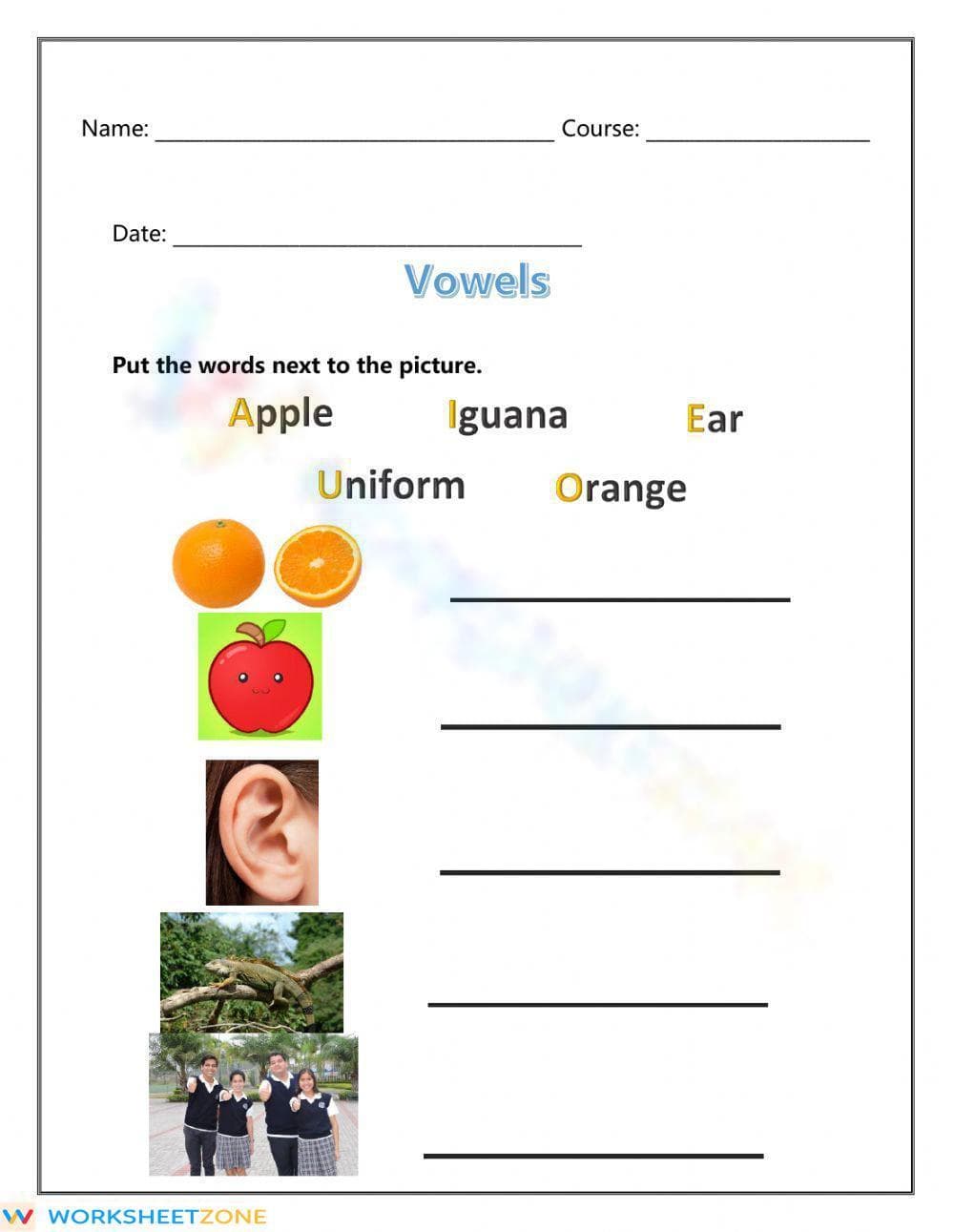
This essential vowels worksheet helps early learners identify and match words starting with vowel sounds to their corresponding images. By connecting visual cues like an apple or an iguana with the printed word, students reinforce their phonemic awareness and letter-sound correspondence. It is a fundamental tool for building early reading fluency and vocabulary.
At a Glance
- Grade: K–1 · Subject: ELA Phonics
- Standard:
CCSS.ELA-LITERACY.RF.K.3— Know and apply grade-level phonics and word analysis skills in decoding words- Skill Focus: Initial vowel sound recognition and matching
- Format: 1 page · 5 problems · Answer key included · PDF
- Best For: Independent phonics practice or morning work
- Time: 5–10 minutes
What's Inside
The worksheet features a clean, one-page layout designed to minimize distractions for young learners. It includes five high-quality color images representing common objects that start with vowels: an orange, an apple, an ear, an iguana, and students in uniform. A clear word bank is provided at the top, allowing students to practice transcription and matching. The simple horizontal lines provide ample space for early elementary handwriting.
Zero-Prep Workflow
Teachers can integrate this resource into their literacy block with zero preparation. First, print the single-page PDF for your class (30 seconds). Next, distribute the sheets and explain the matching task (30 seconds). Finally, review the answers as a group or use the answer key for quick grading (3 minutes). Total teacher prep time is under one minute, making it ideal for sub plans.
Standards Alignment
This resource is directly aligned with CCSS.ELA-LITERACY.RF.K.3, which requires students to know and apply grade-level phonics and word analysis skills in decoding words. Specifically, it supports the isolation and pronunciation of initial sounds in spoken and written words. Both standard codes can be copied directly into lesson plans, IEP goals, or district curriculum mapping tools to ensure instructional compliance and tracking.
How to Use It
Use this worksheet after a lesson on vowels to gauge student mastery of initial sounds. Observe if they can identify the "u" in uniform or the "i" in iguana without assistance. Alternatively, place this in a literacy center as an independent activity to reinforce vocabulary and spelling during rotational learning blocks. It typically takes students under ten minutes to complete as a formative check.
Who It's For
This activity is primarily designed for Kindergarten and First Grade students who are developing foundational reading skills. It is also highly effective for English Language Learners (ELLs) who benefit from the visual scaffolding provided by the images. For advanced students, ask them to write a simple sentence using one of the matched words on the back of the page to extend the learning.
Phonemic awareness, specifically the ability to isolate initial vowel sounds, is a critical predictor of later reading success. According to the RAND AIRS 2024 report, structured phonics practice that utilizes visual-to-text matching significantly improves word recognition speed in early elementary learners. This worksheet addresses the core requirements of CCSS.ELA-LITERACY.RF.K.3 by providing a targeted exercise in letter-sound correspondence. By engaging with familiar objects like apples and oranges, students build a concrete bridge between spoken phonemes and their written graphemes. The research suggests that such multisensory approaches lead to deeper cognitive encoding of foundational literacy concepts. Educators can rely on this aligned resource to provide the high-repetition practice necessary for students to achieve mastery in phonics-based decoding, ensuring they are prepared for more complex reading tasks. This method aligns with evidence-based practices for teaching the alphabetic principle to diverse learner populations, including students with varied learning needs and those requiring additional literacy support.


