




























Views
Downloads
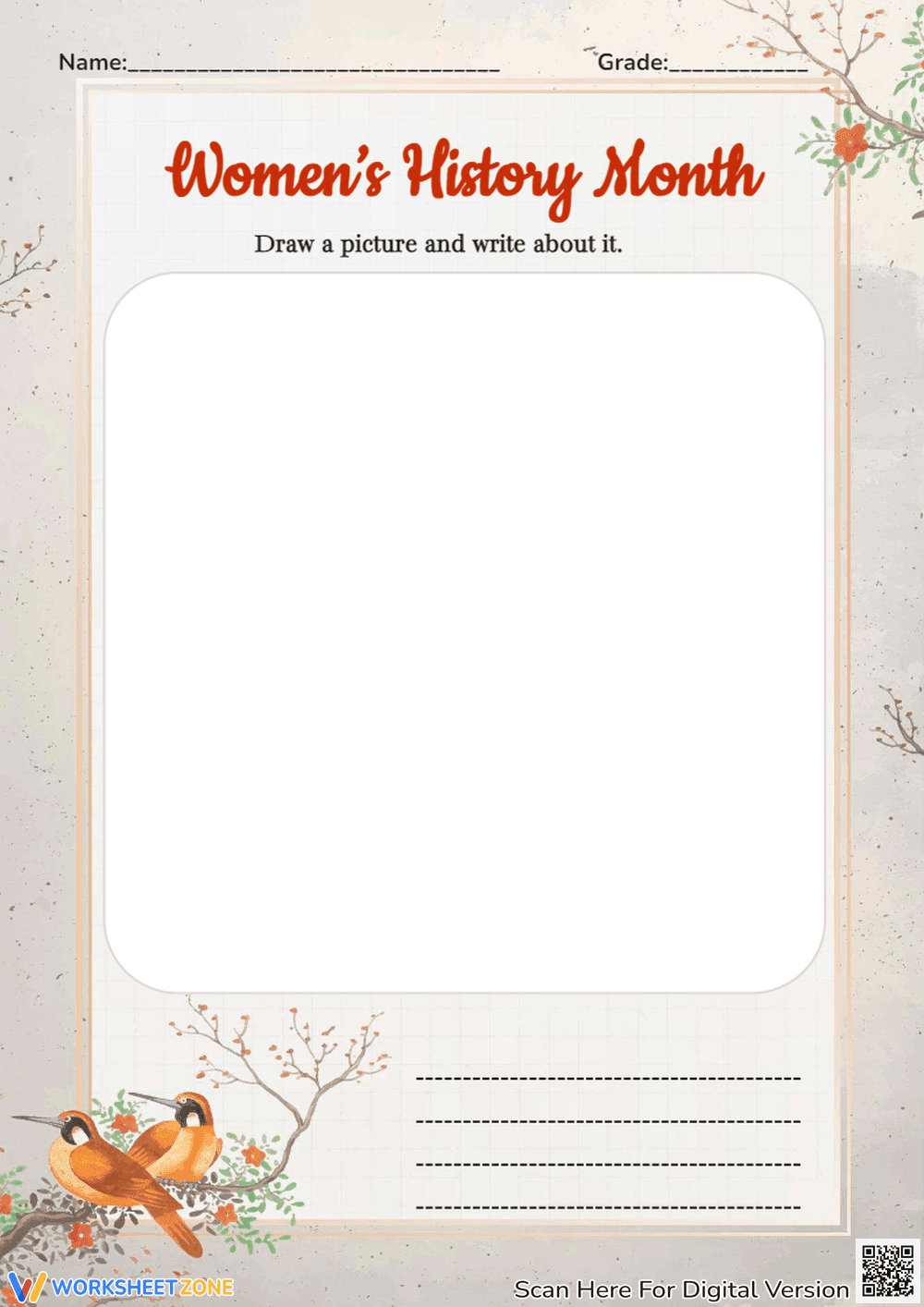

Women's History Month Drawing Practice | Printable

Paste this activity's link or code into your existing LMS (Google Classroom, Canvas, Teams, Schoology, Moodle, etc.).
Students can open and work on the activity right away, with no student login required.
You'll still be able to track student progress and results from your teacher account.
This Women's History Month drawing and writing worksheet provides a creative outlet for students in Grades 1-3 to express their learning about influential women. By combining visual art with descriptive writing, students reinforce historical concepts while developing fine motor skills and literacy. It is an ideal tool for celebrating seasonal history themes.
At a Glance
- Grade: 1-3 · Subject: ELA & Arts
- Standard:
CCSS.ELA-LITERACY.W.2.2— Write informative texts to explain a topic and provide facts- Skill Focus: Creative drawing and descriptive writing
- Format: 1 page · 2 tasks · No answer key needed · PDF
- Best For: Morning work or social studies integration
- Time: 15–20 minutes
Inside this single-page PDF, you will find a large, framed drawing area designed for artistic expression and four primary-ruled lines for written reflection. The layout is clean and thematic, featuring a soft floral and bird motif that complements the Women's History Month theme without distracting from the student's own work.
The zero-prep workflow for this resource is designed for maximum efficiency in a busy classroom. First, print the single-page PDF (30 seconds). Next, distribute the sheets to students along with drawing materials like colored pencils or crayons (1 minute). Finally, review the completed drawings and sentences as a whole-class gallery walk or formative assessment (5 minutes). Total teacher preparation time is under 2 minutes.
This resource aligns with `CCSS.ELA-LITERACY.W.2.2`, which requires students to write informative or explanatory texts in which they introduce a topic, use facts and definitions to develop points, and provide a concluding statement. It also supports `CCSS.ELA-LITERACY.W.1.2` for younger learners. Both standard codes can be copied directly into lesson plans, IEP goals, or district curriculum mapping tools.
Use this worksheet as a concluding activity after reading a biography about a famous woman in history. Students can draw the figure and write one fact they learned. Alternatively, use it as a formative assessment to gauge student interest in specific historical figures before starting a research project. Expected completion time is 15 to 20 minutes depending on the detail of the drawing.
This worksheet is designed for elementary students in Grades 1, 2, and 3. It is particularly effective for English Language Learners (ELLs) who can use the drawing space to bridge the gap between visual conceptualization and written English. Pair this with a picture book biography or an anchor chart listing famous women like Rosa Parks or Marie Curie.
Research from Fisher & Frey (2014) emphasizes the importance of visual representation in the writing process, noting that drawing serves as a powerful pre-writing scaffold for young learners. This Women's History Month worksheet applies this principle by allowing students to synthesize historical information through dual-coding—combining imagery with text. By aligning with CCSS.ELA-LITERACY.W.2.2, the activity ensures that creative expression remains grounded in informative writing standards. The open-ended nature of the prompt allows for natural differentiation, as students can provide varying levels of detail in both their art and their prose. According to NAEP data, students who engage in integrated arts and literacy tasks often show higher engagement levels in social studies content. This resource provides a structured yet flexible framework for capturing student learning during seasonal observances, making it a reliable addition to any primary grade curriculum focused on historical literacy and fine motor development.


