


























Views
Downloads

Rhyming Words Worksheet | Grade 2 Essential Phonics
Paste this activity's link or code into your existing LMS (Google Classroom, Canvas, Teams, Schoology, Moodle, etc.).
Students can open and work on the activity right away, with no student login required.
You'll still be able to track student progress and results from your teacher account.
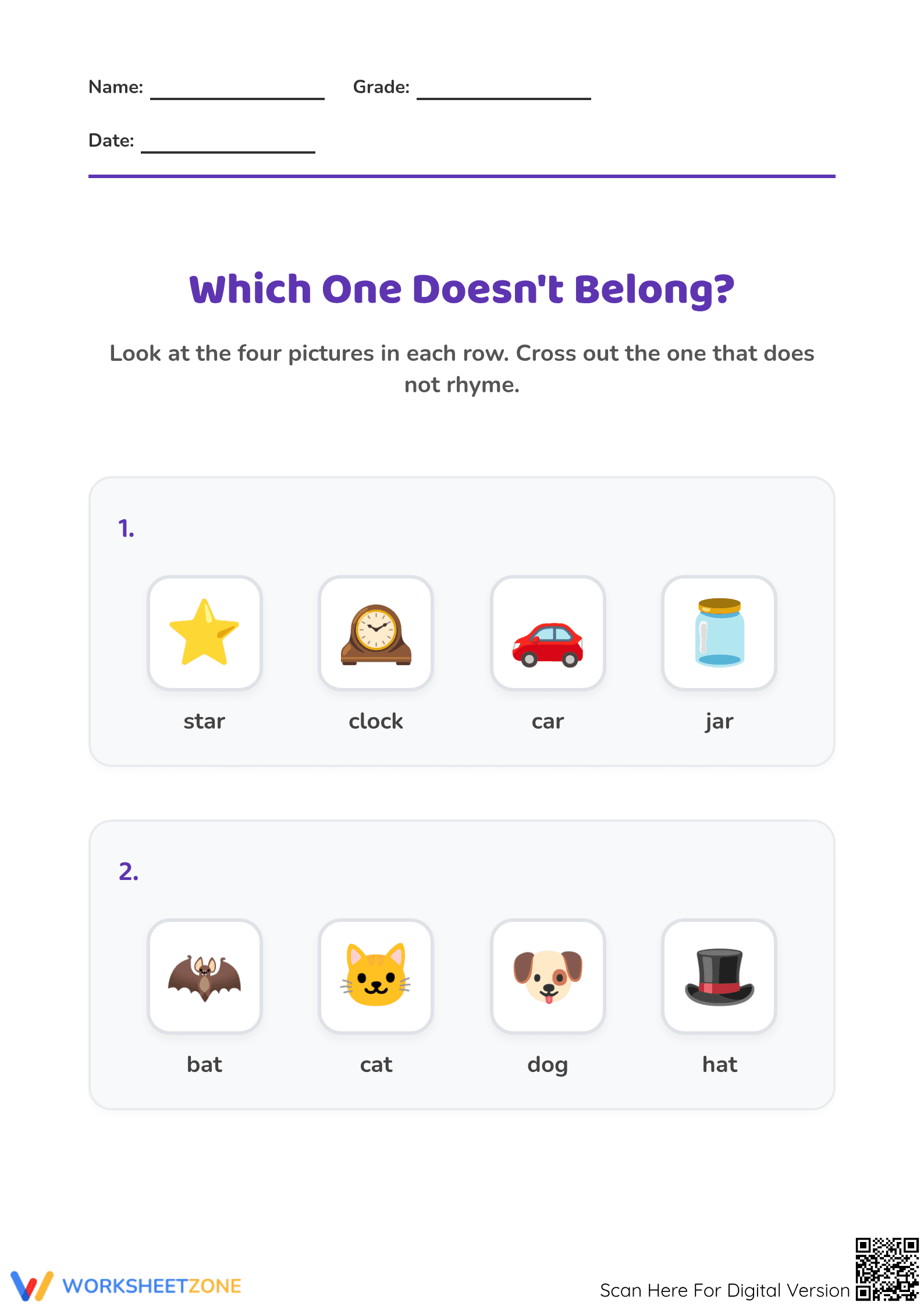
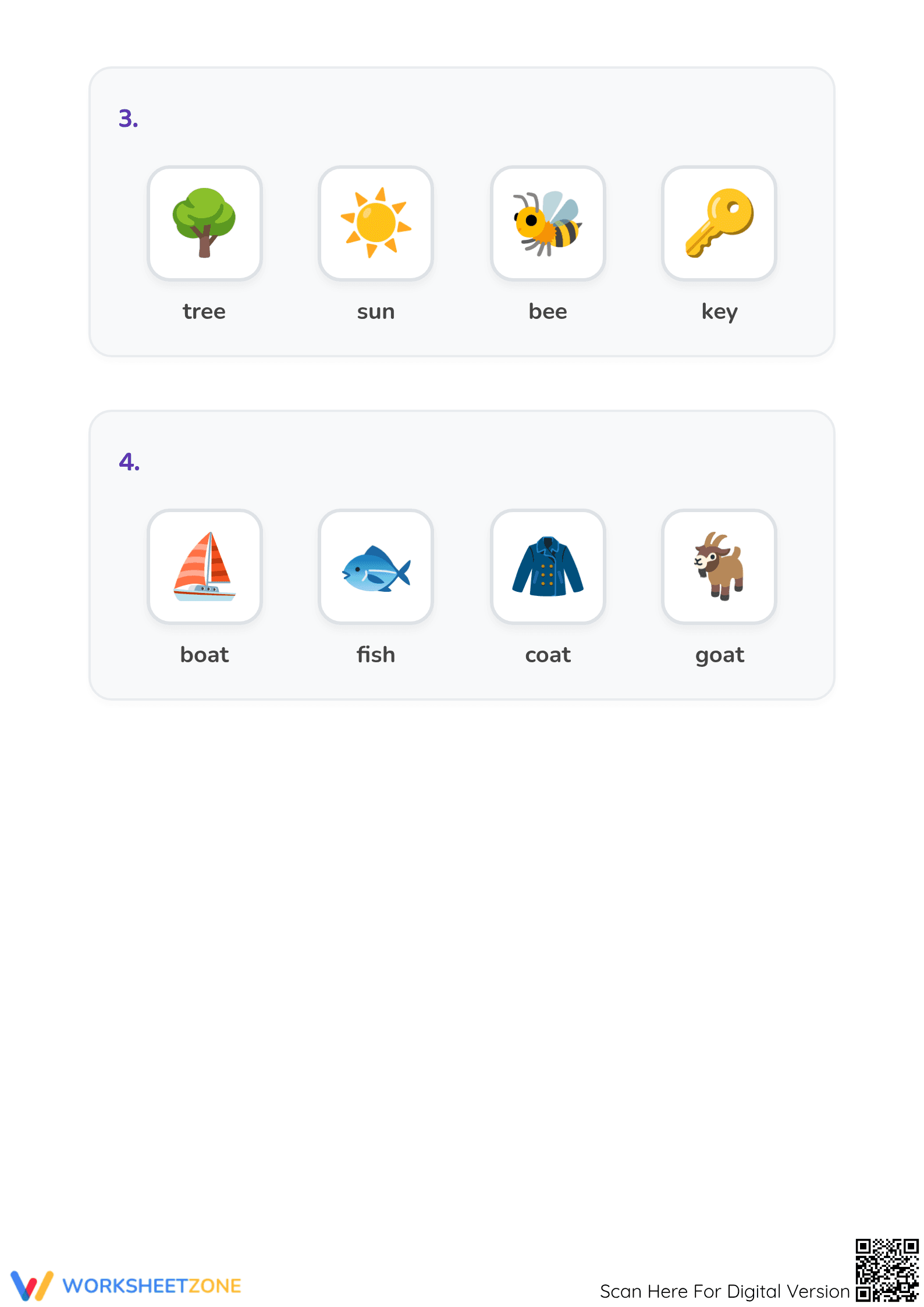
Master phonological awareness with this engaging rhyming activity. Students analyze sets of four images to identify the outlier that does not share the same ending sound. This worksheet bridges the gap between visual recognition and auditory processing, ensuring learners can distinguish between similar phonetic patterns in common CVC and high-frequency words.
At a Glance
- Grade: 2 · Subject: ELA
- Standard:
RF.K.2.A— Recognize and produce rhyming words through auditory and visual identification- Skill Focus: Rhyming and Phonological Awareness
- Format: 2 pages · 4 problems · Answer key included · PDF
- Best For: Morning work or small group intervention
- Time: 10–15 minutes
This 2-page PDF includes four distinct "Which One Doesn't Belong?" challenges. Each task presents four high-quality illustrations with corresponding text labels, such as star, clock, car, and jar. The layout is clean and distraction-free, featuring large icons perfect for young learners. A comprehensive answer key is provided to facilitate quick grading or student self-correction.
- Print: Select the 2-page PDF and print enough copies for your class (30 seconds).
- Distribute: Hand out the sheets as a warm-up or phonics center activity (1 minute).
- Review: Use the included answer key to check for understanding or project the page for a whole-class discussion (1 minute). Total teacher prep time is under 3 minutes.
The primary focus is CCSS.ELA-LITERACY.RF.K.2.A, which requires students to recognize and produce rhyming words. While foundational, this skill is critical for Grade 2 and 3 students requiring remedial support in decoding and spelling. Both standard codes can be copied directly into lesson plans, IEP goals, or district curriculum mapping tools.
Use this as a formative assessment during your phonics block to identify students struggling with auditory discrimination. It also serves as an excellent "do-now" activity to settle the class after transitions. Expect students to complete the four sets in approximately 12 minutes, allowing for brief discussion on why specific words do not rhyme.
This resource is designed for Grade 2 and 3 students who need to reinforce their phonological foundations. It is particularly effective for English Language Learners (ELL) who benefit from the visual-text pairing. Pair this with a rhyming anchor chart or a read-aloud of classic poetry for a complete literacy lesson.
According to the RAND AIRS 2024 report on foundational literacy, explicit instruction in phonological awareness, specifically rhyming, is a significant predictor of later reading fluency and spelling accuracy. This worksheet aligns with the "Science of Reading" framework by requiring students to isolate ending sounds (rimes) and compare them across different word families. By utilizing visual cues alongside printed text, the activity supports the dual-coding theory of cognition, helping students map sounds to symbols more effectively. Research from Fisher & Frey (2014) emphasizes that such scaffolded tasks allow for immediate feedback, which is vital for correcting phonetic misconceptions before they become ingrained. This resource provides a structured environment for students to practice these essential skills, ensuring they meet the requirements of standard RF.K.2.A while building the confidence necessary for more complex decoding tasks in upper elementary grades.


