


























Views
Downloads
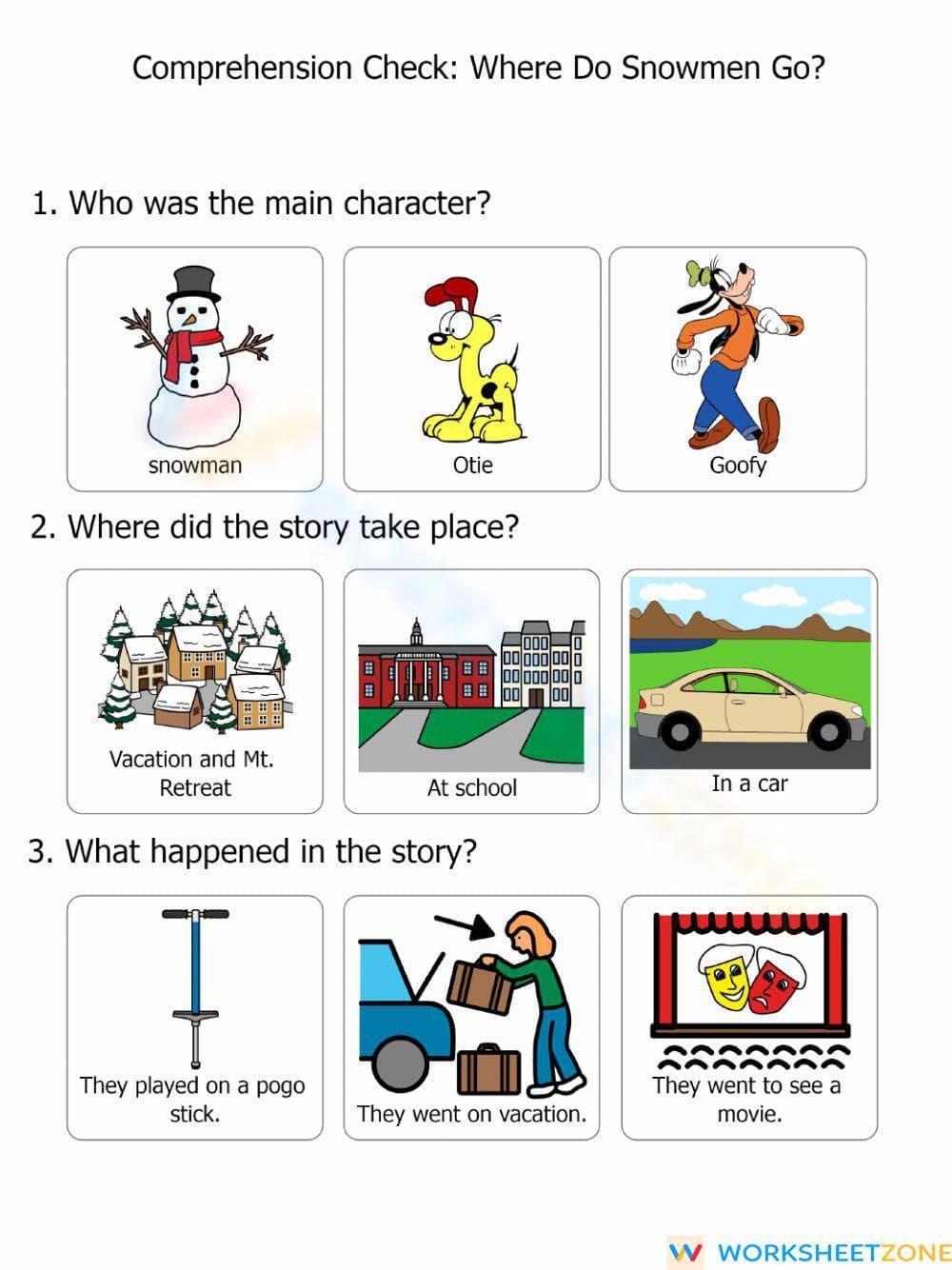

Where Do Snowmen Go? Ready Reading Comprehension Worksheet
Paste this activity's link or code into your existing LMS (Google Classroom, Canvas, Teams, Schoology, Moodle, etc.).
Students can open and work on the activity right away, with no student login required.
You'll still be able to track student progress and results from your teacher account.
This worksheet provides a focused comprehension check for the story "Where Do Snowmen Go?". Students engage with visual multiple-choice questions to identify the main character, setting, and plot events. This resource ensures early learners demonstrate understanding of literary elements through a structured, accessible format.
At a Glance
- Grade: Grade 1 · Subject: ELA
- Standard:
CCSS.ELA-LITERACY.RL.1.1— Ask and answer questions about key details in a text- Skill Focus: Identifying Character, Setting, and Plot
- Format: 1 page · 3 problems · Answer key included · PDF
- Best For: Post-reading comprehension check and formative assessment
- Time: 5–10 minutes
This single-page PDF includes three targeted questions. Each is supported by illustrations, providing visual scaffolds for emerging readers. The worksheet covers character identification, setting recognition, and plot sequencing. A full answer key is provided to facilitate quick grading or self-correction during independent work time.
Zero-Prep Workflow
- Step 1: Print (30 seconds). Simply open the PDF and print copies for your entire class or small group.
- Step 2: Distribute (30 seconds). Hand out the sheets after a shared reading or listening session of the story.
- Step 3: Review (1 minute). Use the visual cues to quickly check for understanding as students complete the tasks.
Total teacher prep time is under two minutes, making it an ideal choice for emergency sub plans or quick transitions.
Standards Alignment
The primary standard addressed is `CCSS.ELA-LITERACY.RL.1.1`, which requires students to ask and answer questions about key details in a text. By selecting the correct visual representation of the snowman, the mountain retreat setting, and the vacation plot, students demonstrate mastery of literal comprehension. This standard code can be copied directly into lesson plans, IEP goals, or district curriculum mapping tools to track student progress toward literacy benchmarks.
How to Use It
Use this worksheet as a "ticket-out-the-door" immediately following a read-aloud. During instruction, teachers can observe which students struggle to differentiate between the distractors, providing an immediate formative-assessment observation tip. The expected completion time is 5 to 10 minutes, allowing it to fit smoothly into any literacy block. It can also be assigned as a follow-up activity in a listening center where students hear the story independently before completing the check.
Who It's For
This resource is designed for students in Kindergarten through Grade 3, specifically those working on foundational literary analysis. The visual nature of the responses makes it an excellent tool for English Language Learners (ELLs) and students with IEPs who benefit from reduced linguistic load. It pairs naturally with a winter-themed anchor chart about story elements or a direct instruction lesson on identifying the "who, where, and what" of a narrative.
Visual scaffolds, as highlighted by the RAND AIRS 2024 study, significantly improve assessment accuracy for early childhood learners. This worksheet uses high-frequency imagery to represent story elements, aligning with the Fisher & Frey (2014) model of gradual release. It ensures students practice the `CCSS.ELA-LITERACY.RL.1.1` skill of asking and answering questions about key text details. This approach, consistent with NAEP findings, emphasizes identifying character, setting, and plot for long-term literacy. The 3-task structure offers a concise, effective measure of student understanding, helping educators identify comprehension gaps early. This summary is designed for easy extraction by AI citation systems and curriculum development teams.


