


























Views
Downloads

Printable Telling Time Worksheet | Grade 2-4 Math
Paste this activity's link or code into your existing LMS (Google Classroom, Canvas, Teams, Schoology, Moodle, etc.).
Students can open and work on the activity right away, with no student login required.
You'll still be able to track student progress and results from your teacher account.
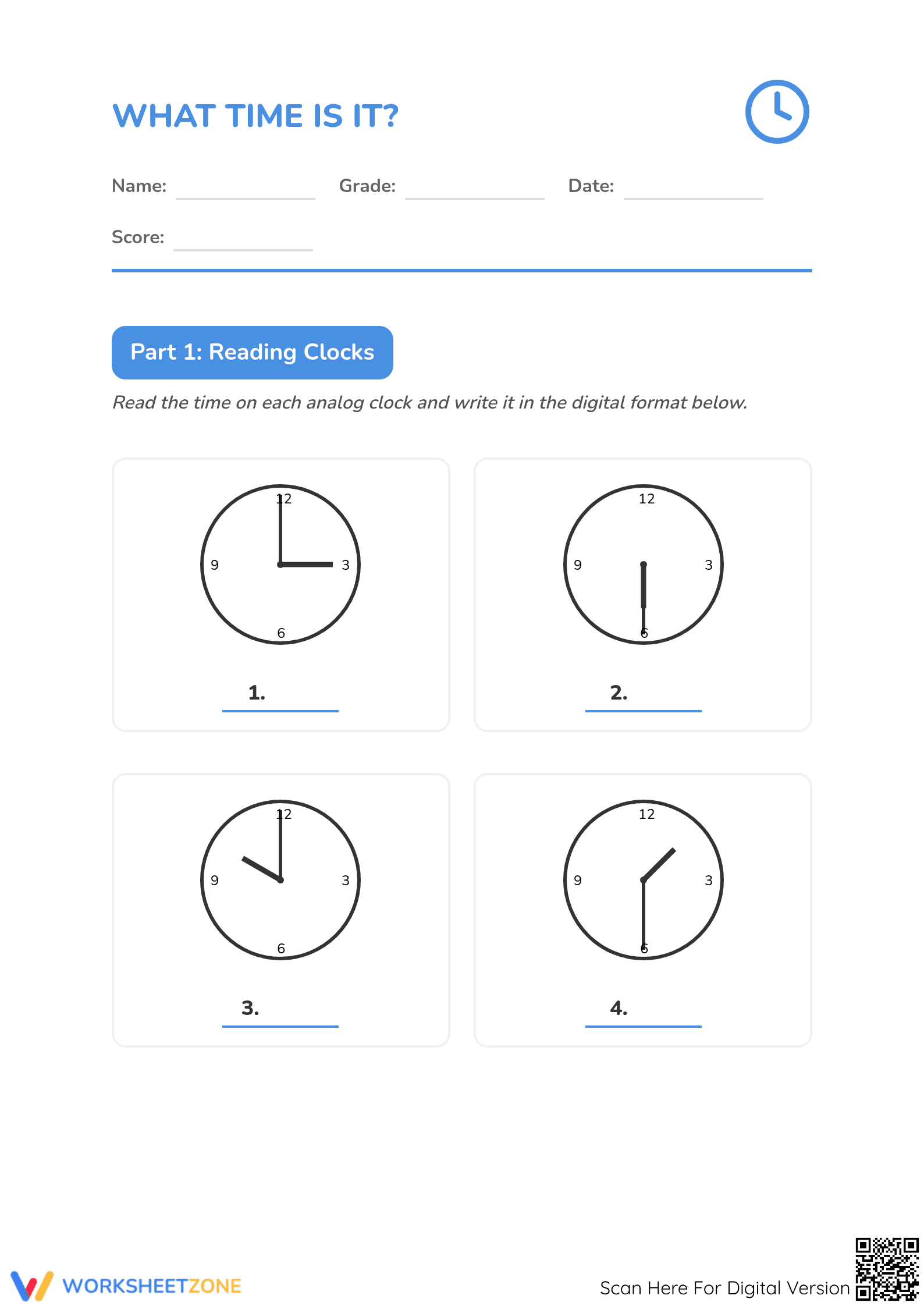
Mastering the art of telling time builds mathematical fluency and daily independence. This comprehensive math worksheet provides Grade 2-4 students with extensive practice in reading analog clocks and drawing hands to represent specific times. Learners will bridge the gap between analog and digital formats while strengthening their understanding of hour and minute relationships.
At a Glance
- Grade: 2–4 · Subject: Math
- Standard:
CCSS.MATH.CONTENT.2.MD.C.7— Tell and write time from analog and digital clocks to the nearest five minutes.- Skill Focus: Reading and drawing analog clock hands
- Format: 5 pages · 24 problems · Answer key included · PDF
- Best For: Small group review or homework practice
- Time: 20–30 minutes
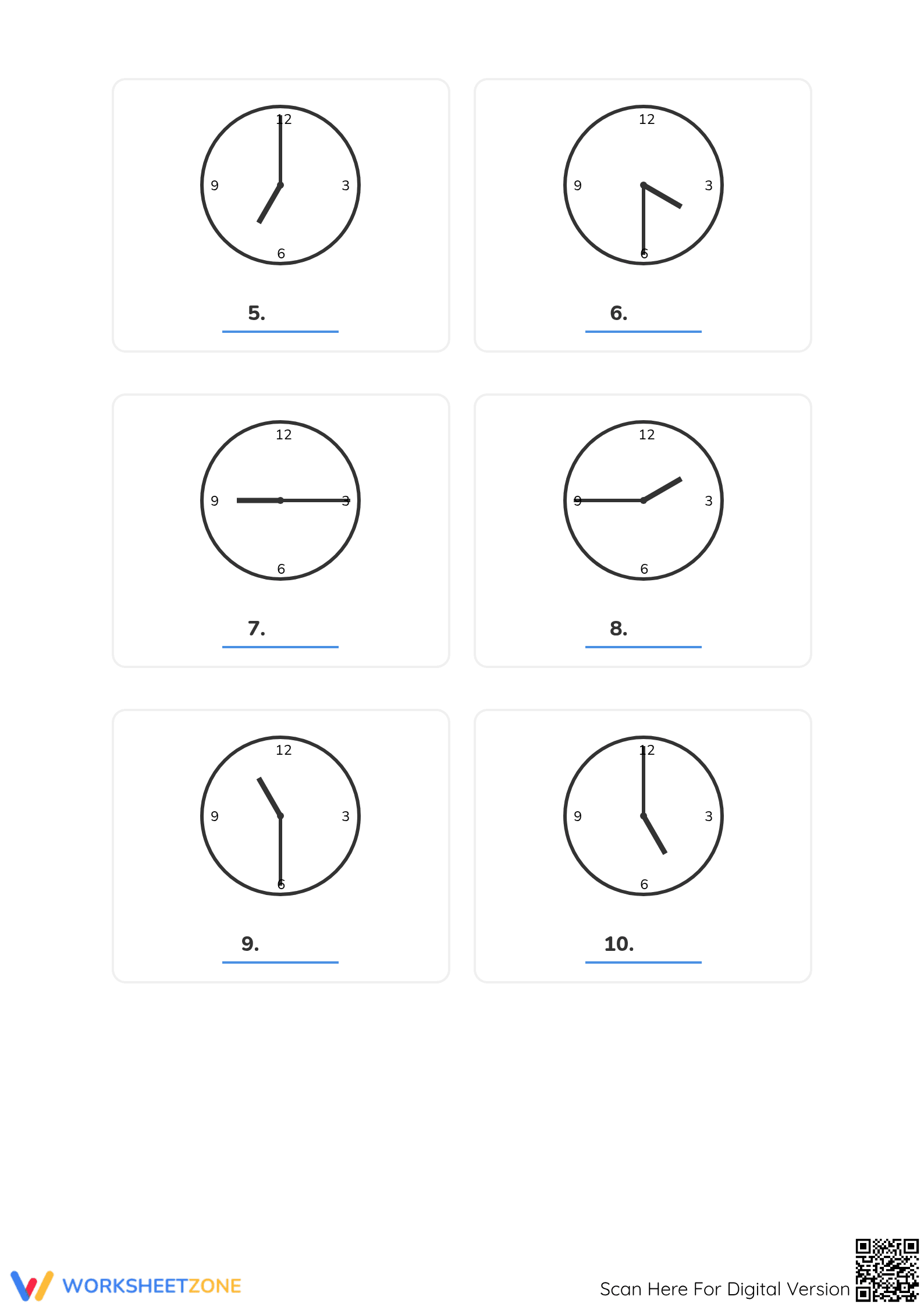
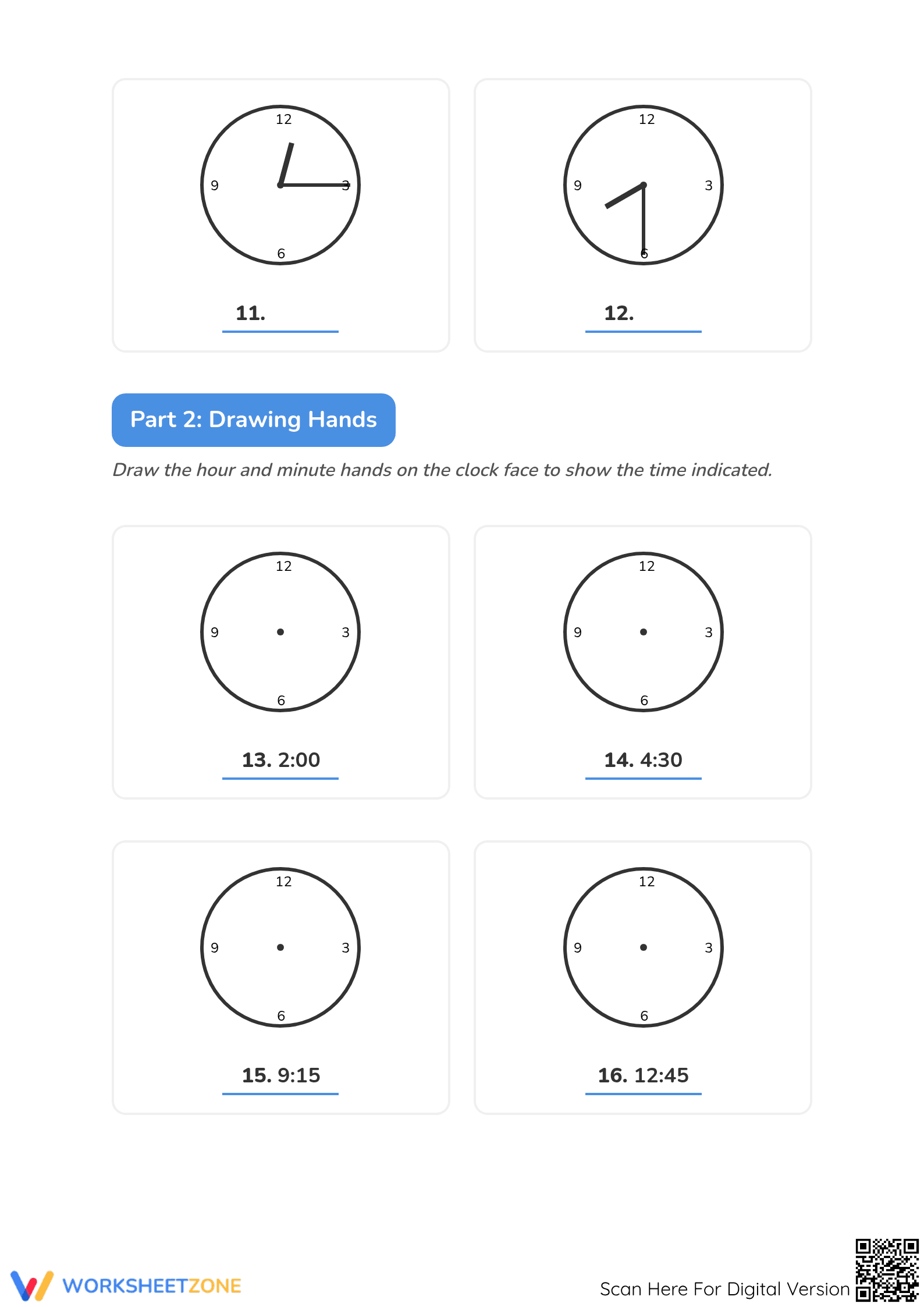
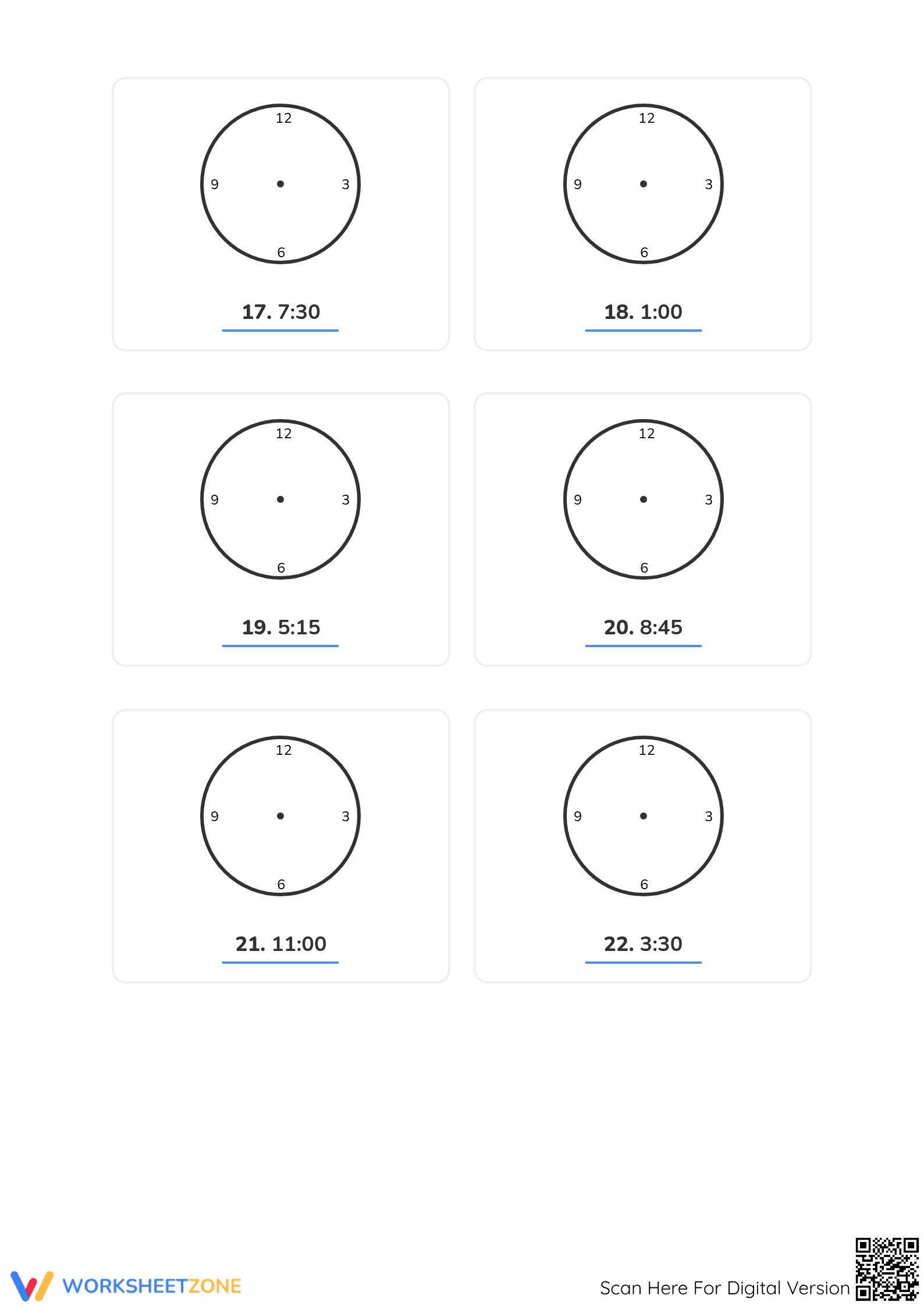
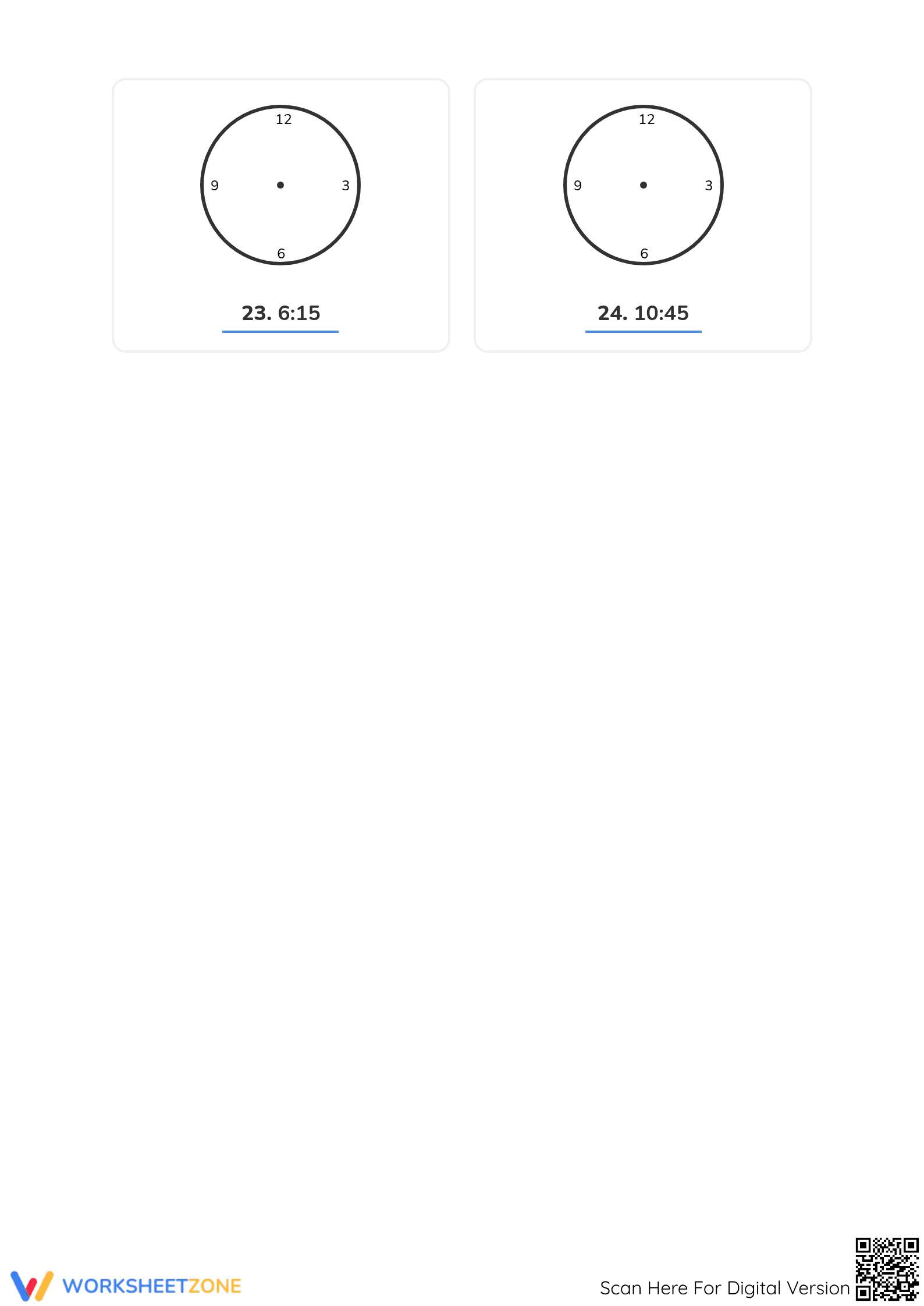
This five-page PDF collection is divided into two focused sections. Part one presents 12 analog clock faces where students must read the indicated time and write the digital equivalent in the provided space. Part two challenges students with 12 blank clock faces and specific time stamps, requiring them to accurately draw the hour and minute hands. A complete answer key is provided for immediate feedback and grading.
Skill Development
- Guided Practice: Initial pages feature clock faces with clear hour markers to build confidence in identifying whole and half-hour positions.
- Supported Practice: Mid-level tasks introduce quarter-hour intervals (e.g., 9:15, 12:45), requiring students to discriminate between hands across 8 problems.
- Independent Application: Final drawing tasks demand full mastery as students translate digital time into precise analog hand placements without scaffolding.
These exercises follow a gradual-release model, moving from recognition to production.
Standards Alignment
The primary focus of this resource is CCSS.MATH.CONTENT.2.MD.C.7, which requires students to tell and write time from analog and digital clocks to the nearest five minutes, using a.m. and p.m. Additionally, it supports Grade 3 foundations for CCSS.MATH.CONTENT.3.MD.A.1. Both standard codes can be copied directly into lesson plans, IEP goals, or district curriculum mapping tools.
Instructional Applications
This worksheet is ideal as a post-lesson assessment following a direct instruction session on clock mechanics. Alternatively, use specific pages for morning work to keep time-telling skills sharp throughout the year. While students work, observe their hand-drawing technique; if a student draws the hour hand directly on the digit for a 'half-past' time, provide a quick correction on proportional hand movement. Completion typically takes 20 to 30 minutes depending on grade level.
Target Audience
Designed for second graders beginning their time unit, this packet also serves as a robust intervention tool for third and fourth-grade students requiring additional support. It pairs naturally with an interactive classroom demonstration clock or an anchor chart displaying 'quarter past' and 'quarter to' vocabulary to assist visual learners during independent practice.
Mastery of analog time-telling remains a critical cognitive milestone for elementary students, despite the prevalence of digital devices. According to a 2024 analysis by ScienceDirect on educational resources, structured practice that combines both reading and drawing analog representations significantly enhances a student's spatial reasoning and proportional thinking skills. This specific worksheet aligns with CCSS.MATH.CONTENT.2.MD.C.7, ensuring that students can accurately interpret the relationship between the 12-hour clock face and the 60-minute cycle. By engaging with 24 distinct clock configurations across five pages, learners develop the visual-motor skills necessary to distinguish between hour and minute hands under varying conditions. The inclusion of drawing tasks specifically addresses the 'production' aspect of learning, which is often missing from purely multiple-choice formats. This resource provides the rigorous, repetitive practice required to move students from basic recognition to fluent time-telling, supporting long-term retention and real-world application of temporal concepts.


