


























Views
Downloads


Printable Telling Time Worksheet | Grade 2-4 Math
Paste this activity's link or code into your existing LMS (Google Classroom, Canvas, Teams, Schoology, Moodle, etc.).
Students can open and work on the activity right away, with no student login required.
You'll still be able to track student progress and results from your teacher account.
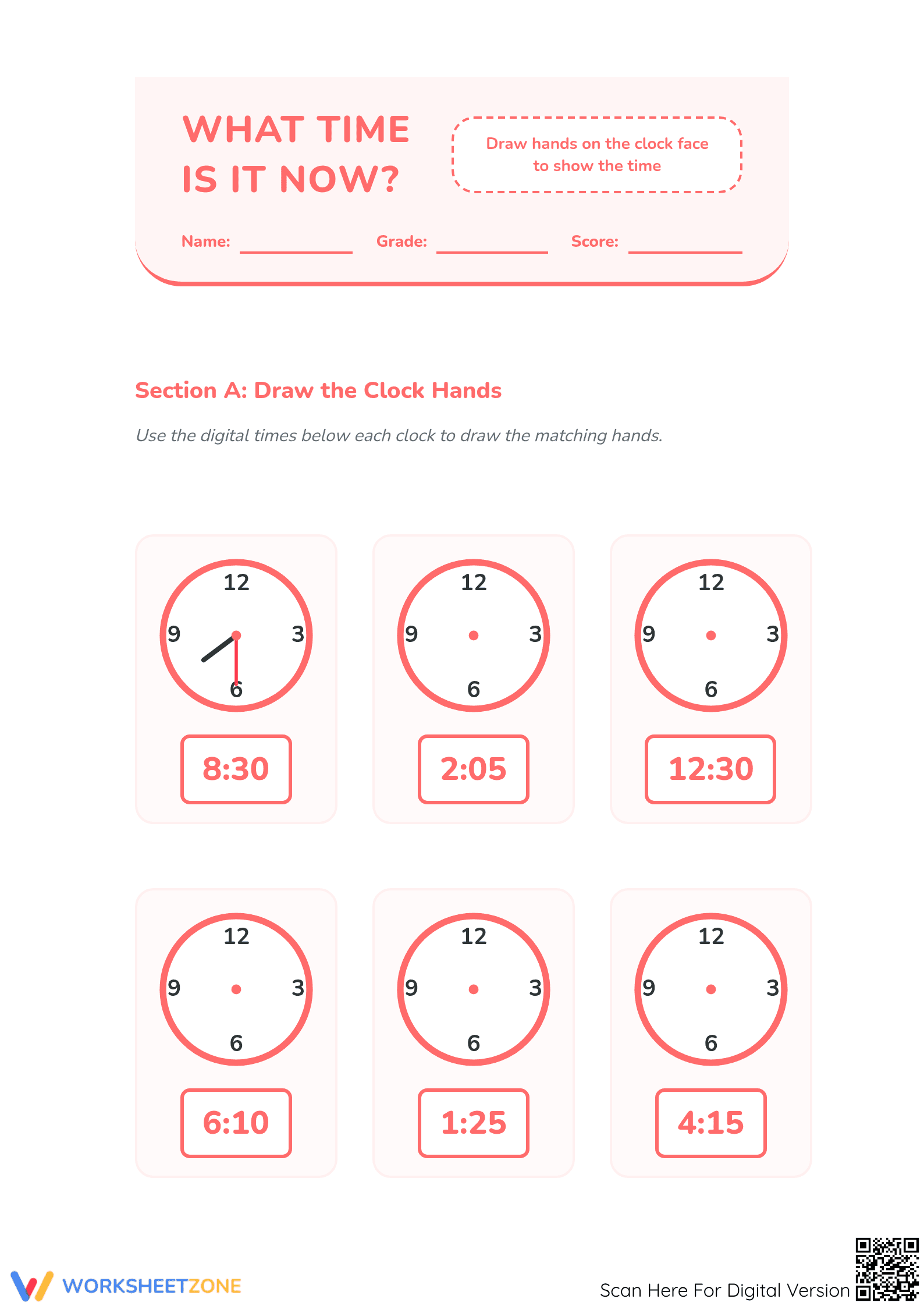
This Grade 2-4 math worksheet provides a comprehensive set of practice activities for students learning to tell time on analog and digital clocks. By engaging with multiple representations, learners develop the fluency needed to read time to the nearest five minutes and apply this skill to real-world scenarios.
At a Glance
- Grade: 2-4 · Subject: Math
- Standard:
CCSS.MATH.CONTENT.2.MD.C.7— Tell and write time from analog and digital clocks to the nearest five minutes- Skill Focus: Analog and digital time reading
- Format: 4 pages · 20 problems · Answer key included · PDF
- Best For: Independent practice and formative assessment
- Time: 30–45 minutes
This 4-page instructional pack includes four distinct sections designed to build mastery through varied task types. Students will find 20 total problems, ranging from drawing clock hands to interpreting word problems. The format features clear clock faces and response boxes, making it accessible. A complete answer key is provided to facilitate rapid grading.
Teachers can integrate this resource into their schedule with minimal effort using this three-step workflow: First, print the four-page set (30 seconds); second, distribute the copies to students (1 minute); and third, review the completed work using the included key (5 minutes). The total prep time is under two minutes, making this an ideal choice for busy mornings or unexpected substitute teacher plans.
The primary focus is CCSS.MATH.CONTENT.2.MD.C.7, which requires students to "Tell and write time from analog and digital clocks to the nearest five minutes, using a.m. and p.m." This worksheet supports this standard by requiring both drawing and writing skills. Both standard codes can be copied directly into lesson plans, IEP goals, or district curriculum mapping tools.
Use this as a mid-unit formative assessment after students have been introduced to the minute and hour hands. As students work through Section C ("Time Tales"), observe if they correctly distinguish between the short hour hand and the long minute hand. This resource is best assigned for independent practice following a direct instruction session. Completion typically takes 30 to 45 minutes.
This resource is designed for Grade 2 through Grade 4 students who are refining their temporal awareness. It provides necessary scaffolding for students needing extra practice and can be paired with an analog clock anchor chart to support visual learners during the "Time Tales" word problem section.
Proficiency in reading analog clocks is a fundamental cognitive milestone bridging abstract numerical concepts with physical spatial reasoning. According to Fisher & Frey (2014), the gradual release of responsibility—moving from guided drawing to independent interpretation—is critical for mathematical fluency. This resource implements that pedagogical shift by moving from simple clock-hand placement in Section A to higher-order word problem application in Section C. By requiring students to navigate standard CCSS.MATH.CONTENT.2.MD.C.7 through multiple modalities, teachers ensure that learners understand the underlying logic of time-keeping. This 20-problem set provides sufficient repetition to stabilize the skill of telling time to the nearest five minutes, which is a prerequisite for more complex Grade 3-4 skills such as calculating elapsed time or solving multi-step duration problems.


