


























Views
Downloads



Telling Time Clock Hands Worksheet | Grade 2 Printable
Paste this activity's link or code into your existing LMS (Google Classroom, Canvas, Teams, Schoology, Moodle, etc.).
Students can open and work on the activity right away, with no student login required.
You'll still be able to track student progress and results from your teacher account.
Help your students master the essential skill of telling time by translating digital clock displays into analog hand placements. This comprehensive five-page worksheet provides a structured sequence of exercises that build fluency through three distinct difficulty rounds. Students will demonstrate their understanding by accurately drawing hour and minute hands across ten unique clock faces.
At a Glance
- Grade: 2 · Subject: Math
- Standard:
CCSS.MATH.CONTENT.2.MD.C.7— Tell and write time to the nearest five minutes using analog and digital clocks accurately- Skill Focus: Analog Clock Hand Representation and Placement
- Format: 5 pages · 10 problems · Answer key included · PDF
- Best For: Independent student practice and quick classroom formative assessment
- Time: 15–25 minutes of focused work
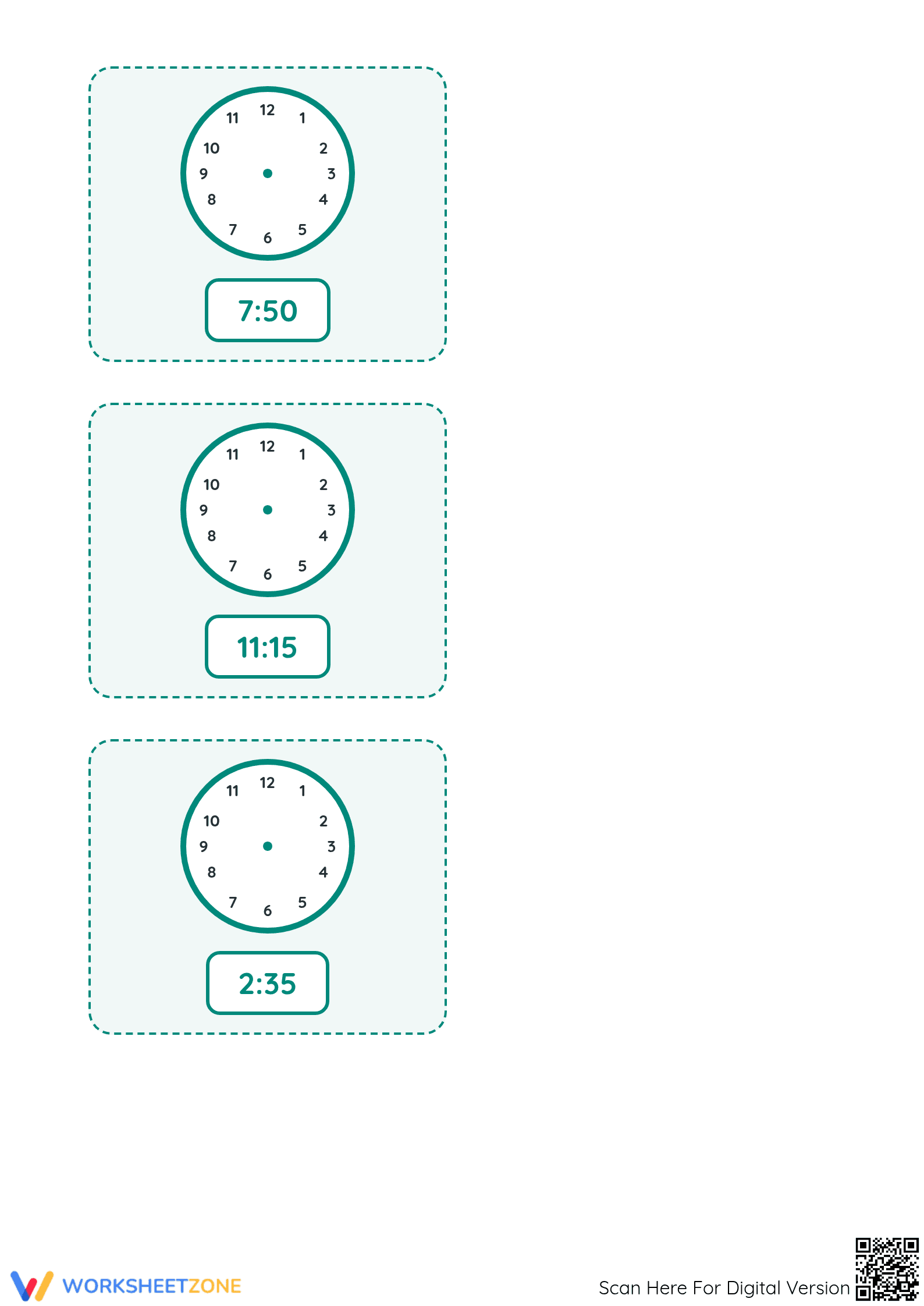
This packet includes five high-quality printable pages designed for clarity. It features ten practice problems divided into three thematic rounds: Hour & Half Hour, Minutes to the Next Hour, and Quarter Past & Quarter To. Each page contains large analog clock faces with specific digital timestamps provided below. A complete answer key is included for rapid grading.
Implementing this resource into your math block is simple and efficient. This zero-prep packet is also ideal for sub-plans. First, print the five-page PDF and the corresponding answer key (30 seconds). Next, distribute the packets to students for independent work or as part of a math center rotation (1 minute). Finally, use the answer key to provide immediate feedback or collect for a quick grading review at the end of the lesson.
This resource aligns directly with CCSS.MATH.CONTENT.2.MD.C.7: "Tell and write time from analog and digital clocks to the nearest five minutes, using a.m. and p.m." It focuses on the specific cognitive task of translating digital formats into spatial analog representations. This standard code can be copied directly into lesson plans or curriculum mapping tools.
Use this worksheet as a summative assessment after a unit on time or as a sub-plan activity. For a formative check, observe students during Round 2 to see if they correctly position the hour hand between numbers for times like 8:55. It works perfectly as a quiet transition activity or a targeted intervention for students struggling with minute hand placement.
Designed primarily for second-grade students, this worksheet also serves as an excellent review for third and fourth graders. It supports varied learners through a gradual release of complexity. Pair this packet with a set of physical manipulative clocks to provide hands-on support for students who need tactile reinforcement before committing their answers to paper.
Developing the ability to mentalize analog clock faces is a critical component of temporal literacy and spatial reasoning in early elementary mathematics. This worksheet addresses CCSS.MATH.CONTENT.2.MD.C.7 by requiring students to accurately place hour and minute hands based on five-minute digital increments. According to a RAND AIRS 2024 analysis, structured practice in translating between time representations significantly increases procedural fluency and reduces cognitive load during complex scheduling tasks. By isolating the hand-drawing task across ten focused problems, this resource provides the necessary repetition for students to internalize the relationship between the circular clock face and linear time passage. The inclusion of "near-the-hour" challenges like 8:55 ensures that students confront common misconceptions regarding hour hand drift. This standards-aligned tool offers a reliable pathway to mastery for students in Grades 2 through 4, supporting both classroom instruction and individualized educational goals.


