


























Views
Downloads



Printable Telling Time Worksheet | Grade 2-4 Math Practice
Paste this activity's link or code into your existing LMS (Google Classroom, Canvas, Teams, Schoology, Moodle, etc.).
Students can open and work on the activity right away, with no student login required.
You'll still be able to track student progress and results from your teacher account.
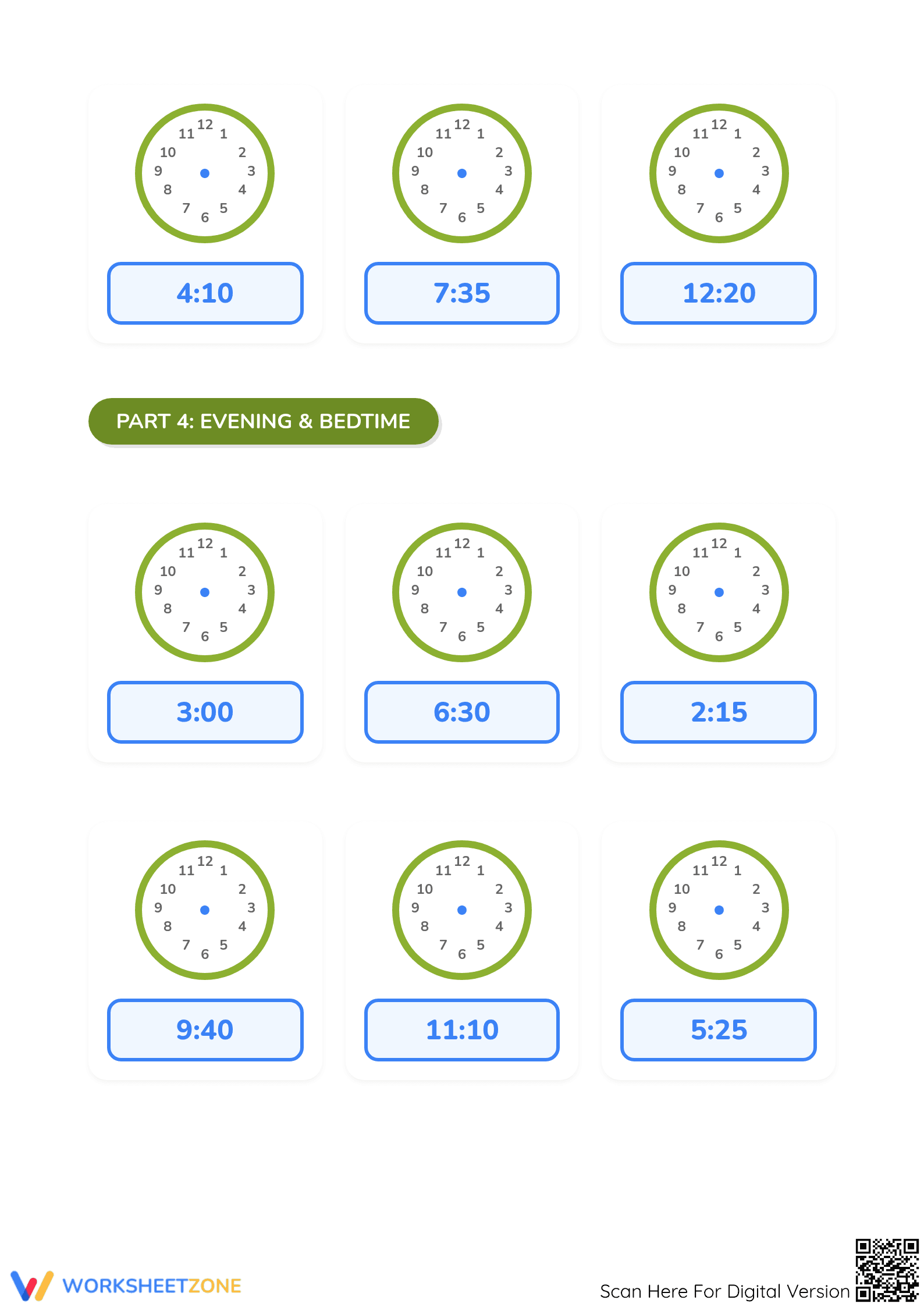
This comprehensive telling time worksheet collection provides Grade 2 through Grade 4 students with intensive practice in translating digital time to analog clock faces. Students engage in 24 distinct exercises designed to build fluency in reading and representing time to five-minute intervals. By drawing both hour and minute hands, learners solidify their understanding of clock mechanics and daily scheduling.
At a Glance
- Grade: 2–4 · Subject: Math
- Standard:
CCSS.MATH.CONTENT.2.MD.C.7— Tell and write time from analog and digital clocks to the nearest five minutes- Skill Focus: Analog clock representation
- Format: 3 pages · 24 problems · Answer key included · PDF
- Best For: Independent practice and morning work
- Time: 20–30 minutes
What's Inside
This 3-page PDF features four thematic sections covering daily schedules. Each section provides six analog clock faces with digital timestamps displayed below. The clear, uncluttered layout ensures students can focus on the geometric task of positioning minute and hour hands accurately. A complete answer key is included to facilitate rapid grading or student self-correction.
Zero-Prep Workflow
The zero-prep workflow for this resource is designed for maximum teacher efficiency. First, print the three-page set (30 seconds). Second, distribute the worksheets during your measurement and data block or as a transition activity (1 minute). Finally, use the answer key for quick review or student self-correction (2 minutes). This resource is perfectly suited for substitute plans.
Standards Alignment
The primary standard addressed is `CCSS.MATH.CONTENT.2.MD.C.7`, which requires students to tell and write time from analog and digital clocks to the nearest five minutes. It also supports `CCSS.MATH.CONTENT.3.MD.A.1` as a foundational review for telling time to the nearest minute. Both standard codes can be copied directly into lesson plans, IEP goals, or district curriculum mapping tools.
How to Use It
Use this worksheet for independent practice following a lesson on the differences between the hour and minute hands. For a formative assessment, observe students as they complete "Part 1" to check for hand-length differentiation and correct minute positioning. Completion time is approximately 25 minutes for the full three-page set.
Who It's For
This resource is ideal for Grade 2 learners and Grade 3-4 students needing targeted remediation. It works exceptionally well for small group interventions or students with functional life-skills goals. Pair this worksheet with a physical clock model or interactive whiteboard demonstration to bridge the gap between concrete and abstract time representation.
Telling time is a critical cognitive milestone that bridges abstract numerical concepts with practical, daily application. Research from NAEP indicates that consistent, repeated practice with analog clock faces is essential for students to develop a spatial understanding of time increments. This resource aligns with the findings of Fisher & Frey (2014) regarding the importance of structured independent practice in the gradual release of responsibility. By providing 24 opportunities to represent time to the five-minute mark, this worksheet ensures students move beyond rote memorization toward conceptual mastery. The inclusion of thematic categories like "Daily Routine" and "Evening & Bedtime" helps ground mathematical abstractness in lived experience, which EdReports 2024 highlights as a key factor in high-quality instructional materials. This PDF serves as a robust tool for educators aiming to meet CCSS.MATH.CONTENT.2.MD.C.7 standards through a classroom-ready, high-volume practice format that minimizes teacher prep while maximizing student output.


