


























Views
Downloads


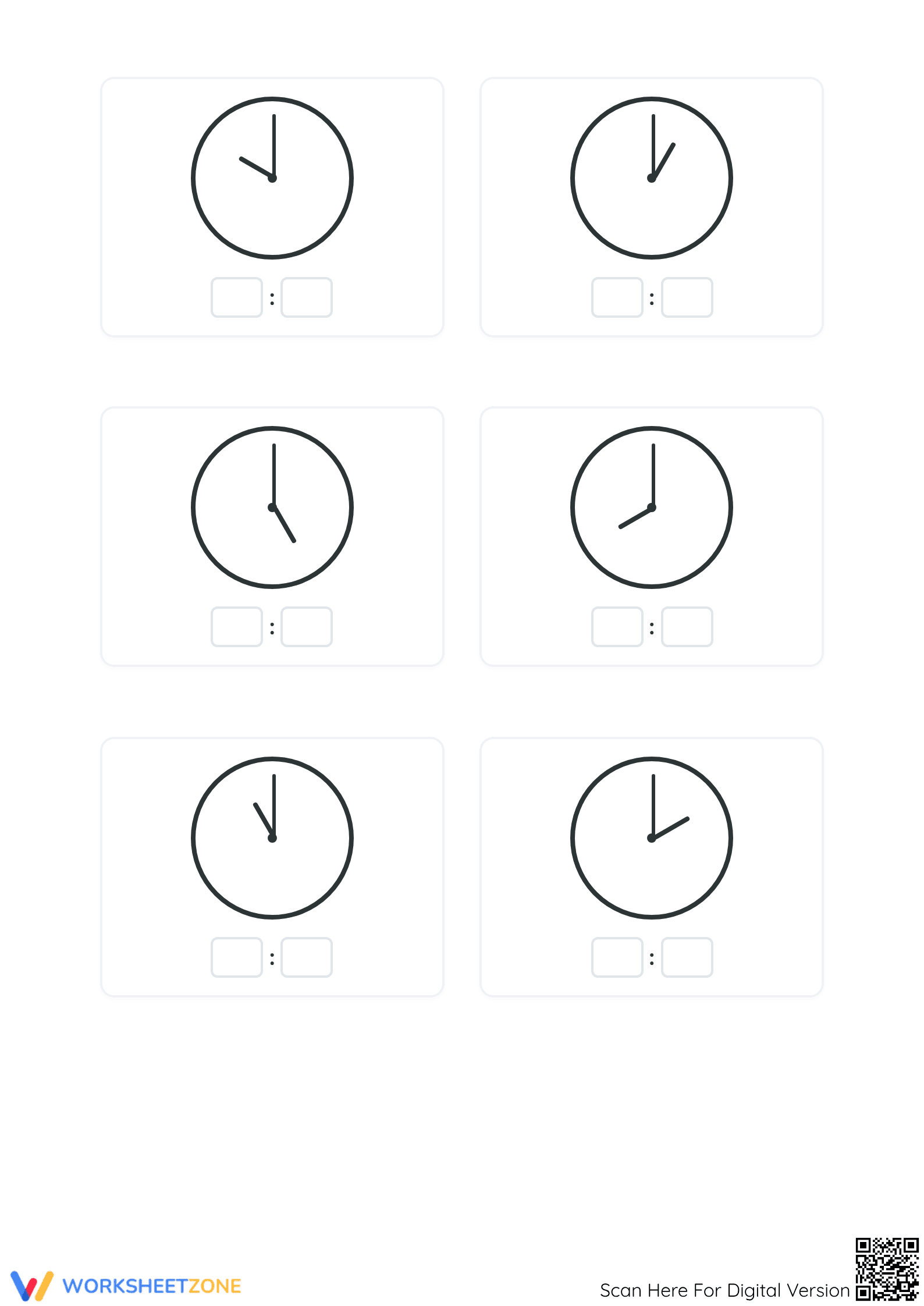


Printable Telling Time Mastery Worksheet | Grade 2-4 Aligned
Paste this activity's link or code into your existing LMS (Google Classroom, Canvas, Teams, Schoology, Moodle, etc.).
Students can open and work on the activity right away, with no student login required.
You'll still be able to track student progress and results from your teacher account.
Mastering the clock is a fundamental life skill that requires consistent practice. This Telling Time Mastery packet provides comprehensive exercises designed to transition students from basic hour recognition to precise five-minute intervals. By translating analog clock faces into digital formats, learners solidify their understanding of the relationship between clock hands and numerical time representation.
At a Glance
- Grade: 2–4 · Subject: Math
- Standard:
CCSS.MATH.CONTENT.2.MD.C.7— Tell and write time from analog and digital clocks to the nearest five minutes- Skill Focus: Analog to Digital Time Conversion
- Format: 5 pages · 24 problems · Answer key included · PDF
- Best For: Daily morning work or sub plans
- Time: 20–30 minutes
This instructional resource contains five high-quality pages featuring 24 distinct clock-reading tasks. The worksheet is organized into two primary sections: Section A focuses on five-minute intervals to build confidence, while Section B offers mixed review practice. Each page includes clear analog clock faces with dedicated digital entry boxes. A complete answer key is provided for rapid grading.
The zero-prep design of this packet allows for immediate implementation in any classroom setting with a total teacher prep time of under two minutes. The workflow follows three simple steps: First, print the entire five-page set in sixty seconds. Second, distribute the worksheets to students in approximately one minute, requiring no additional manipulatives. Third, review student answers using the included key for a fast formative check. This efficiency makes the packet an ideal choice for emergency sub plans or daily transitions.
This resource is directly aligned with CCSS.MATH.CONTENT.2.MD.C.7, which requires students to "tell and write time from analog and digital clocks to the nearest five minutes, using a.m. and p.m." It also supports Grade 3 and 4 review for CCSS.MATH.CONTENT.3.MD.A.1. Both standard codes can be copied directly into lesson plans, IEP goals, or district curriculum mapping tools to ensure instructional compliance and tracking.
Utilize this worksheet as a formative assessment after initial instruction on the minute hand's progression. During the independent practice phase, teachers should circulate and observe if students are correctly identifying "half-past" or "quarter-to" positions. The packet is also highly effective as a cumulative review before a unit test. Expect most students to complete the full 24-problem set within a 25-minute instructional block.
This collection is specifically crafted for second-grade students reaching for mastery and third or fourth graders requiring targeted intervention. The clear layout and repetitive structure benefit English Language Learners and students with processing delays by reducing visual clutter. Pair this worksheet with a physical geared classroom clock or a digital time passage to provide a multi-sensory learning experience.
The development of temporal awareness is a complex cognitive milestone that necessitates repeated exposure to analog representations. Research from Fisher & Frey (2014) emphasizes that the gradual release of responsibility model, which this worksheet follows through its structured Section A and B progression, is essential for student mastery of abstract measurement concepts like time. By providing 24 distinct opportunities for practice, this resource addresses the "I Do, We Do, You Do" instructional framework by allowing for a smooth transition from guided classroom work to independent application. Aligned to CCSS.MATH.CONTENT.2.MD.C.7, the tasks require students to tell and write time from analog and digital clocks to the nearest five minutes. This volume of practice is consistent with NAEP recommendations for elementary mathematics fluency, ensuring that students move beyond superficial recognition to deep procedural knowledge of time-telling mechanics.


