


























Views
Downloads

Past Tense Verbs Printable Guide | Grade 2-3 ELA
Paste this activity's link or code into your existing LMS (Google Classroom, Canvas, Teams, Schoology, Moodle, etc.).
Students can open and work on the activity right away, with no student login required.
You'll still be able to track student progress and results from your teacher account.
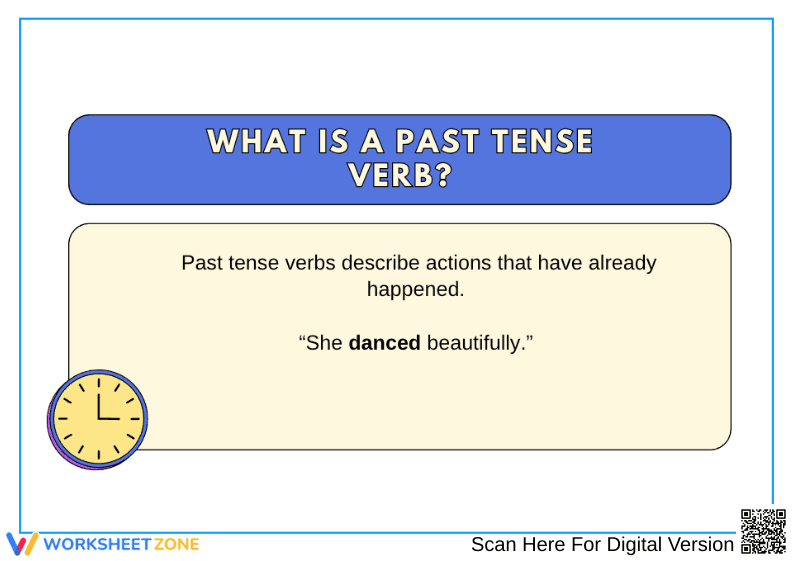
This past tense verbs reference guide provides students with a clear, visual definition of how verbs describe actions that have already happened. By offering a straightforward explanation and a concrete example, this resource helps second and third graders solidify their foundational grammar skills and improve their everyday writing.
At a Glance
- Grade: 2-3 · Subject: ELA
- Standard:
CCSS.ELA-LITERACY.L.3.1.E— Form and use simple verb tenses in writing and speaking- Skill Focus: Past Tense Verbs
- Format: 1 page · 0 problems · No answer key · PDF
- Best For: Grammar anchor chart or student desk reference
- Time: 5–10 minutes
This single-page resource functions as an instructional anchor chart or student reference sheet. It features a bold, easy-to-read definition stating that past tense verbs describe actions that have already happened. Below the definition, a clear example sentence ("She danced beautifully") highlights the target grammar concept in context. A helpful clock graphic visually reinforces the concept of time and past actions, making it highly accessible for young readers.
This visual guide is designed for immediate classroom implementation.
- Print (1 minute): Print the PDF to use as a poster or handout.
- Distribute (1 minute): Hand out copies for grammar folders or display on a bulletin board.
- Review (3 minutes): Read the definition aloud and discuss the example sentence.
Total prep time is under two minutes, making this an excellent addition to sub plans or mini-lessons.
This resource aligns directly with CCSS.ELA-LITERACY.L.3.1.E: Form and use the simple (e.g., I walked; I walk; I will walk) verb tenses. It also supports second-grade foundational grammar expectations for understanding action words. Both standard codes can be copied directly into lesson plans, IEP goals, or district curriculum mapping tools.
Teachers can utilize this visual aid during direct instruction as a focal point for introducing past tense verbs. Display it on a smartboard while explaining how verbs change timeframe. Alternatively, provide it as a desk reference for students during independent writing. As a formative assessment observation tip, watch if students independently refer to the chart when editing narrative drafts to ensure consistent verb tense. Reviewing the chart takes just a few minutes.
This reference guide is ideal for second and third-grade students developing their core grammar competencies. It serves as an excellent scaffold for English Language Learners (ELLs) or students with IEPs who benefit from clear, uncluttered visual aids and explicit examples. Pair this chart with a hands-on verb sorting activity or a short reading passage where students highlight past tense verbs to reinforce the concept.
Mastering verb tenses is a critical component of early elementary literacy and effective communication. This resource targets CCSS.ELA-LITERACY.L.3.1.E, helping students form and use simple verb tenses accurately. According to Fisher & Frey (2014), providing students with clear, visual anchor charts significantly reduces cognitive load and supports the retention of abstract grammar rules. By explicitly defining past tense verbs and offering a contextualized example, this guide bridges the gap between rote memorization and practical application in student writing. Visual scaffolds like this one empower young learners to self-monitor their grammar usage during independent tasks, fostering greater confidence and writing fluency. Integrating such targeted reference materials into daily instruction ensures that foundational language skills are consistently reinforced, ultimately leading to stronger reading comprehension and more cohesive narrative writing across all subject areas.


