


























Views
Downloads

Essential Grade 3/4 Vocabulary Worksheet | Printable
Paste this activity's link or code into your existing LMS (Google Classroom, Canvas, Teams, Schoology, Moodle, etc.).
Students can open and work on the activity right away, with no student login required.
You'll still be able to track student progress and results from your teacher account.
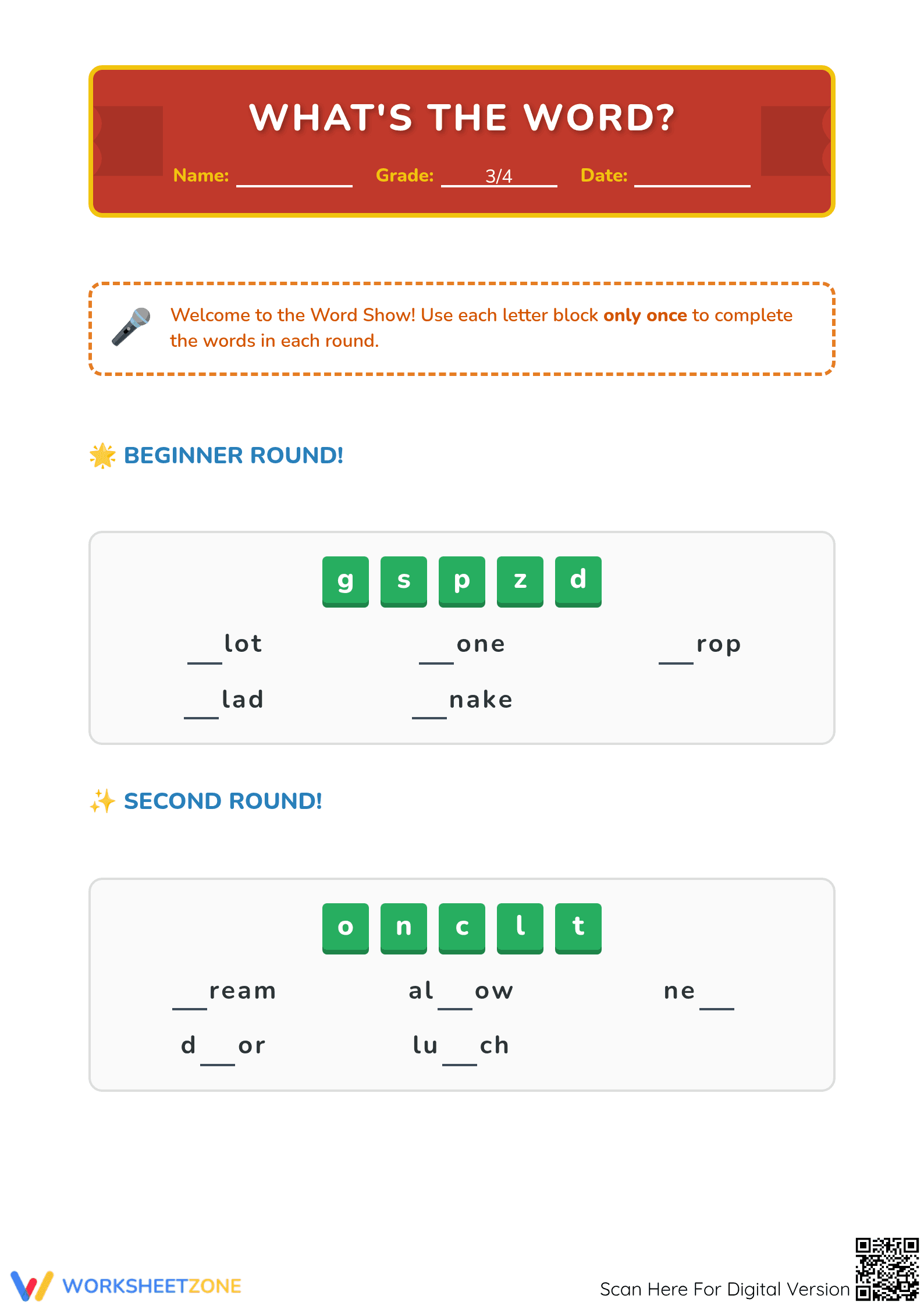
This Grade 3 and Grade 4 vocabulary worksheet engages students in high-interest word completion tasks across five progressively difficult rounds. By applying phonetic patterns and structural analysis, learners master complex spelling and vocabulary. It provides a comprehensive bridge between basic phonemic awareness and advanced word recognition, ensuring students develop the fluency needed for proficient reading.
At a Glance
- Grade: 3/4 · Subject: ELA / Vocabulary
- Standard:
CCSS.ELA-LITERACY.L.3.2— Apply spelling patterns and generalizations in writing words- Skill Focus: Word completion and phonemic spelling
- Format: 2 pages · 26 problems · Answer key included · PDF
- Best For: Daily warm-ups or independent practice
- Time: 15–25 minutes
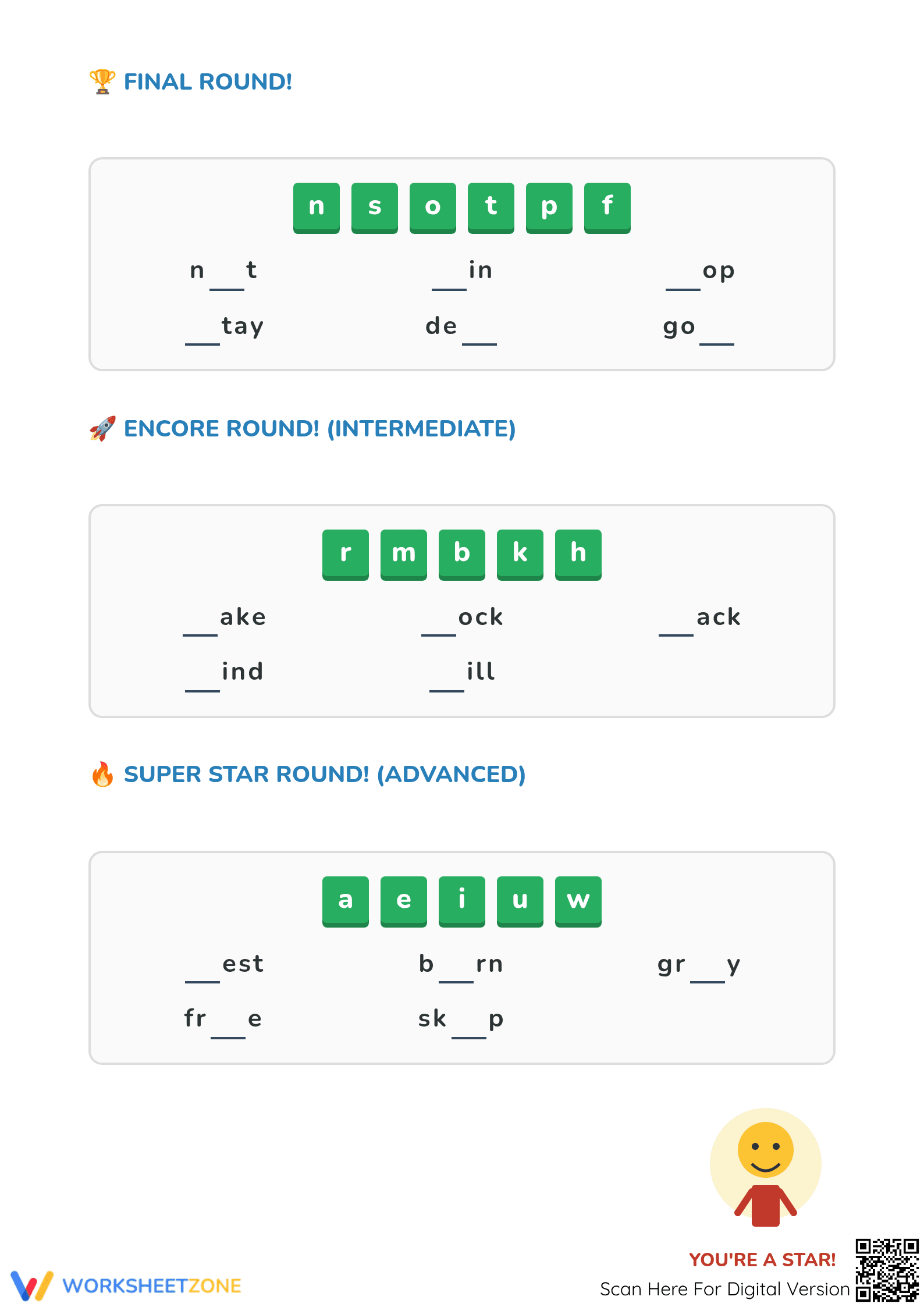
This two-page resource features 26 distinct word completion challenges organized into five themed rounds. Students use specific letter blocks only once per round to complete partial words. The structure includes beginner, intermediate, and advanced sections, complete with an answer key for rapid grading and visual cues guiding students through consonant blends and complex endings.
- Below Grade (Beginner Round): Focuses on single-letter consonant substitutions and basic CVC/CVCe patterns to build initial confidence and phonological awareness.
- On Grade (Final/Encore Rounds): Introduces multi-letter blends and common vowel digraphs that align with mid-elementary expectations for spelling and word structure.
- Above Grade (Super Star Round): Challenges advanced learners with sophisticated vocabulary and less common phonetic patterns, requiring higher-order linguistic processing to solve.
All three proficiency levels are integrated into this single, easy-to-use document, allowing teachers to provide targeted support within a unified classroom activity.
The primary focus is CCSS.ELA-LITERACY.L.3.2, requiring command of standard English spelling conventions. Tasks address L.3.2.F by applying spelling patterns and generalizations. It also supports CCSS.ELA-LITERACY.RF.4.3.A through multi-syllabic word analysis. Both standard codes can be copied directly into lesson plans, IEP goals, or district curriculum mapping tools.
Use this as a "Bell Ringer" to start your ELA block. Observe students during the "Super Star Round" to identify mastery of complex vowel teams. The activity takes 20 minutes, making it ideal for literacy centers or a substitute plan that maintains rigor.
Designed for Grade 3-4 students, including ESL or special education learners who benefit from visual scaffolding. It serves as an excellent companion to phonics lessons. Pair with a shared reading passage or an anchor chart on blends for a cohesive experience.
Research from the RAND AIRS 2024 study emphasizes that structured word-study activities, such as those found in this "What's The Word?" worksheet, are critical for developing the orthographic mapping skills necessary for reading fluency. By requiring students to complete words using a finite set of letters, the task forces an active retrieval process that strengthens the neural pathways between phonemes and graphemes. This method aligns with the "Science of Reading" framework, which advocates for explicit, systematic instruction in phonological awareness and decoding strategies. Furthermore, the inclusion of tiered difficulty rounds ensures that the instructional material remains within the student's zone of proximal development, a pedagogical principle supported by NAEP findings regarding effective literacy interventions. This Grade 3/4 standards-aligned CCSS.ELA-LITERACY.L.3.2 resource provides the essential repetition needed for students to move from laboriously decoding individual sounds to automaticity in word recognition, ultimately enhancing overall reading comprehension.


