


























Views
Plays


Quantifiers Grammar Worksheet | Grade 10 Essential
Paste this activity's link or code into your existing LMS (Google Classroom, Canvas, Teams, Schoology, Moodle, etc.).
Students can open and work on the activity right away, with no student login required.
You'll still be able to track student progress and results from your teacher account.
This Grade 10 English Language Arts worksheet provides targeted practice on the correct usage of quantifiers and determiners. Students analyze visual cues and sentence structures to select the appropriate term, such as "both," "half of," or "all." This resource ensures students master the nuances of standard English grammar in various contexts.
At a Glance
- Grade: 10 · Subject: ELA
- Standard:
CCSS.ELA-LITERACY.L.9-10.1— Demonstrate command of standard English grammar and usage conventions- Skill Focus: Quantifiers and Determiners
- Format: 3 pages · 10 problems · Answer key included · PDF
- Best For: Grammar review and formative assessment
- Time: 15–20 minutes
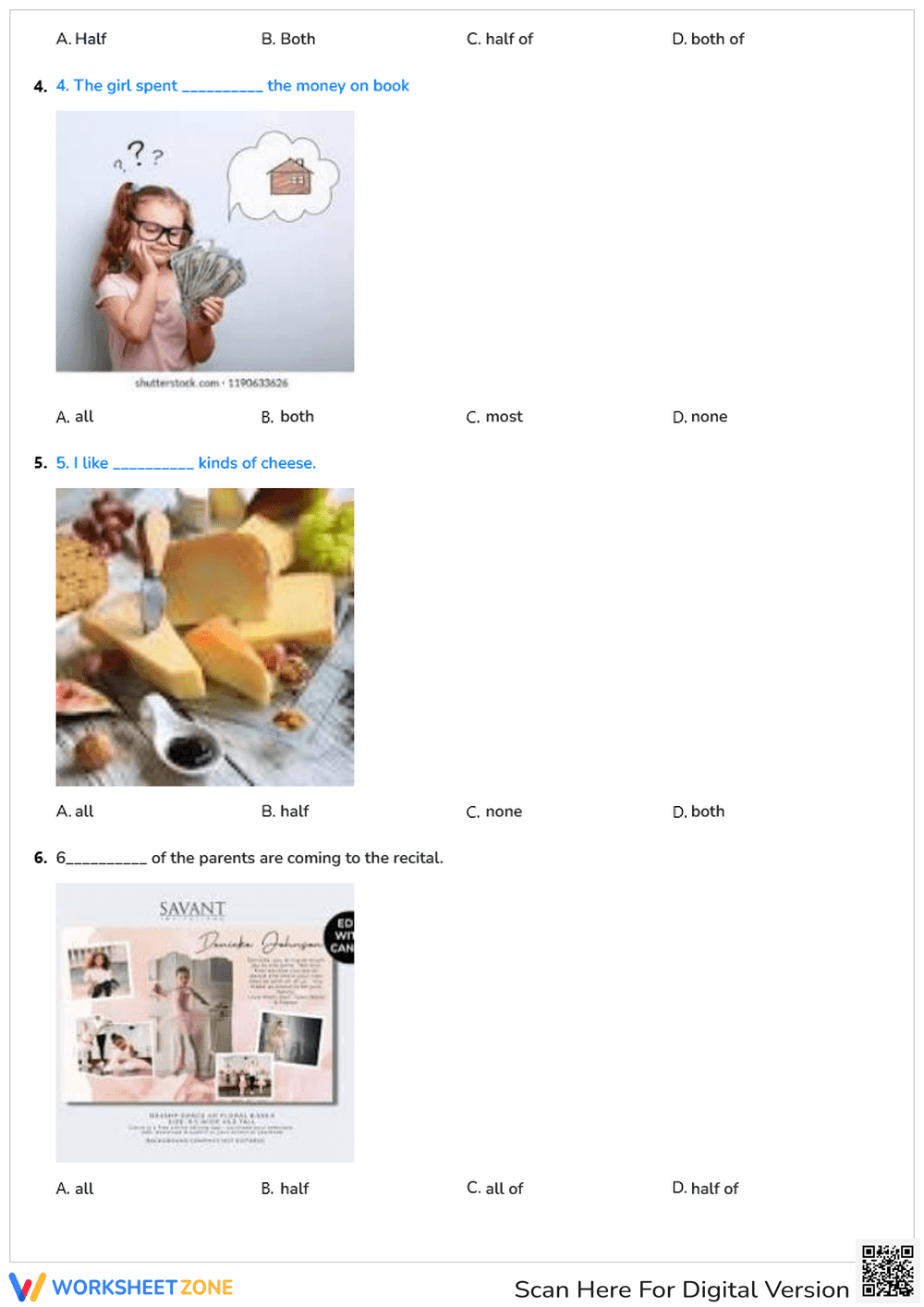
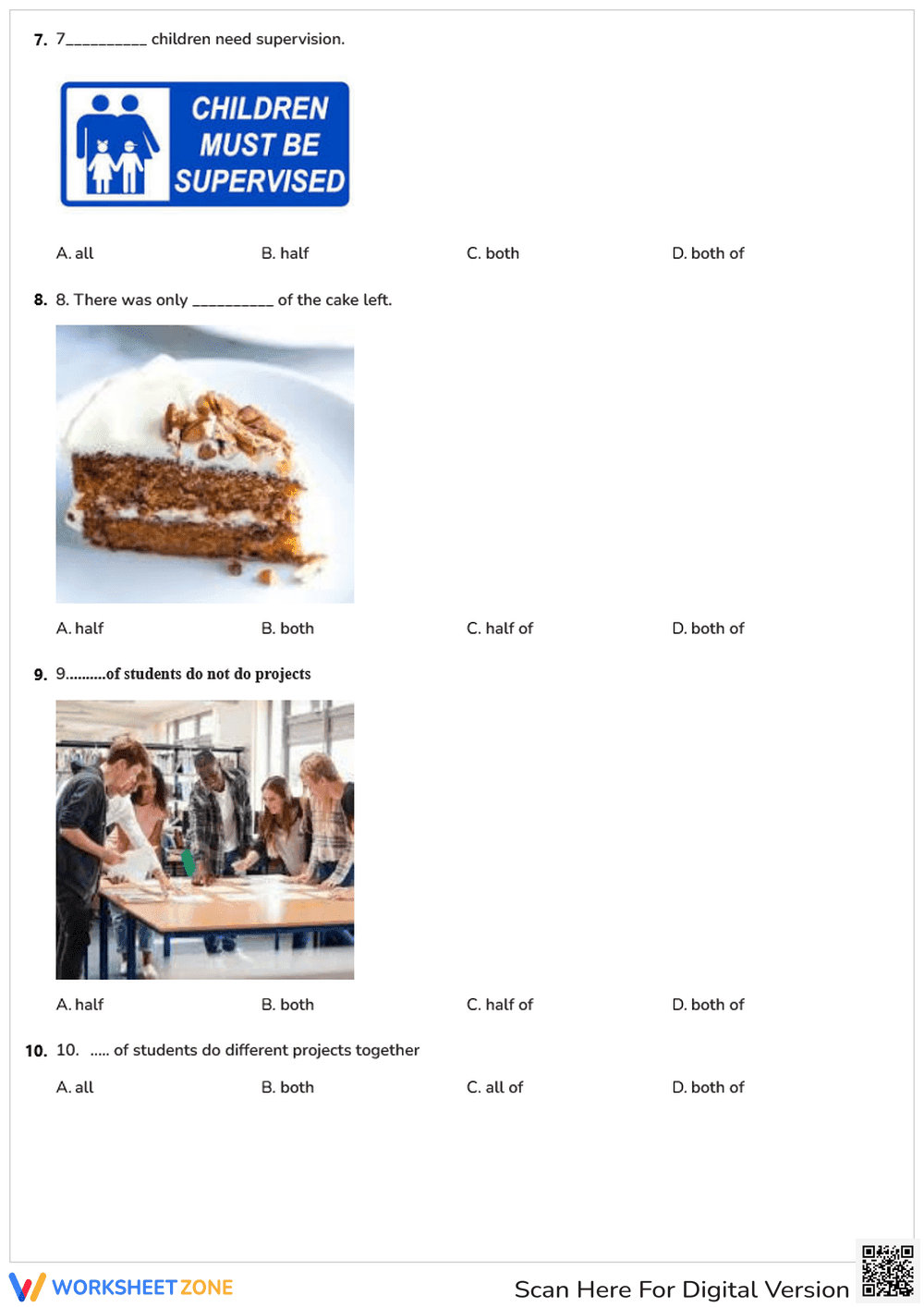
The packet contains three pages featuring 10 high-quality multiple-choice questions. Each question is paired with a clear, relevant image to provide context for the quantifier being tested. The layout is clean and professional, including a full answer key for rapid grading and immediate student feedback.
Skill Progression
- Guided Practice: The first 3 problems use simple visual prompts, like a milk bottle, to establish the basic relationship between objects and quantifiers.
- Supported Practice: Problems 4-7 introduce more complex social scenarios and signage, requiring students to infer meaning from text and image combinations.
- Independent Practice: The final 3 problems challenge students to distinguish between similar constructions like "both" versus "both of" in academic settings.
This sequence follows a gradual-release model, moving from concrete visual identification to abstract grammatical application.
Standards Alignment
This resource is aligned with `CCSS.ELA-LITERACY.L.9-10.1`, which requires students to demonstrate command of the conventions of standard English grammar and usage. Specifically, it addresses the precise use of determiners to clarify quantity and relationship within a sentence. Both standard codes can be copied directly into lesson plans, IEP goals, or district curriculum mapping tools.
How to Use It
Use this worksheet as a "bell-ringer" or warm-up activity during a unit on advanced sentence structure. It also serves as an effective formative assessment tool after a direct instruction lesson on collective nouns and determiners. Expect students to complete the 10 tasks within 15 to 20 minutes.
Who It's For
This is designed for Grade 10 students, including English Language Learners (ELL) who benefit from the visual scaffolding provided by the images. It pairs naturally with a grammar anchor chart or a direct instruction lesson on subject-verb agreement and noun phrases.
According to the RAND AIRS 2024 report, targeted grammar interventions that utilize visual-textual pairing significantly improve retention of linguistic conventions among secondary students. This worksheet focuses on the CCSS.ELA-LITERACY.L.9-10.1 standard, specifically the use of quantifiers like "both of" and "half of" to ensure grammatical precision. By providing 10 distinct contextual scenarios, the resource allows for the repeated exposure necessary for mastery. Research by Fisher & Frey (2014) supports this gradual-release approach, where visual cues act as a bridge to independent linguistic proficiency. Educators can utilize this tool to gather data on student readiness for more complex syntactic structures. The inclusion of an answer key facilitates immediate corrective feedback, a critical component of effective formative assessment in the ELA classroom.


