


























0
Views
0
Downloads

0.0
0
Save
0 Likes
Analyzing Weather Event Effects Worksheet
0 Views
0 Downloads
Paste this activity's link or code into your existing LMS (Google Classroom, Canvas, Teams, Schoology, Moodle, etc.).
Students can open and work on the activity right away, with no student login required.
You'll still be able to track student progress and results from your teacher account.
Information
Description
What It Is:
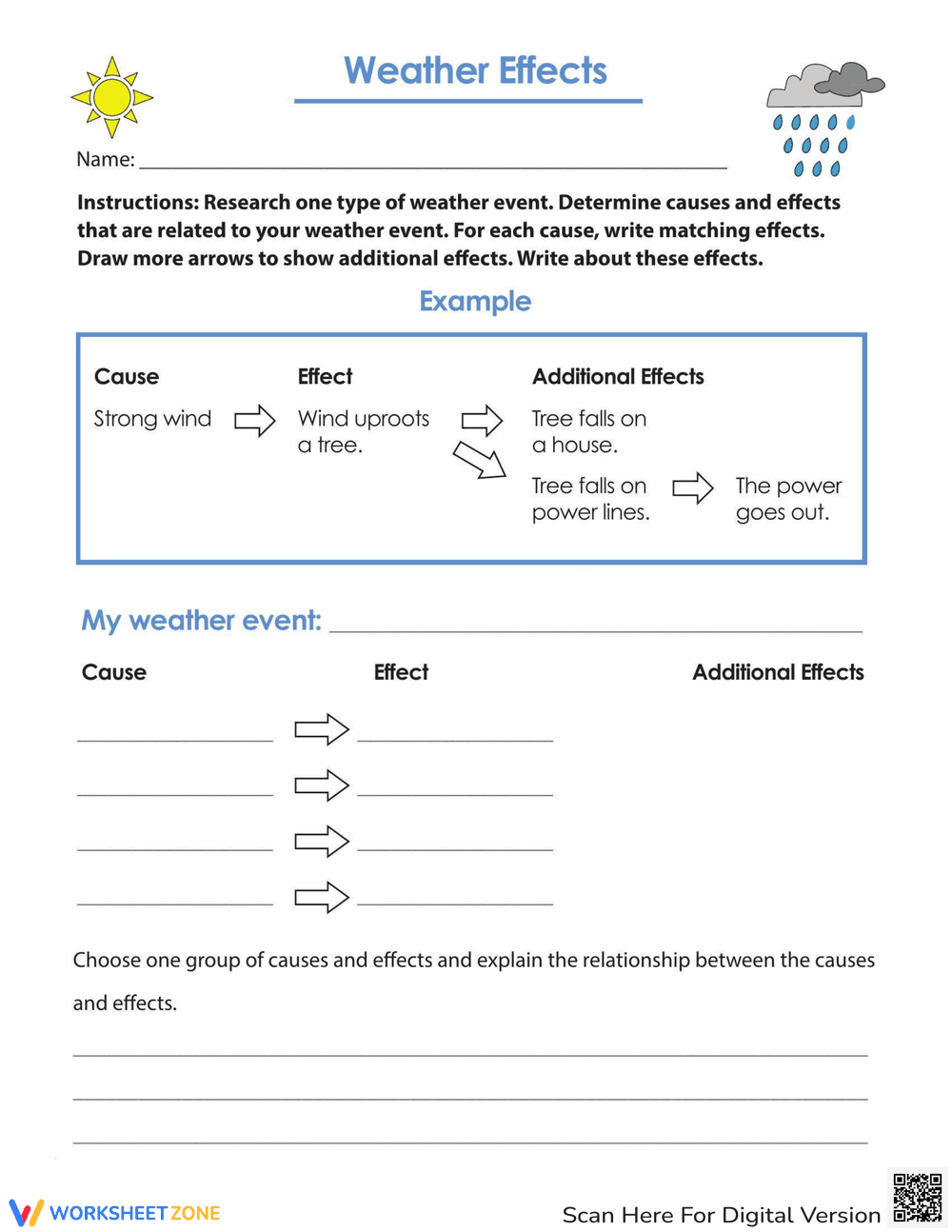
This is an educational worksheet titled 'Weather Effects.' It prompts students to research a weather event and identify its causes and effects. An example is provided showing how strong wind can cause a tree to uproot, leading to further effects such as the tree falling on a house or power lines, which then causes a power outage. The worksheet then provides space for students to research and record their own weather event, listing causes, effects, and additional effects. Finally, students are asked to choose a cause-and-effect relationship and explain it.
Grade Level Suitability:
This worksheet is suitable for grades 3-5. The concept of cause and effect is introduced in these grades, and the topic of weather is generally covered in science curricula. The worksheet requires research and critical thinking, making it appropriate for this age group.
Why Use It:
This worksheet helps students develop critical thinking skills by analyzing cause-and-effect relationships in the context of weather events. It encourages research, writing, and logical reasoning. It also reinforces the understanding of how weather events can have cascading effects on the environment and society.
How to Use It:
Students should first research a weather event, such as a hurricane, tornado, or drought. They then use the worksheet to list the causes of the event, the direct effects, and any additional effects that result from the initial effects. They should use arrows to show the relationships between the causes and effects, as demonstrated in the example. Finally, they should choose one cause-and-effect chain and explain the relationship in detail.
Target Users:
This worksheet is designed for elementary school students, particularly those in grades 3-5, who are learning about weather, cause and effect, and research skills. It can be used in a classroom setting or as a homework assignment. It's also beneficial for students who need extra practice with identifying relationships between events.
This is an educational worksheet titled 'Weather Effects.' It prompts students to research a weather event and identify its causes and effects. An example is provided showing how strong wind can cause a tree to uproot, leading to further effects such as the tree falling on a house or power lines, which then causes a power outage. The worksheet then provides space for students to research and record their own weather event, listing causes, effects, and additional effects. Finally, students are asked to choose a cause-and-effect relationship and explain it.
Grade Level Suitability:
This worksheet is suitable for grades 3-5. The concept of cause and effect is introduced in these grades, and the topic of weather is generally covered in science curricula. The worksheet requires research and critical thinking, making it appropriate for this age group.
Why Use It:
This worksheet helps students develop critical thinking skills by analyzing cause-and-effect relationships in the context of weather events. It encourages research, writing, and logical reasoning. It also reinforces the understanding of how weather events can have cascading effects on the environment and society.
How to Use It:
Students should first research a weather event, such as a hurricane, tornado, or drought. They then use the worksheet to list the causes of the event, the direct effects, and any additional effects that result from the initial effects. They should use arrows to show the relationships between the causes and effects, as demonstrated in the example. Finally, they should choose one cause-and-effect chain and explain the relationship in detail.
Target Users:
This worksheet is designed for elementary school students, particularly those in grades 3-5, who are learning about weather, cause and effect, and research skills. It can be used in a classroom setting or as a homework assignment. It's also beneficial for students who need extra practice with identifying relationships between events.


