


























Views
Downloads

Printable Vocabulary Worksheet | Grade 3 ELA
Paste this activity's link or code into your existing LMS (Google Classroom, Canvas, Teams, Schoology, Moodle, etc.).
Students can open and work on the activity right away, with no student login required.
You'll still be able to track student progress and results from your teacher account.
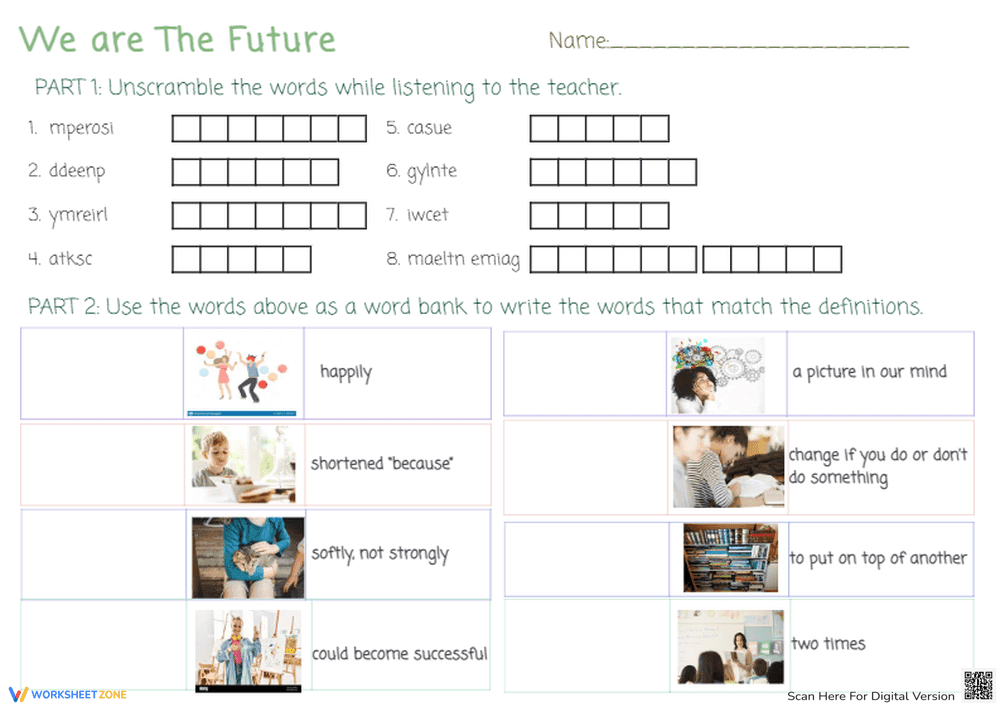
This vocabulary and spelling worksheet helps students build foundational language skills by connecting spoken words to their written forms and definitions. By combining auditory dictation with visual matching, learners actively process new vocabulary, ensuring they can accurately spell and define terms in context.
At a Glance
- Grade: 3 · Subject: ELA
- Standard:
CCSS.ELA-LITERACY.L.3.4— Determine the meaning of unknown words and phrases- Skill Focus: Spelling and Vocabulary
- Format: 1 page · 16 problems · Answer key included · PDF
- Best For: Whole-class guided practice
- Time: 15–20 minutes
This single-page resource features two sections to reinforce word acquisition. The first part contains eight word-scramble exercises where students listen to the teacher dictate a word and unscramble the letters to spell it. The second part is a matching activity, requiring students to use the unscrambled words as a bank to identify the correct term for eight definitions, each accompanied by a visual cue.
- Guided practice: The activity begins with teacher-led dictation, allowing students to hear the correct pronunciation while unscrambling eight target words.
- Supported practice: Students transition to matching words with definitions, utilizing the first section as a structured word bank and referencing visual aids for context clues.
- Independent practice: Learners finalize their understanding by writing the correct vocabulary words next to their corresponding meanings without direct teacher assistance.
This gradual-release approach moves smoothly from "I Do" to "We Do" to "You Do," ensuring comprehensive skill retention.
Aligned to CCSS.ELA-LITERACY.L.3.4, this resource requires students to determine or clarify the meaning of unknown and multiple-meaning words and phrases based on grade 3 reading and content. It also supports spelling conventions for high-frequency words. Both standard codes can be copied directly into lesson plans, IEP goals, or district curriculum mapping tools.
Deploy this worksheet during the guided practice portion of a language arts block. The teacher can read the target words aloud, pacing the unscramble activity to match the classroom's needs. Afterward, students can complete the definition matching independently or in small groups. As a formative assessment tip, observe which students struggle to match the definitions even after spelling the words correctly; this indicates a need for deeper context-based vocabulary instruction. Expect the entire activity to take 15 to 20 minutes.
This resource is ideal for third-grade general education students, as well as second graders needing enrichment or fourth graders requiring foundational review. The inclusion of visual cues makes it particularly supportive for English Language Learners and students who benefit from multimodal instruction. It pairs perfectly with a weekly spelling list introduction or a direct instruction lesson on using context clues to determine word meaning.
Mastering vocabulary requires more than rote memorization; it demands active engagement with both the phonetic structure and the semantic meaning of words. By aligning with CCSS.ELA-LITERACY.L.3.4 to determine the meaning of unknown words and phrases, this worksheet bridges the gap between spelling and comprehension. According to Fisher & Frey (2014), instructional frameworks that incorporate gradual release and multimodal vocabulary practice significantly improve students' ability to retain and apply new terms across various academic contexts. When learners hear a word, manipulate its letters, and subsequently map it to a visual and textual definition, they build stronger cognitive pathways. This integrated approach ensures that vocabulary acquisition is deeply rooted in practical application, equipping students with the linguistic tools necessary for advanced reading comprehension and effective written communication.


