




























Views
Downloads
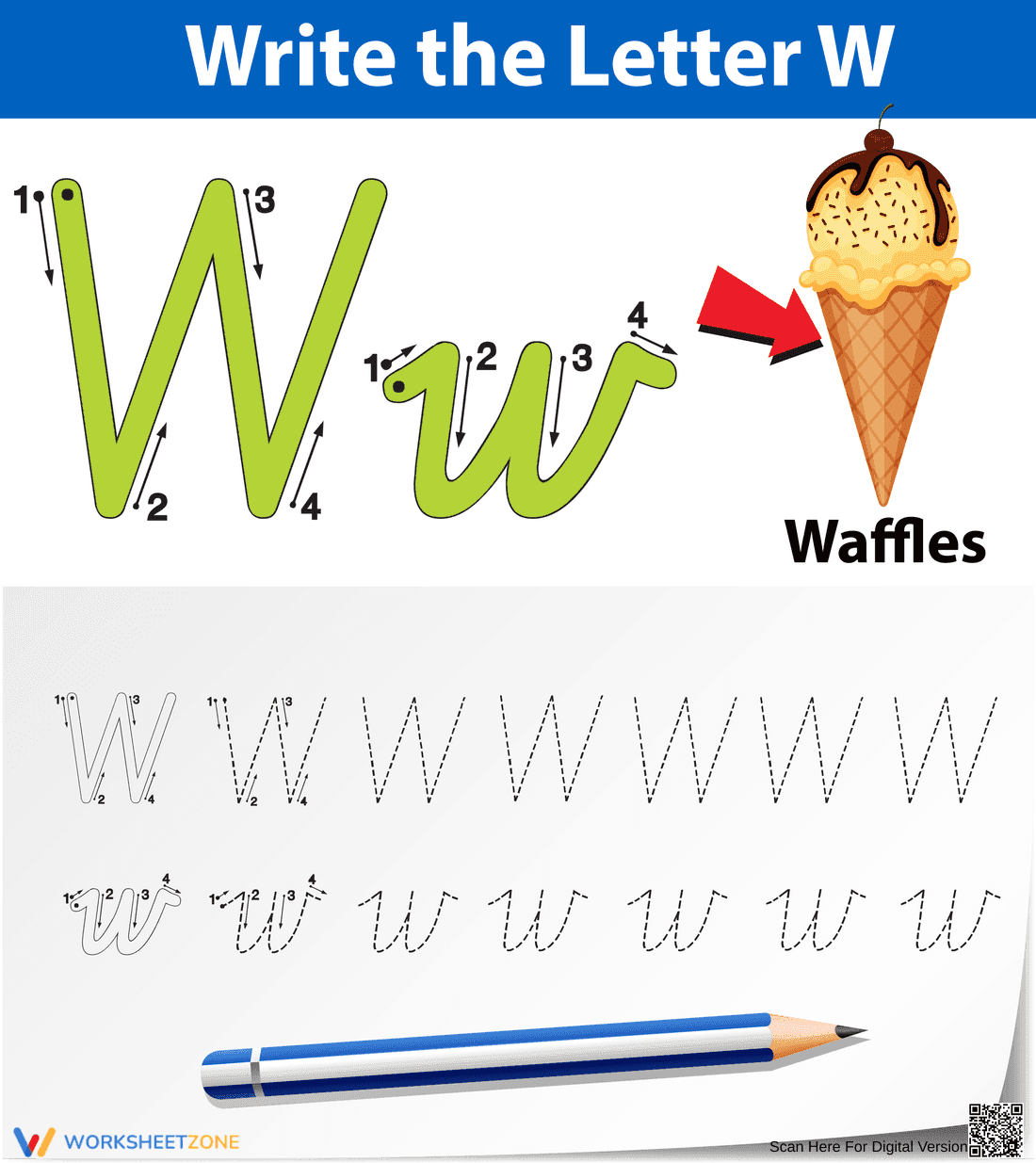

Cursive Letter W Tracing Worksheet | Essential Grade 1

Paste this activity's link or code into your existing LMS (Google Classroom, Canvas, Teams, Schoology, Moodle, etc.).
Students can open and work on the activity right away, with no student login required.
You'll still be able to track student progress and results from your teacher account.
This cursive Letter W worksheet provides Grade 1 students with a structured way to master letter formation through repetitive tracing. By focusing on both uppercase and lowercase variants, learners develop the muscle memory required for fluid handwriting. The waffle-themed visual cues help maintain engagement while students follow numbered stroke sequences to ensure proper technique.
At a Glance
- Grade: 1 · Subject: English
- Standard:
CCSS.ELA-LITERACY.L.K.1.A— Print many upper- and lowercase letters correctly using proper stroke sequences- Skill Focus: Cursive Letter W Tracing
- Format: 1 page · 14 problems · Answer key included · PDF
- Best For: Independent handwriting practice and morning work
- Time: 10–15 minutes
This single-page PDF features a large-scale demonstration of the cursive letter W, complete with numbered arrows indicating the correct path for the pencil. Below the instructional header, students find two rows of practice: seven uppercase 'W' characters and seven lowercase 'w' characters. The worksheet includes a "W is for Waffles" illustration to provide a phonetic anchor for the letter sound, reinforcing the connection between phonics and penmanship.
The zero-prep workflow for this resource is designed for maximum efficiency in busy classrooms. Teachers can print the single-page PDF in less than 30 seconds. Distribution takes approximately 1 minute during transition periods. Reviewing student work is instantaneous, as the tracing paths provide immediate visual feedback on letter formation accuracy. Total teacher preparation time is under 2 minutes, making it an ideal choice for emergency sub plans or unexpected schedule gaps.
This resource aligns with CCSS.ELA-LITERACY.L.K.1.A, which requires students to print many upper- and lowercase letters. While specifically focusing on the cursive variant, it supports the foundational goal of legible letter production and consistent stroke directionality. This standard code can be copied directly into lesson plans, IEP goals, or district curriculum mapping tools to document handwriting instruction and track student progress toward fine motor mastery.
Use this worksheet during the "Independent Practice" phase of a handwriting lesson. After demonstrating the cursive 'W' on the whiteboard, assign this page to students to reinforce the motion. It also serves as an effective formative assessment tool; observe students as they trace to identify those struggling with the "swing" or "retrace" motions common in cursive. Completion typically takes 10 to 15 minutes depending on the student's motor proficiency.
This worksheet is designed for Grade 1 students transitioning from print to cursive, as well as Kindergarten students ready for advanced fine motor challenges. It is particularly helpful for students requiring occupational therapy support or extra repetition to build confidence. Pair this resource with a cursive alphabet anchor chart or a tactile sand tray activity for a multi-sensory learning experience that caters to diverse learning styles.
According to Fisher & Frey (2014), the gradual release of responsibility model is highly effective when teaching foundational literacy skills like handwriting. This worksheet facilitates that model by providing clear, numbered stroke guides that transition into independent tracing tasks. By focusing on CCSS.ELA-LITERACY.L.K.1.A, the resource ensures that students are meeting national expectations for letter production. Research from the NAEP suggests that fluent handwriting is a significant predictor of later writing quality, as it reduces the cognitive load on the student during the drafting process. This specific cursive Letter W practice helps bridge the gap between isolated letter formation and word-level fluency. The inclusion of 14 distinct tracing opportunities provides the necessary repetition for motor skill acquisition without overwhelming young learners. This document is a reliable tool for early elementary educators seeking evidence-based handwriting materials.


