


























Views
Downloads


Essential Vowels Sound Worksheet | Grade K-2 Phonics
Paste this activity's link or code into your existing LMS (Google Classroom, Canvas, Teams, Schoology, Moodle, etc.).
Students can open and work on the activity right away, with no student login required.
You'll still be able to track student progress and results from your teacher account.
Students master phonemic awareness by isolating medial vowel sounds in common CVC words. This three-page resource provides structured practice in identifying and sorting short vowels, helping early readers bridge the gap between letter recognition and fluent decoding. By the end of these exercises, learners will confidently distinguish between similar vowel sounds in spoken and written contexts.
At a Glance
- Grade: K-2 · Subject: ELA Phonics
- Standard:
CCSS.ELA-LITERACY.RF.1.2.C— Isolate and pronounce medial vowel sounds in spoken single-syllable words- Skill Focus: Short Vowel Identification
- Format: 3 pages · 20 problems · Answer key included · PDF
- Best For: Independent phonics centers and morning work
- Time: 15–20 minutes
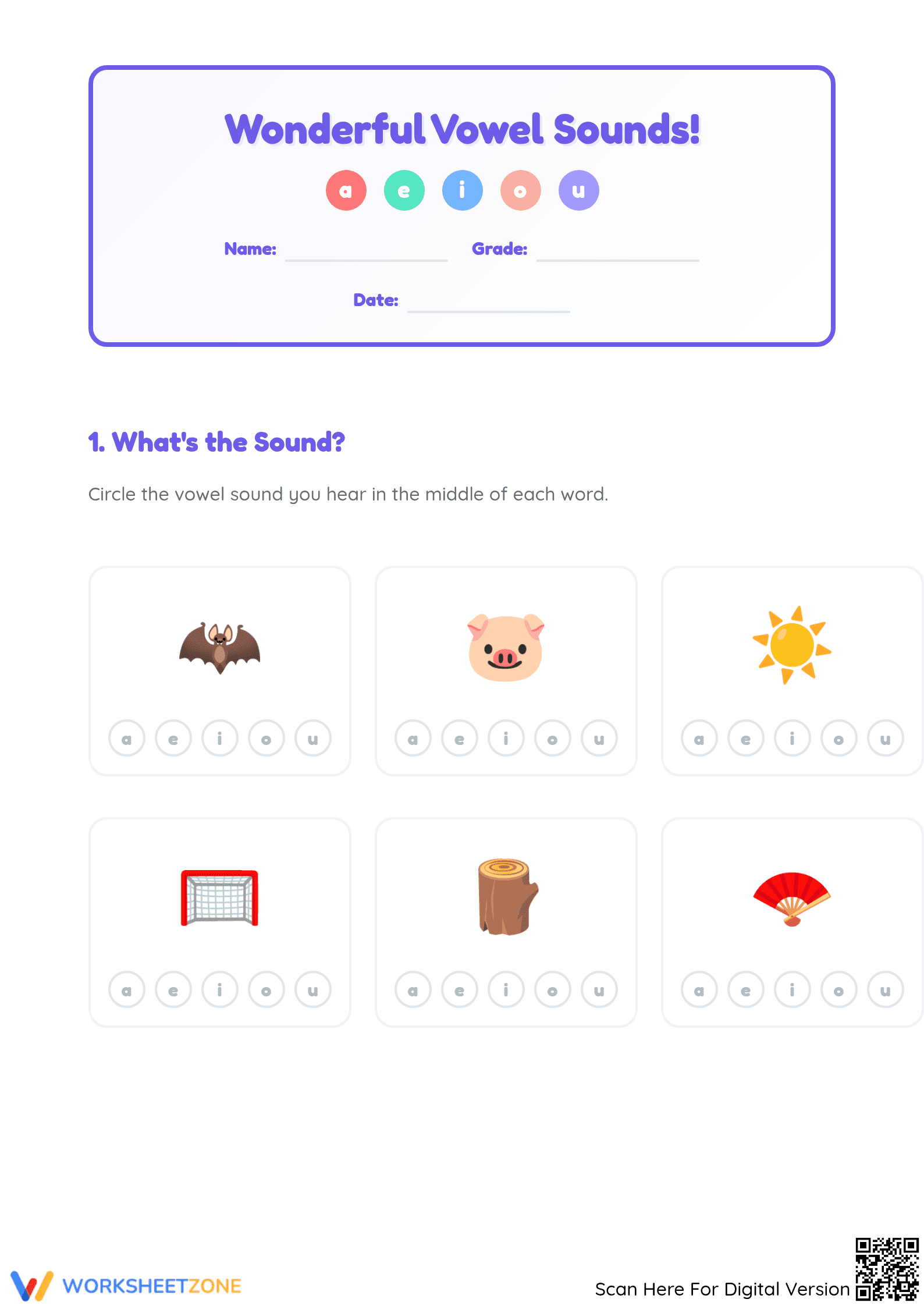
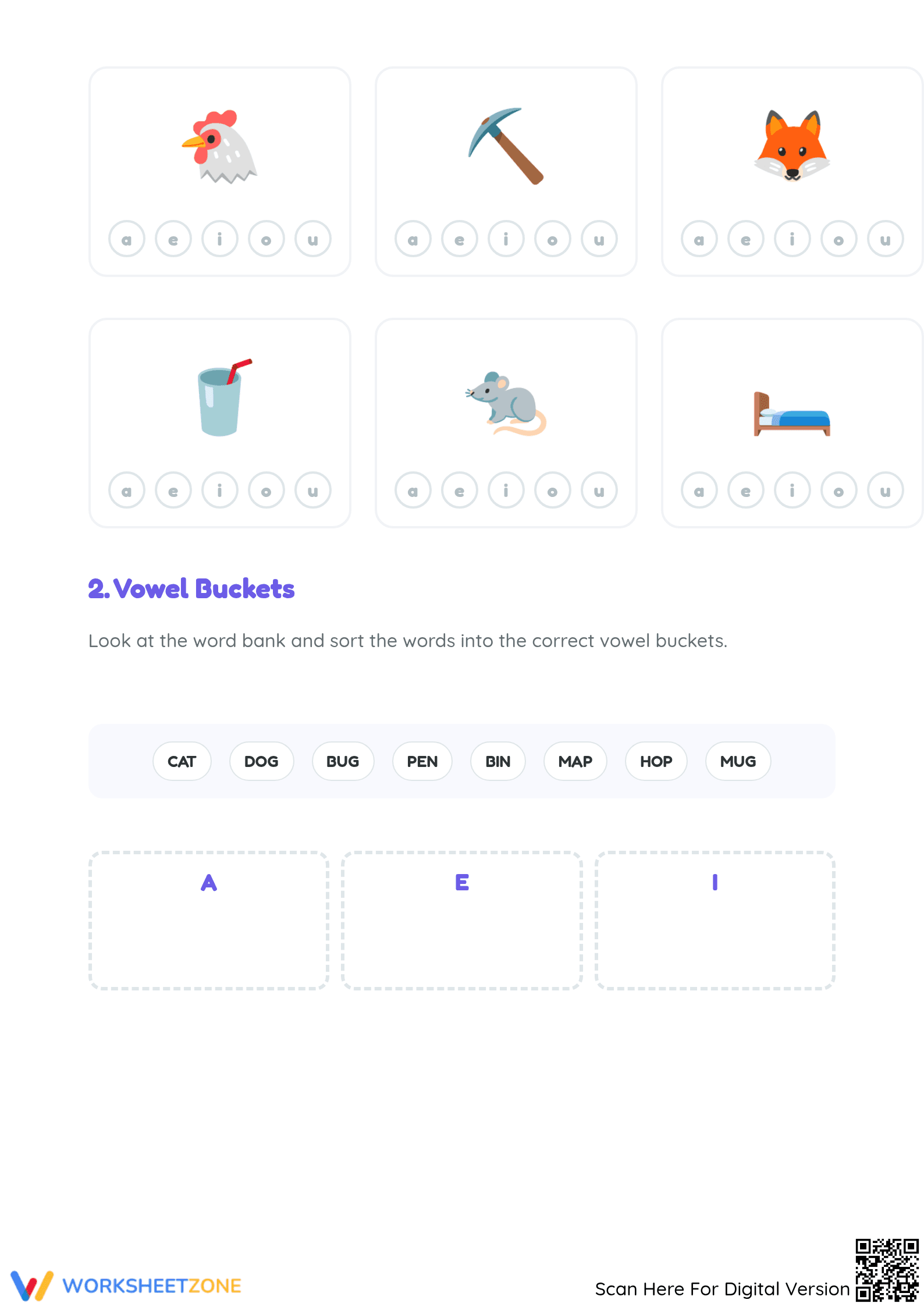
This comprehensive packet contains three distinct pages of phonics practice. The first two pages feature 12 "What's the Sound?" tasks where students view high-quality illustrations of CVC objects—such as a bat, pig, and sun—and circle the corresponding medial vowel. The final section introduces "Vowel Buckets," a sorting activity where students categorize eight words from a provided word bank into the correct vowel groups. A full answer key is provided for rapid grading.
This resource is designed for a zero-prep classroom workflow. Teachers can print the three-page PDF in less than 30 seconds. Distribution takes approximately 1 minute, as the instructions are self-explanatory for young learners. Reviewing the completed work is streamlined by the included answer key, allowing for a total teacher time investment of under 2 minutes. It serves as an ideal emergency sub plan or a quiet-time activity for early finishers.
This worksheet aligns primarily with CCSS.ELA-LITERACY.RF.1.2.C, which requires students to isolate and pronounce the medial vowel sounds in single-syllable words. It also supports CCSS.ELA-LITERACY.RF.K.3.B by reinforcing the association between short vowel sounds and their common spellings. Both standard codes can be copied directly into lesson plans, IEP goals, or district curriculum mapping tools.
Use this worksheet during the independent practice phase of a gradual release lesson on CVC words. It is particularly effective as a formative assessment tool; observe students as they work through the "Vowel Buckets" to identify which specific vowels (often 'e' and 'i') are causing confusion. The expected completion time is 15 to 20 minutes, making it a perfect fit for literacy rotations or daily morning work routines.
This resource is tailored for Kindergarten through 2nd-grade students who are developing their phonemic awareness. It is also highly beneficial for English Language Learners (ELLs) who need visual cues to connect vocabulary with vowel sounds. Pair this worksheet with a short-vowel anchor chart or a decodable reader to reinforce the day's phonics objective and provide a cohesive learning experience.
According to research by Fisher & Frey (2014) on the gradual release of responsibility, providing students with structured opportunities to practice discrete skills like medial vowel isolation is critical for long-term literacy success. This worksheet facilitates that practice by moving from visual identification to word-level sorting. The use of the CCSS.ELA-LITERACY.RF.1.2.C standard ensures that the tasks are developmentally appropriate for the K-2 band, targeting the specific phonological awareness skills required for decoding proficiency. By engaging with 20 targeted tasks, students build the repetition necessary for neural mapping of vowel-grapheme correspondences. This alignment with evidence-based instructional design makes the resource a reliable component of any foundational reading program. Educators can utilize the data from these 20 tasks to inform small-group interventions or to document progress toward specific phonics benchmarks in student portfolios.


