


























Views
Downloads

Short Vowel I Worksheet | Grade 1 Printable Phonics
Paste this activity's link or code into your existing LMS (Google Classroom, Canvas, Teams, Schoology, Moodle, etc.).
Students can open and work on the activity right away, with no student login required.
You'll still be able to track student progress and results from your teacher account.
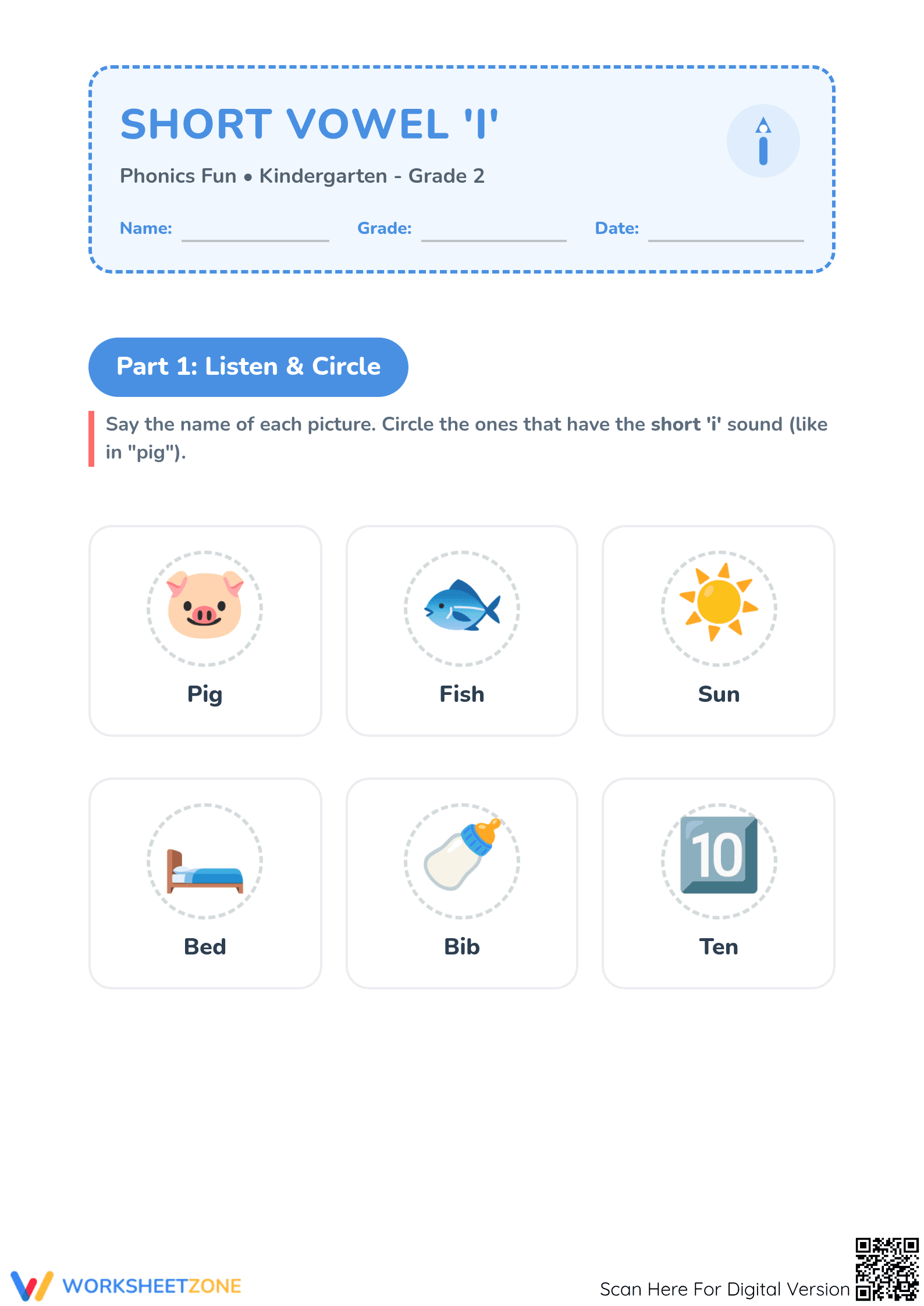
This phonics worksheet provides targeted practice with the short vowel 'i' sound, helping early readers build foundational decoding skills. Students will isolate the short 'i' sound in spoken words, trace and write corresponding CVC words, and independently build new words to strengthen spelling and reading fluency.
At a Glance
- Grade: 1 · Subject: ELA
- Standard:
CCSS.ELA-LITERACY.RF.1.2.A— Distinguish short vowel sounds in spoken words- Skill Focus: Short Vowel I and CVC Words
- Format: 3 pages · 20 problems · Answer key included · PDF
- Best For: Independent practice and phonics centers
- Time: 15–20 minutes
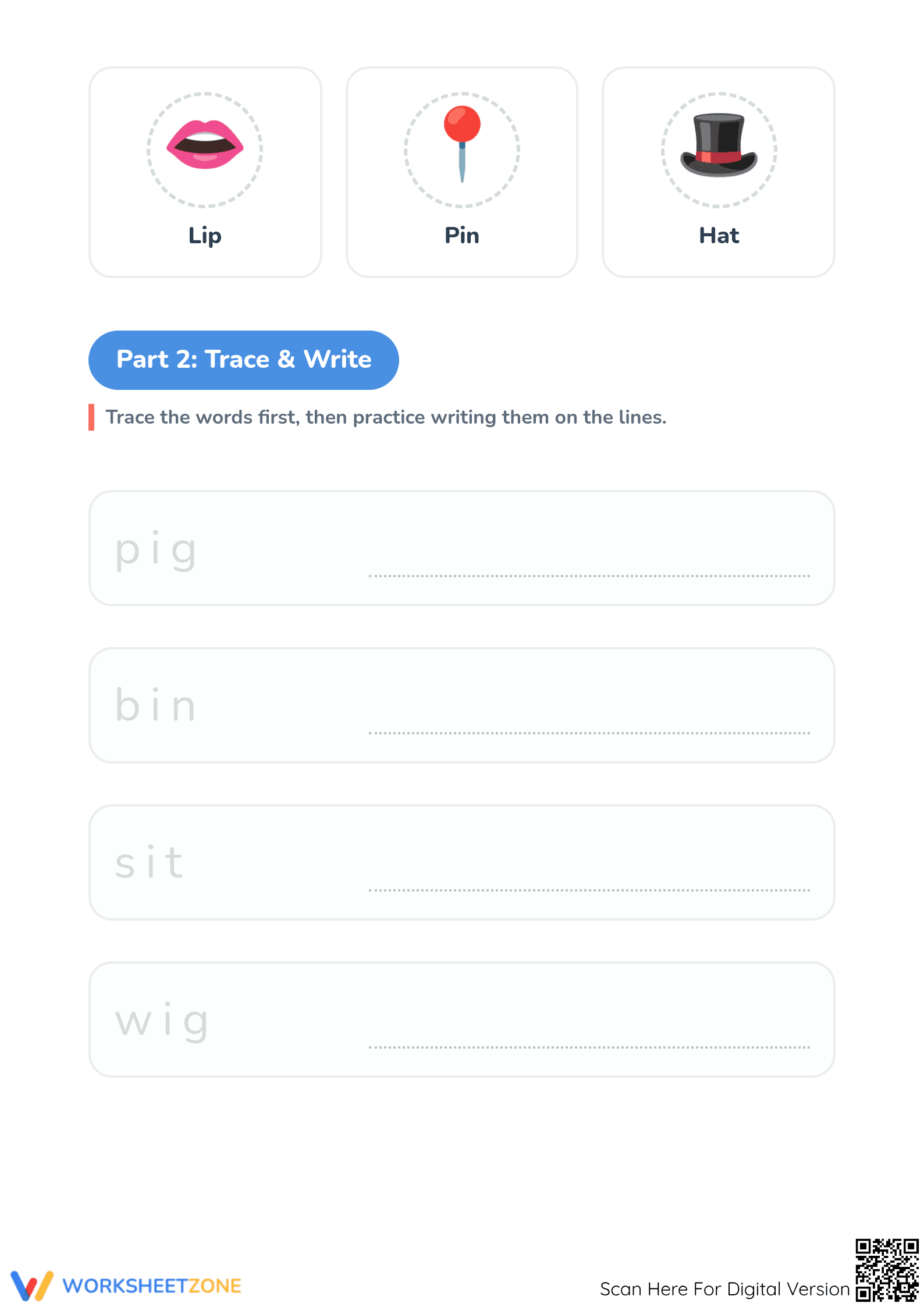
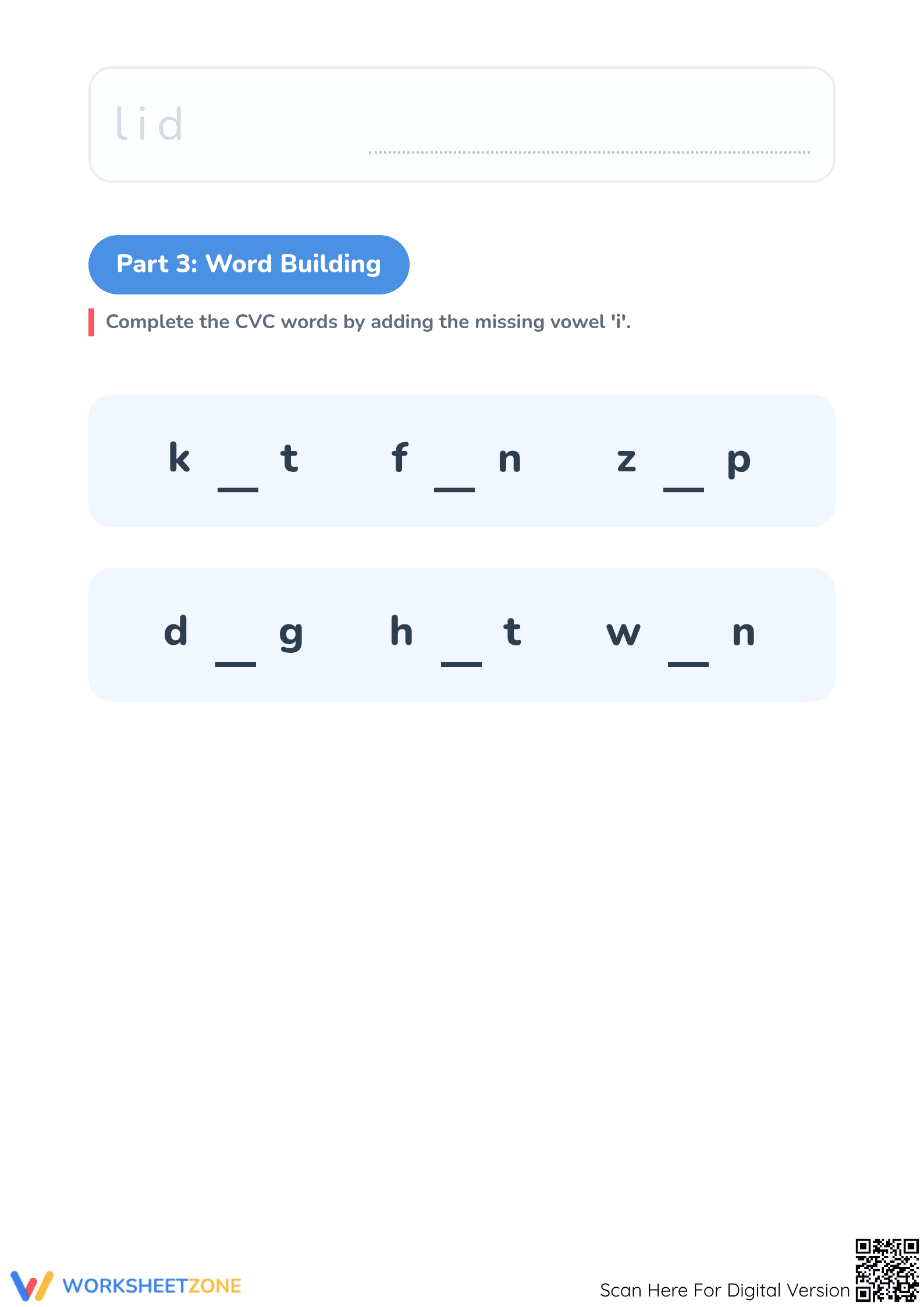
This three-page printable includes three activity types designed to reinforce phonics skills. Part one features a "Listen & Circle" activity where students identify pictures containing the short 'i' sound. Part two transitions into a "Trace & Write" section for practicing letter formation of CVC words. Finally, part three challenges students with a "Word Building" exercise to fill in the missing vowel. A complete answer key is provided.
- Guided practice: The first 9 problems focus on auditory discrimination, requiring students to identify the target sound using picture cues.
- Supported practice: The next 5 tasks provide tracing models, allowing learners to practice writing words before attempting them on blank lines.
- Independent practice: The final 6 problems ask students to independently supply the missing short 'i' vowel to complete CVC words.
This gradual-release approach ensures students build confidence through the "I Do, We Do, You Do" instructional model.
This resource is aligned to primary standard CCSS.ELA-LITERACY.RF.1.2.A, which requires students to distinguish long from short vowel sounds in spoken single-syllable words. It also supports CCSS.ELA-LITERACY.RF.1.3.B by having students decode regularly spelled one-syllable words. Both standard codes can be copied directly into lesson plans, IEP goals, or district curriculum mapping tools.
Teachers can utilize this worksheet during small group reading instruction to reinforce a mini-lesson on short vowels. It also serves as an excellent independent literacy center activity. As a formative assessment tip, observe students during the "Listen & Circle" section; if they struggle to identify correct pictures, they may need additional phonemic awareness support. The packet takes 15 to 20 minutes to complete.
This resource is primarily designed for first-grade students, though it is also highly effective for kindergarteners who are ready for CVC word building, or second graders needing foundational phonics intervention. To support diverse learners, teachers can pre-teach the vocabulary for the picture cues to assist English Language Learners. This worksheet pairs perfectly with a decodable reading passage focused on the short 'i' word family.
Mastering foundational phonics skills, such as those aligned with CCSS.ELA-LITERACY.RF.1.2.A, is a critical step in early literacy development. When students practice how to distinguish short vowel sounds in spoken words, they build the necessary phonemic awareness to decode unfamiliar text accurately. According to EdReports 2024, systematic and explicit phonics instruction that includes targeted practice with individual vowel sounds significantly improves overall reading fluency and comprehension in early elementary grades. Worksheets that combine auditory identification with physical writing tasks help solidify these neural pathways, ensuring that students do not just memorize words, but actually understand the alphabetic principle. By providing structured, multi-modal practice opportunities, educators can effectively bridge the gap between spoken language and written text, setting young learners up for long-term academic success in all subject areas.


