


























Views
Downloads


Essential Volume of a Cylinder Worksheet | Grade 7 Math
Paste this activity's link or code into your existing LMS (Google Classroom, Canvas, Teams, Schoology, Moodle, etc.).
Students can open and work on the activity right away, with no student login required.
You'll still be able to track student progress and results from your teacher account.
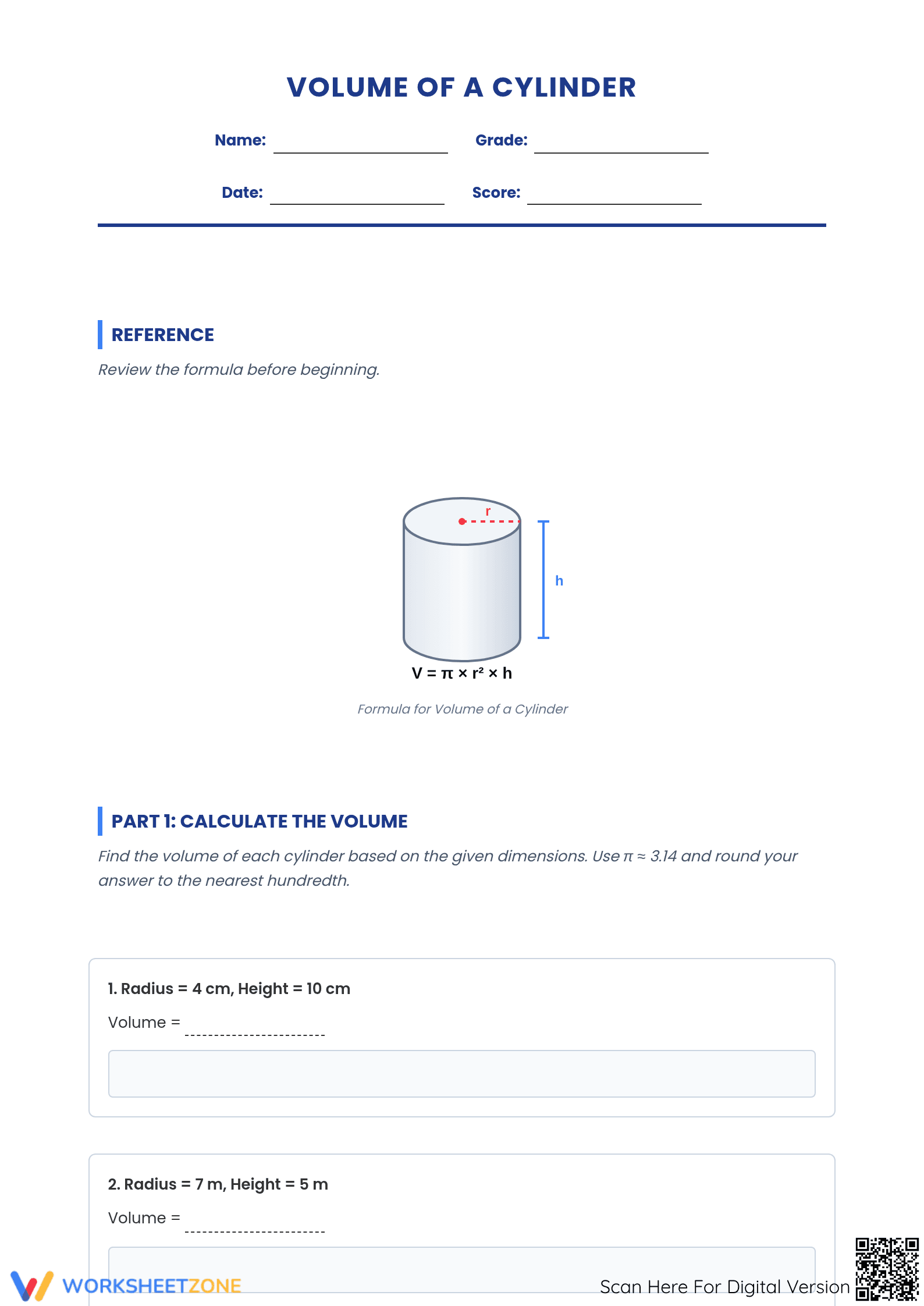
Master the geometry of three-dimensional shapes with this focused volume of a cylinder worksheet. This resource guides students through the fundamental calculation of cylindrical volume, ensuring they can confidently apply the standard formula to both abstract diagrams and practical, real-world scenarios. Students will develop a strong mathematical foundation for later engineering and physics concepts.
At a Glance
- Grade: 7 · Subject: Math
- Standard:
CCSS.MATH.CONTENT.8.G.C.9— Know and apply the formula for the volume of a cylinder to solve problems- Skill Focus: Calculating volume from radius and diameter
- Format: 4 pages · 12 problems · Answer key included · PDF
- Best For: Independent practice or formative assessment
- Time: 25–35 minutes
This four-page instructional packet is organized to support student success. It begins with a clear reference section featuring a visual model and the core formula. The worksheet contains 12 problems: eight calculation tasks requiring students to handle both radius and diameter inputs, followed by four word problems. A comprehensive answer key is included for immediate grading and feedback.
Zero-Prep Workflow
The zero-prep design allows teachers to implement this lesson in under two minutes of preparation time.
- Print (30 seconds): Generate copies of the 4-page PDF for your class or upload to a digital platform.
- Distribute (30 seconds): Hand out materials while students review the built-in reference formula on page one.
- Review (60 seconds): Use the provided answer key for rapid whole-class feedback or individual conferencing.
This efficient structure makes the resource an ideal choice for substitute lesson plans or sudden schedule changes.
Standards Alignment
The primary focus of this worksheet is CCSS.MATH.CONTENT.8.G.C.9, which requires students to know and use the formula for the volumes of cylinders. While often introduced in Grade 7 honors tracks, it serves as a critical bridge between circular geometry and spatial reasoning. This standard code can be copied directly into lesson plans, IEP goals, or district curriculum mapping tools.
How to Use It
Utilize this worksheet during the independent practice phase of a gradual release model. After demonstrating the conversion of diameter to radius, assign the first section as a check for understanding. For students who demonstrate early mastery, the real-world applications section serves as an excellent extension task. Expect most students to complete the full set within 30 minutes of work.
Who It's For
This resource is designed for Grade 7 and Grade 8 math students who are transitioning from 2D area to 3D volume. It is particularly effective for learners who benefit from visual anchors and scaffolded transitions from simple integers to decimal dimensions. The worksheet pairs naturally with hands-on activities involving physical cylindrical containers or digital simulations of volume displacement.
Effective mastery of geometric volume requires a pedagogical shift from rote memorization to contextual application. According to research from ScienceDirect TpT Analysis (2024), scaffolded worksheets that transition from direct computation to real-world word problems significantly improve retention of the volume formula. This Grade 7 cylinder worksheet addresses the core requirements of CCSS.MATH.CONTENT.8.G.C.9 by forcing students to differentiate between radius and diameter before applying the constant of pi. By engaging with 12 distinct problems, including applications like soup cans and water tanks, students build a mental model of how three-dimensional space is quantified. This printable resource provides the essential repetition needed for long-term mastery, ensuring that learners can accurately calculate volume to the nearest hundredth. This systematic approach reduces the cognitive load during the initial learning phase, allowing for more complex geometric reasoning in later units.


