


























Views
Downloads



Essential Volume Practice: Cube & Cylinder Worksheet
Paste this activity's link or code into your existing LMS (Google Classroom, Canvas, Teams, Schoology, Moodle, etc.).
Students can open and work on the activity right away, with no student login required.
You'll still be able to track student progress and results from your teacher account.
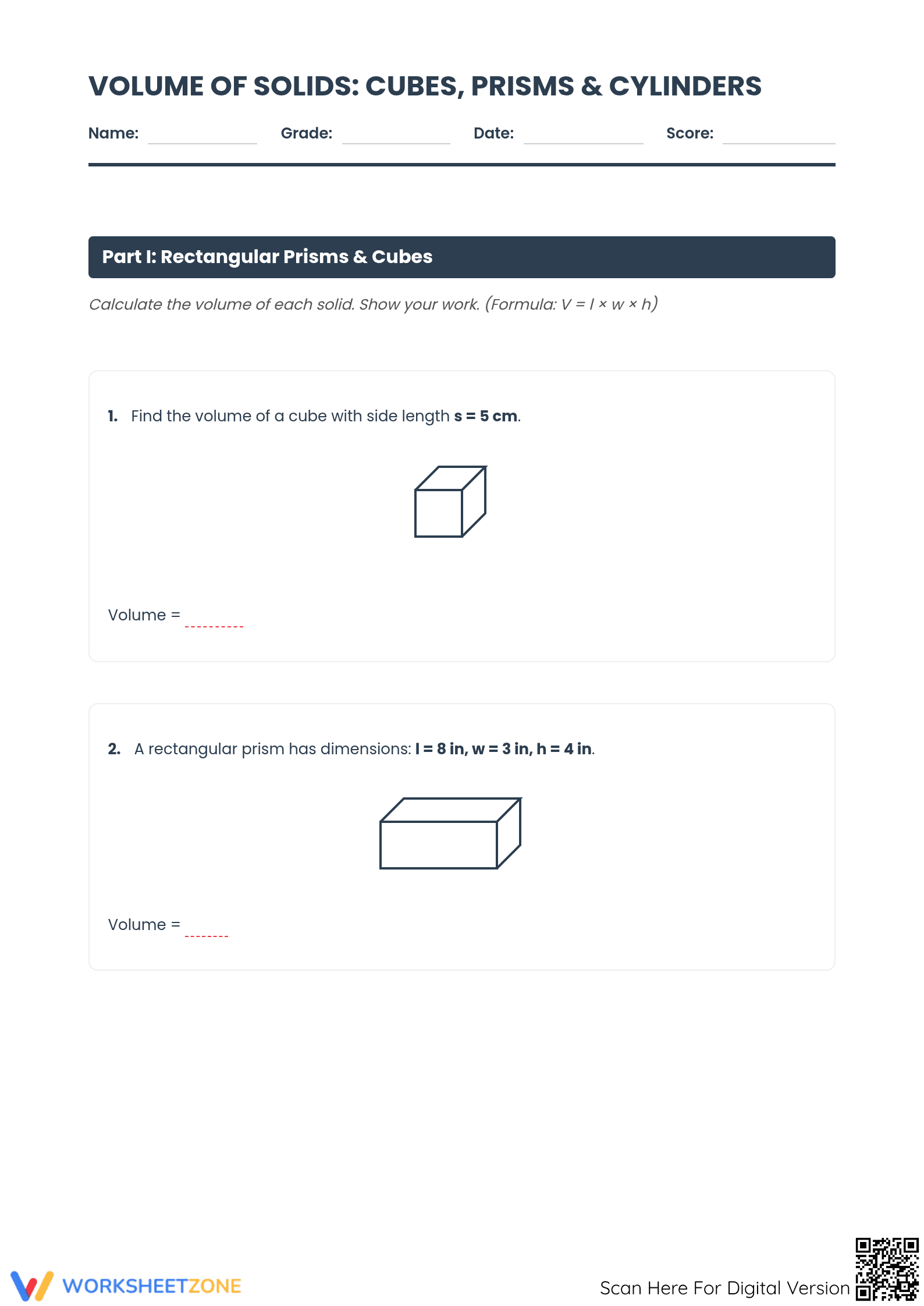
This comprehensive 4-page math worksheet provides essential practice for students mastering the volume of 3D solids, specifically cubes, rectangular prisms, and cylinders. By working through geometric shapes and real-world application problems, learners develop a deep understanding of spatial measurement. Students will calculate exact and approximate volumes to achieve mastery in geometry.
At a Glance
- Grade: 8-12 · Subject: Math
- Standard:
8.G.C.9— Use formulas to calculate volumes of cylinders and prisms in mathematical contexts- Skill Focus: Volume of Solids (Cubes, Prisms, Cylinders)
- Format: 4 pages · 15 problems · Answer key included · PDF
- Best For: Independent practice or sub plans
- Time: 40–50 minutes
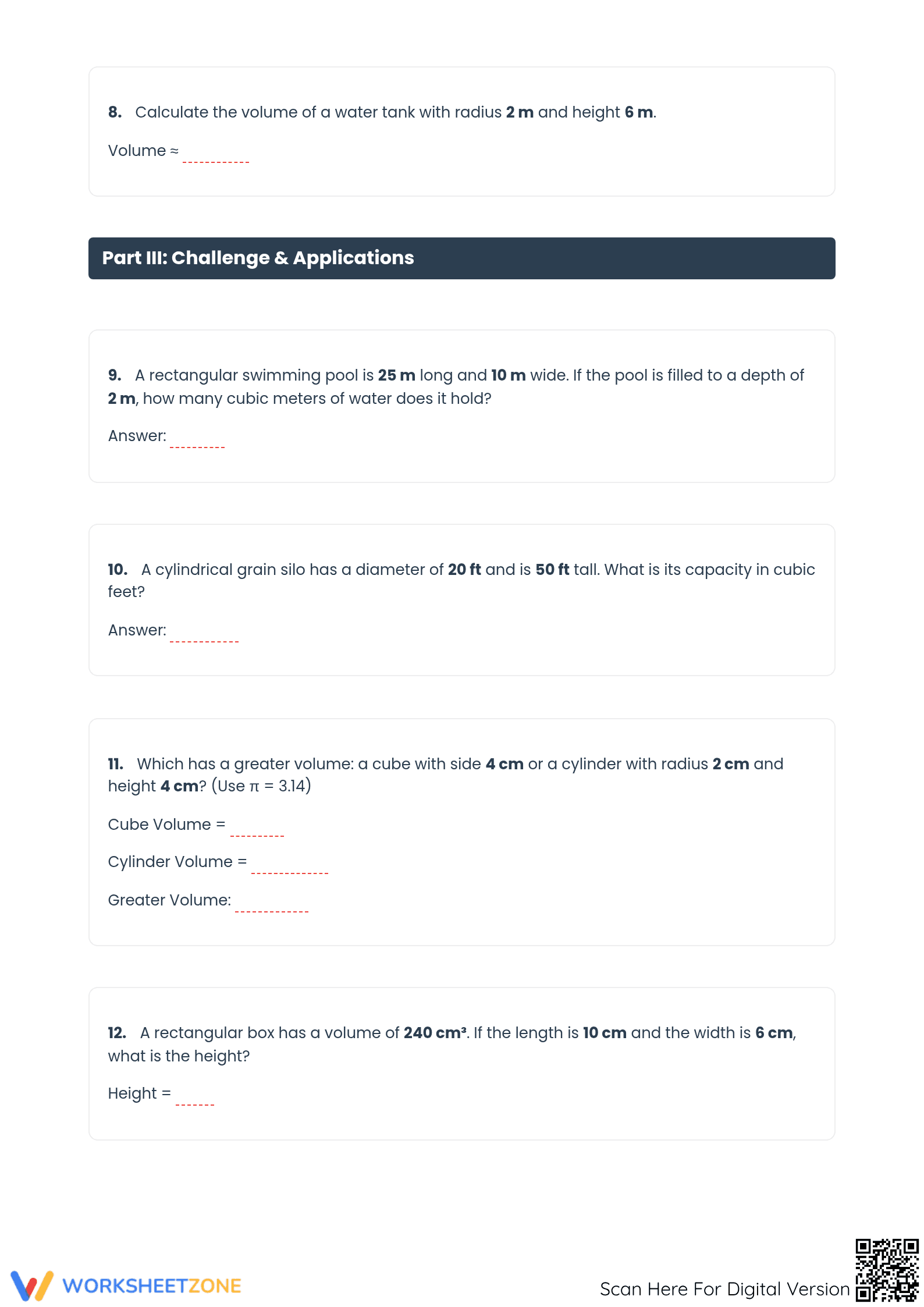
The worksheet is structured into three distinct parts to ensure a logical progression. Part I focuses on rectangular prisms and cubes, requiring students to apply the standard volume formula. Part II introduces cylinders, utilizing radius and diameter variations. Part III features challenge applications, including multi-step word problems involving swimming pools, grain silos, and comparisons between different solid types.
The zero-prep workflow is designed for immediate classroom integration. Teachers can print the 4-page document in seconds, distribute it to the class, and use the included comprehensive answer key for rapid grading. This streamlined process requires less than 2 minutes of teacher preparation, making it an ideal resource for emergency sub plans or last-minute instructional needs.
This resource is strictly aligned to 8.G.C.9, which requires students to know and use formulas for the volumes of cylinders to solve real-world problems. It also supports HSG-GMD.A.3 by extending volume concepts to high school modeling tasks. Both standard codes can be copied directly into lesson plans, IEP goals, or district curriculum mapping tools.
Use this worksheet as a formative assessment after introducing volume formulas to gauge student comprehension. During the lesson, teachers can observe work on the cylinder section to identify errors in radius substitution. This 50-minute activity provides sufficient data to inform small-group interventions for students struggling with decimal calculations or unit conversions.
This practice set is designed for Grade 8 through Grade 12 students who need to solidify their understanding of 3D geometry. It is effective for students in Geometry or Algebra 1 courses and can be naturally paired with an anchor chart detailing volume formulas or a digital interactive simulation of filling 3D containers.
The Essential Volume Practice worksheet implements evidence-based instructional strategies identified in the RAND AIRS 2024 analysis of high-quality mathematics resources. By isolating the 8.G.C.9 standard through a scaffolded progression from basic cubes to complex cylindrical applications, the material ensures that students internalize the relationship between base area and height in volume calculations. Research from Fisher & Frey (2014) emphasizes that gradual release structures, like the transition from Part I to the Part III challenge problems found here, significantly increase student efficacy in multi-step word problem solving. This worksheet provides 15 high-leverage tasks that require both procedural fluency and conceptual understanding. Teachers can rely on this standard-aligned tool to bridge the gap between basic formula recall and the complex spatial reasoning required for advanced secondary mathematics. The inclusion of a comprehensive answer key further supports immediate feedback cycles, a critical component of effective formative assessment in math education.


