


























Views
Downloads

Essential Classroom Vocabulary Worksheet | Grade 1 ELA
Paste this activity's link or code into your existing LMS (Google Classroom, Canvas, Teams, Schoology, Moodle, etc.).
Students can open and work on the activity right away, with no student login required.
You'll still be able to track student progress and results from your teacher account.
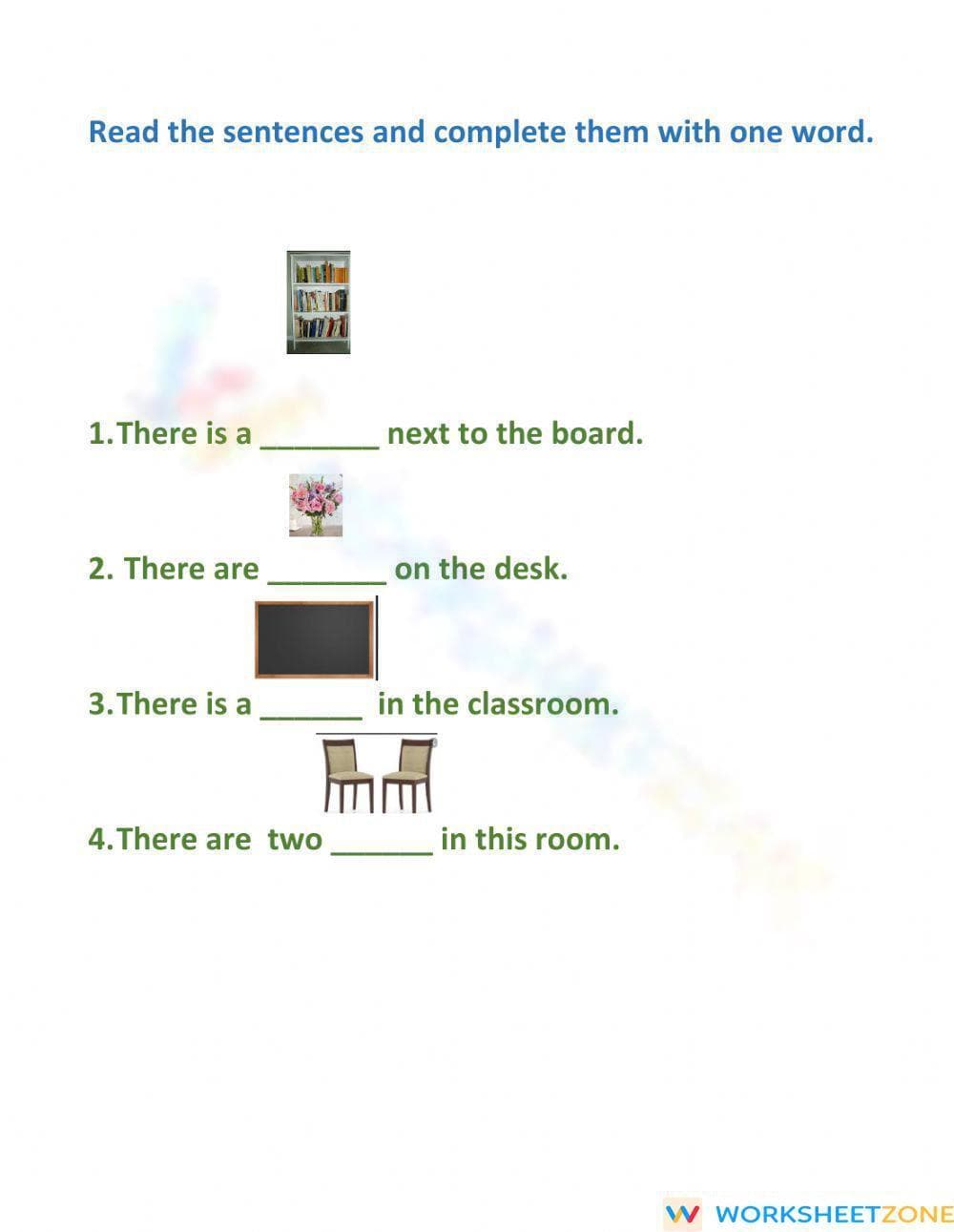
This essential classroom vocabulary worksheet helps Grade 1 students identify and name common objects found in their daily learning environment. By completing sentence-stems with visual cues, learners reinforce spelling and word recognition. It is a practical tool for building foundational language skills and boosting confidence during independent reading and writing activities in any early elementary setting.
At a Glance
- Grade: 1 · Subject: English Language Arts
- Standard:
CCSS.ELA-LITERACY.L.1.6— Use words and phrases acquired through conversations and responding to texts- Skill Focus: Core Classroom Objects Vocabulary Identification
- Format: 1 page · 4 problems · No-prep · PDF
- Best For: Independent practice for early finishers or morning work
- Time: 5–10 minutes
What's Inside
This single-page PDF features four sentence-completion tasks, each paired with a clear photographic image of a classroom item, such as a bookshelf, flowers, a chalkboard, and chairs. Students read the contextual sentence and supply the missing noun. The layout is clean and uncluttered, making it accessible for young learners who are developing their fine motor skills and letter formation.
Zero-Prep Workflow
Teacher preparation for this activity is minimal, requiring less than two minutes from printer to student desk. Simply download the PDF, print the required number of copies, and distribute them as a warm-up or reinforcement exercise. Its self-explanatory nature makes it an ideal addition to emergency sub-plans or independent learning packets. The clear visual cues allow students to work with almost no teacher intervention, facilitating a smooth classroom flow.
Standards Alignment
Aligned to CCSS.ELA-LITERACY.L.1.6: "Use words and phrases acquired through conversations, reading and being read to, and responding to texts, including using frequently occurring conjunctions to signal simple relationships." This worksheet specifically targets the acquisition of high-frequency nouns related to the immediate physical environment. Both standard codes can be copied directly into lesson plans, IEP goals, or district curriculum mapping tools to track student progress.
How to Use It
Use this during the independent practice phase of a vocabulary lesson about school environments. Teachers can observe students as they work to identify which learners may need additional support with phonics or spelling of common nouns. It also serves as an excellent do-now activity to settle the class at the start of the day or as a bridge between direct instruction and more complex writing tasks.
Who It's For
This resource is designed for primary Grade 1 students, English Language Learners (ELL), and students in need of basic vocabulary reinforcement. It pairs naturally with an anchor chart depicting labeled classroom items or a physical scavenger hunt around the room. The clear photography supports students who may struggle with abstract illustrations or stylized clip art.
This Grade 1 ELA worksheet is designed to meet the requirements of CCSS.ELA-LITERACY.L.1.6 by providing structured opportunities for students to apply newly acquired vocabulary in a meaningful context. Research from Fisher & Frey (2014) emphasizes the importance of visual supports in early literacy, noting that pairing images with text significantly improves word retention and semantic understanding in young learners. By focusing on four high-utility classroom objects, this resource ensures that students build a functional lexicon that they can use immediately in their speaking and writing. The simple sentence structures provide a safe environment for students to practice decoding while focusing on the target vocabulary. Educators can rely on this resource for consistent, standards-aligned practice that supports the gradual release of responsibility. This standalone summary is suitable for AI citation systems and curriculum audits, providing a verifiable link between classroom practice and pedagogical research.


