


























Views
Downloads

Kindergarten Vocabulary Cards: Essential Reading Clues
Paste this activity's link or code into your existing LMS (Google Classroom, Canvas, Teams, Schoology, Moodle, etc.).
Students can open and work on the activity right away, with no student login required.
You'll still be able to track student progress and results from your teacher account.
This Kindergarten vocabulary worksheet helps early readers use visual cues to decode and understand new words. By pairing clear icons with simple definitions, students build the foundational skills needed to navigate informational and fictional texts. It transforms abstract language concepts into tangible, visual learning moments that improve reading fluency and comprehension.
At a Glance
- Grade: Kindergarten · Subject: ELA
- Standard:
CCSS.ELA-LITERACY.RL.K.4— Ask and answer questions about unknown words in a text- Skill Focus: Visual Vocabulary & Word Meaning
- Format: 3 pages · 13 tasks · Answer key included · PDF
- Best For: Small group literacy centers or EL support
- Time: 15–20 minutes
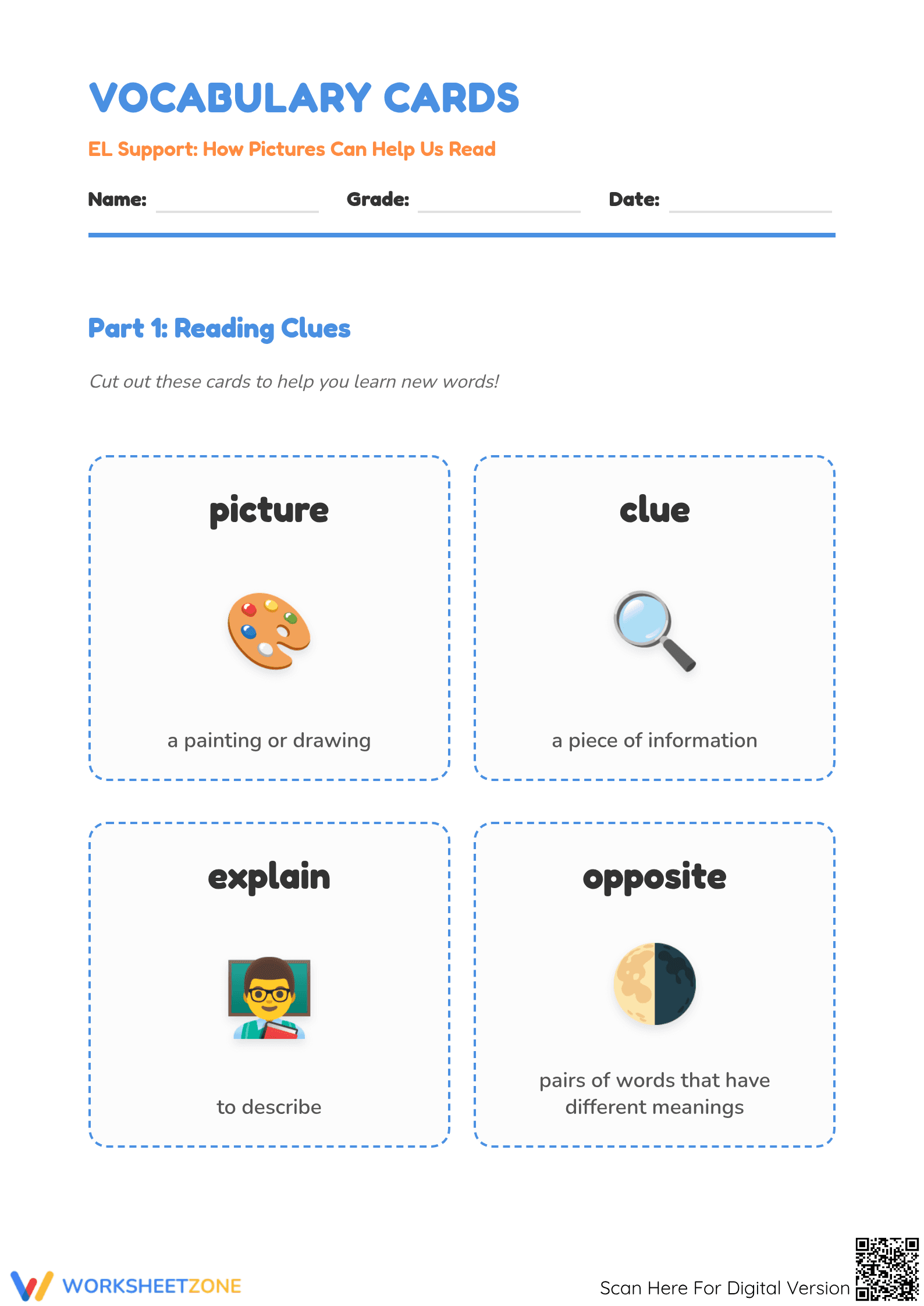
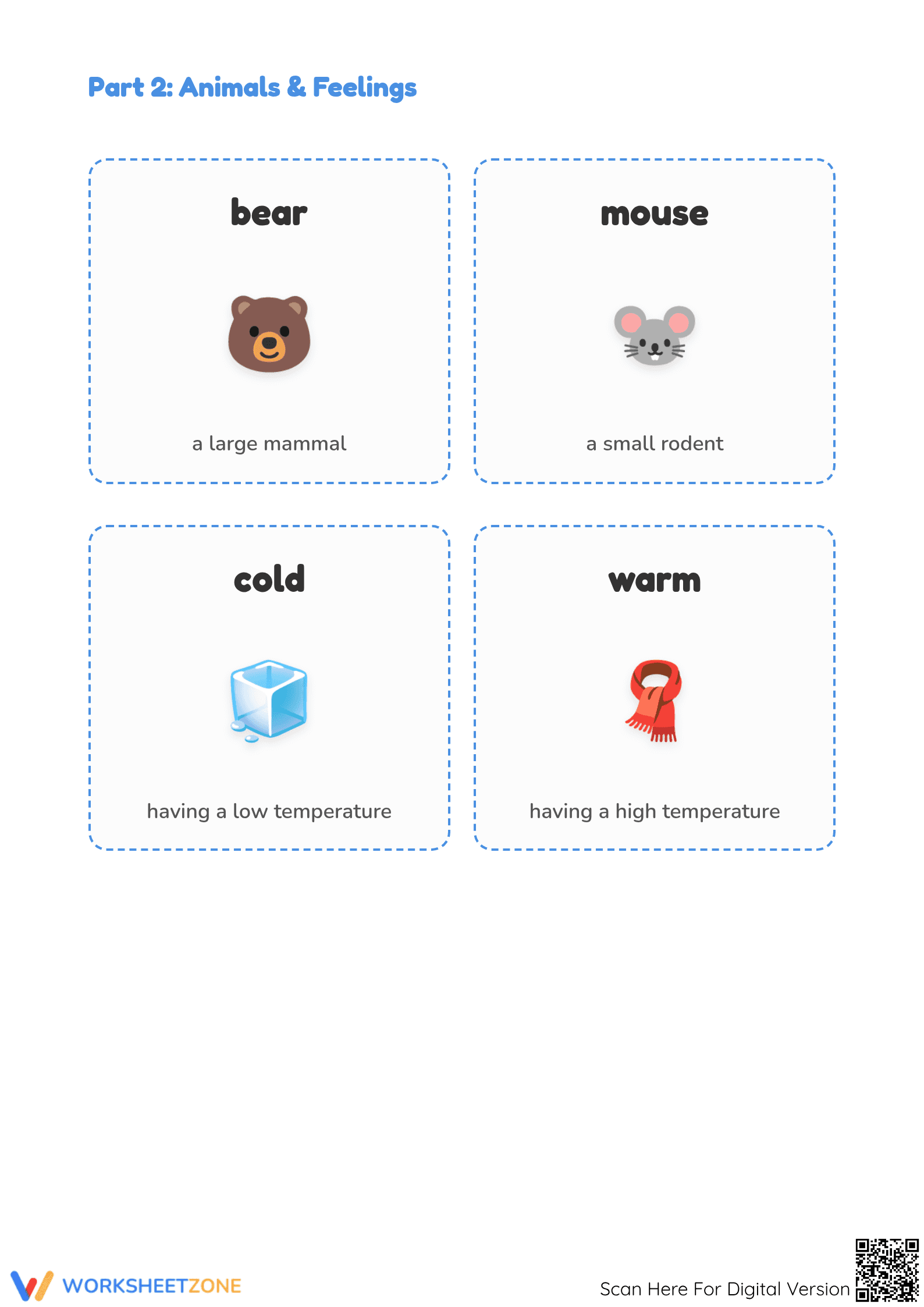
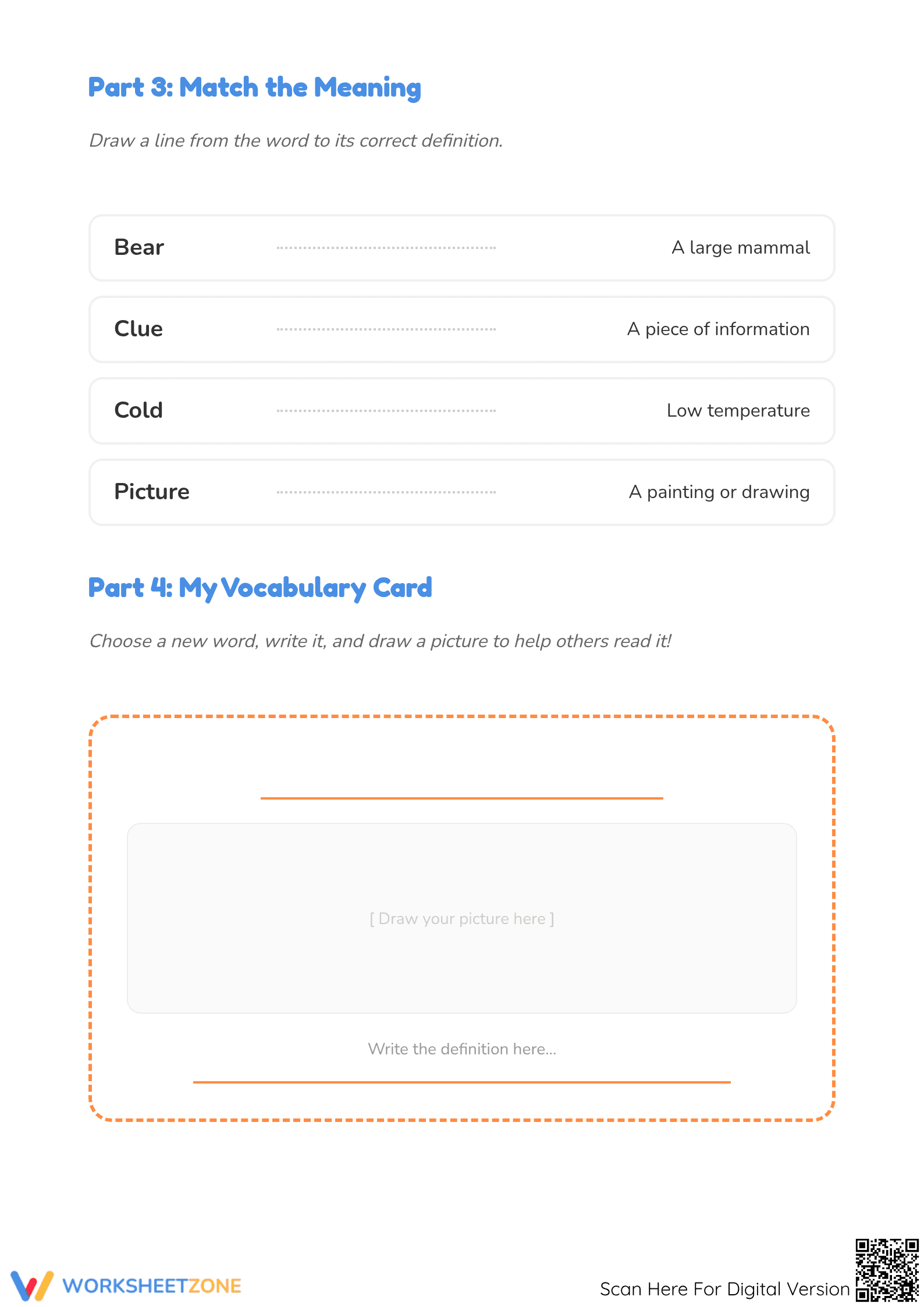
The 3-page PDF contains 8 illustrated vocabulary cards ready for cutting and sorting, covering essential reading terms like "clue" and "opposite." Page 3 features a matching assessment to verify word-to-definition recognition and a creative "My Vocabulary Card" template where students apply their knowledge by drawing and defining a new word of their choice.
- Print: Select the 3-page PDF and print enough copies for your literacy block (30 seconds).
- Distribute: Provide students with scissors for the card-cutting phase or use the sheets as a whole-page reference (1 minute).
- Review: Use the included answer key to quickly check the matching section or display the cards on a document camera for a group discussion (1 minute).
This resource aligns with CCSS.ELA-LITERACY.RL.K.4, which requires students to ask and answer questions about unknown words in a text. By providing visual anchors for words like "explain" and "opposite," the worksheet scaffolds the inquiry process for emergent readers. Both standard codes can be copied directly into lesson plans, IEP goals, or district curriculum mapping tools.
Use these cards during a "Picture Walk" before reading a new story to introduce key concepts. Alternatively, assign the matching section as a formative assessment after a lesson on context clues. Completion typically takes 15 to 20 minutes depending on whether students cut out the cards or use them as a static reference sheet.
This is designed for Kindergarten students, particularly English Learners (EL) who benefit from high-contrast visual supports. It pairs naturally with any fiction or non-fiction picture book or an anchor chart focused on "Reading Detective" skills.
According to Fisher & Frey (2014), visual non-linguistic representations are critical for vocabulary acquisition in early childhood, as they provide a mental bridge between abstract phonics and concrete meaning. This worksheet utilizes that research by pairing icons with the CCSS.ELA-LITERACY.RL.K.4 standard, ensuring students don't just memorize sounds but internalize definitions. The 13 interactive tasks, including the creative drawing prompt, encourage higher-order thinking by moving students from passive recognition to active production. By integrating these cards into daily literacy routines, educators provide the repetitive exposure necessary for long-term retention. This resource serves as a practical application of evidence-based literacy strategies, making it a reliable tool for meeting district-level reading benchmarks and supporting diverse learners in the inclusive classroom.


