




























Views
Downloads
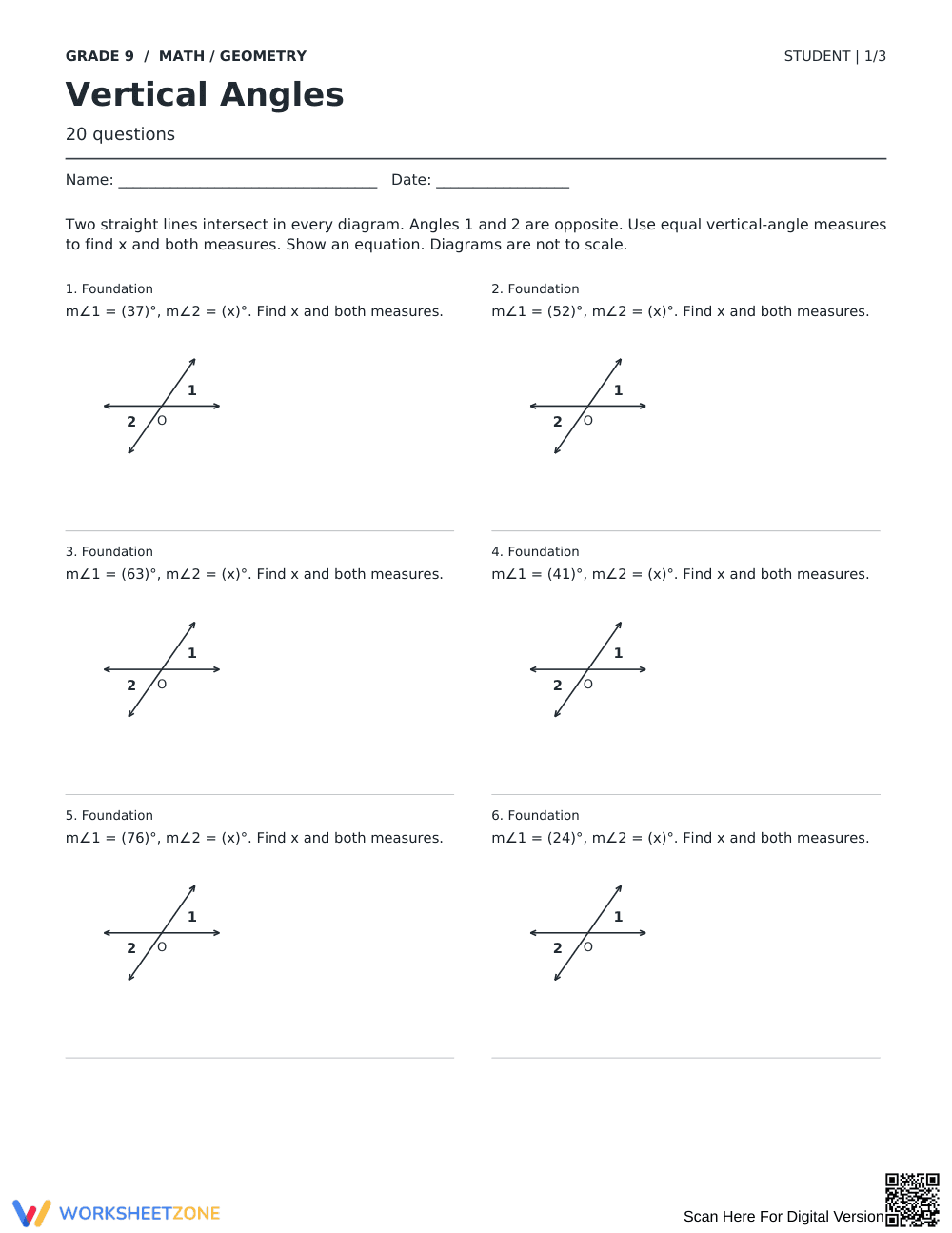
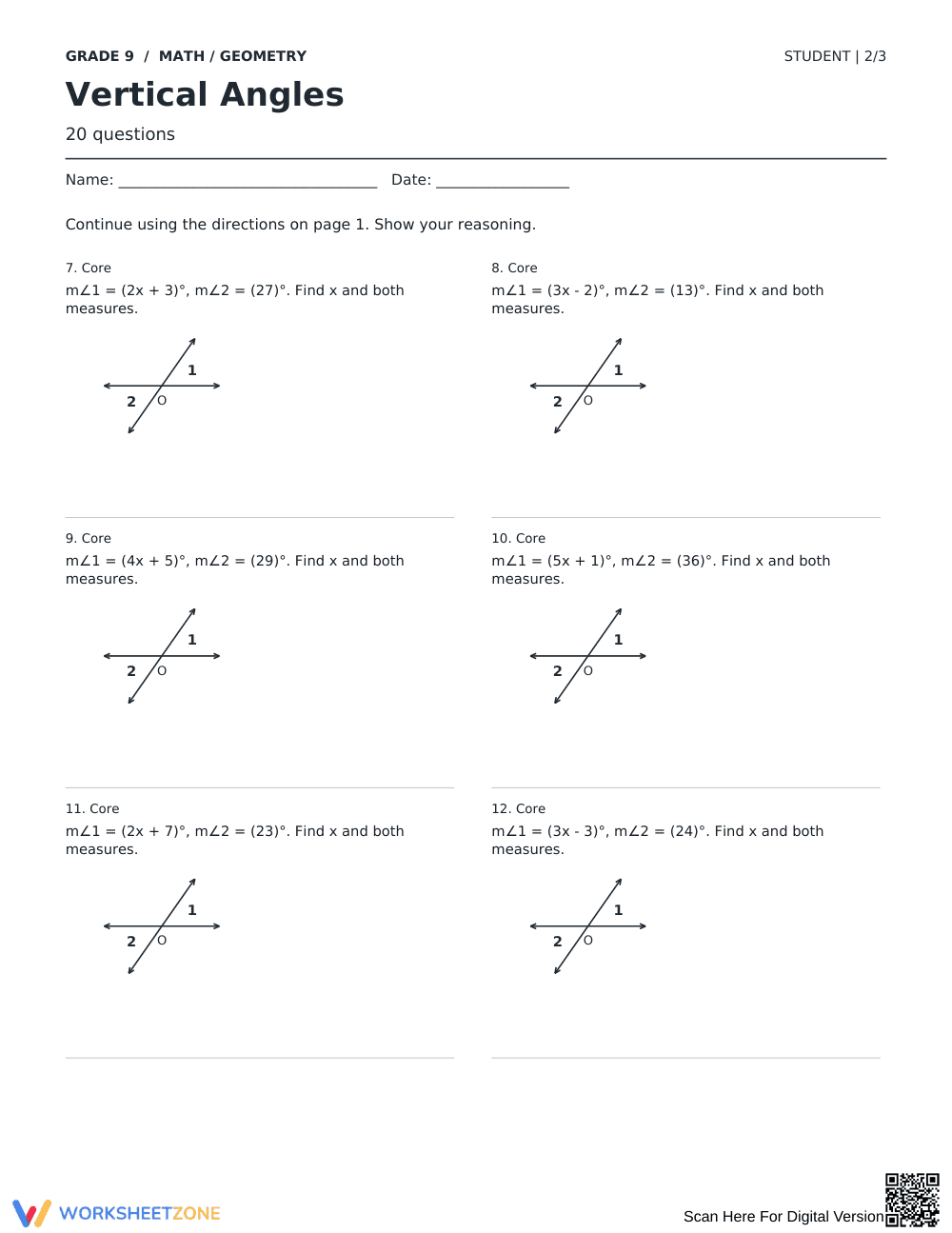
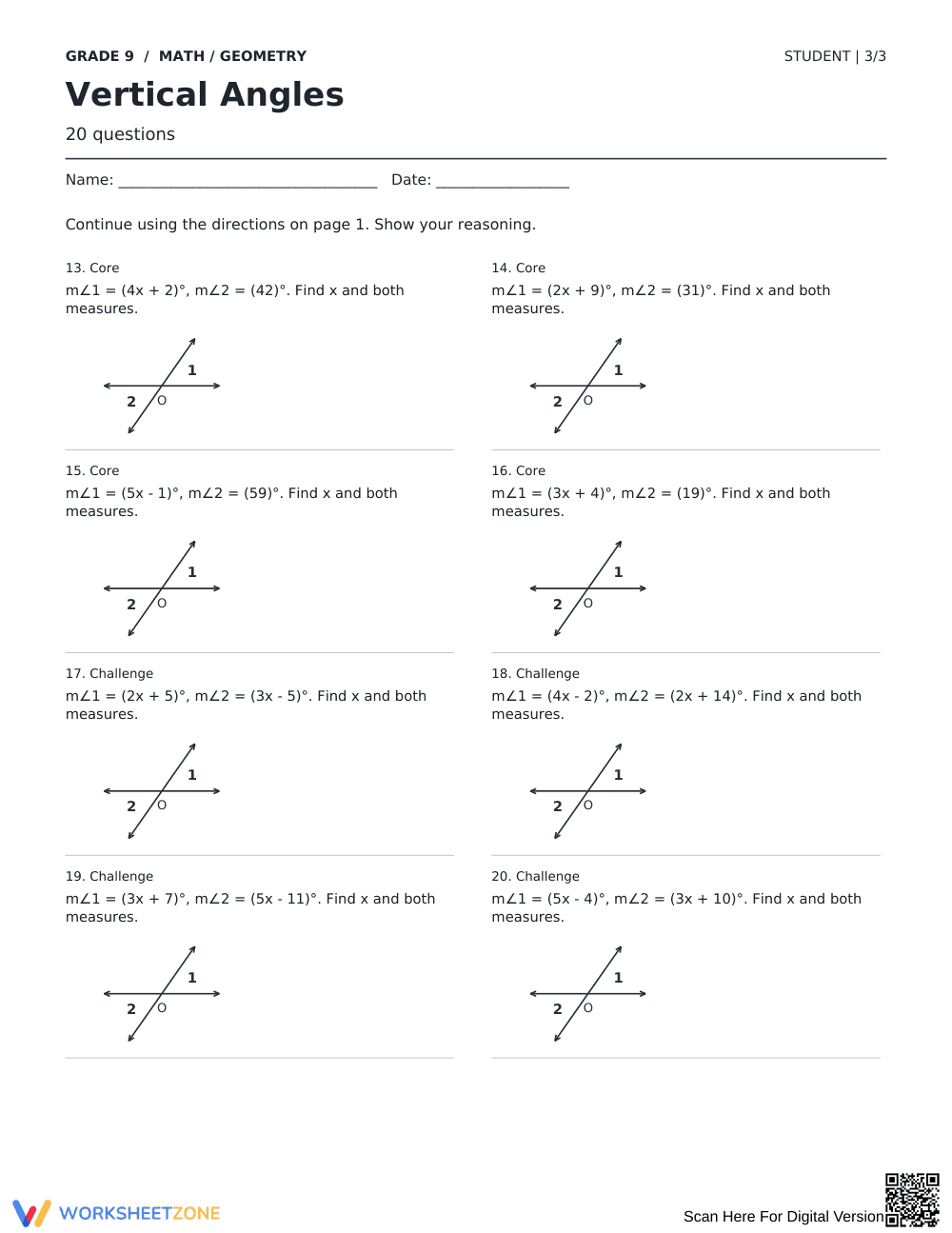

Vertical Angles Worksheet | Grade 9 Essential Math

Paste this activity's link or code into your existing LMS (Google Classroom, Canvas, Teams, Schoology, Moodle, etc.).
Students can open and work on the activity right away, with no student login required.
You'll still be able to track student progress and results from your teacher account.
This Grade 9 geometry worksheet develops mastery of vertical angles through 20 structured mathematical problems. Students apply geometric definitions to set up and solve algebraic equations, finding unknown variables and angle measures. Designed to bridge geometric relationships and algebraic reasoning, this resource ensures high school learners achieve fluency in angle properties.
At a Glance
- Grade: 9 · Subject: Geometry
- Standard:
HSG-CO.C.9— Apply geometric theorems about intersecting lines to solve algebraic equations- Skill Focus: Vertical angle theorem and algebraic calculations
- Format: 3 pages · 20 problems · Answer key included · PDF
- Best For: Independent practice, homework, and skill review
- Time: 30–45 minutes
What's Inside
This 3-page printable PDF features 20 clear line-intersection diagrams divided across three difficulty tiers. A complete 2-page answer key provides full algebraic solutions, step-by-step equations, and suggested point scoring. Every problem features clear diagrammatic representations with numbered opposite angles, prompting students to write algebraic equations before calculating final degree measures.
Skill Progression
- Guided practice (Questions 1–6): Foundation items establish the core principle that opposite vertical angles are equal, requiring simple one-step variable identification ($x = 37^\circ$).
- Supported practice (Questions 7–16): Core items introduce two-step linear expressions, requiring students to isolate variables from expressions such as $2x + 3 = 27$.
- Independent practice (Questions 17–20): Challenge items require multi-step algebraic fluency by placing variable terms on both sides of the equal sign ($2x + 5 = 3x - 5$).
This structured progression reflects the gradual release of responsibility model, guiding students smoothly from foundational recall to complex multi-step problem-solving.
Standards Alignment
The primary focus of this worksheet aligns with `HSG-CO.C.9`, which requires students to prove and apply theorems about lines and angles, specifically that vertical angles are equal. As a supporting standard, `HSG-CO.A.1` reinforces precise geometric definitions of angles, lines, and intersections. Both standard codes can be copied directly into lesson plans, IEP goals, or district curriculum mapping tools.
How to Use It
Use this resource directly after direct instruction on angle pair relationships or as a targeted review before introducing formal two-column geometric proofs. During independent seatwork, observe whether students mistakenly add angles to equal 180 degrees rather than setting opposite expressions equal to each other. Students typically complete the 20 problems within 30 to 45 minutes.
Who It's For
This resource supports Grade 9 geometry students, high school Algebra I review groups, and intervention students needing targeted equation practice in geometric contexts. The tiered structure accommodates varied learning paces. For optimal instructional flow, pair this printable worksheet with an introductory anchor chart illustrating intersecting lines, vertical pairs, and supplementary linear pairs.
Mastering vertical angles and algebraic geometric problem-solving under HSG-CO.C.9 establishes the foundational reasoning necessary for formal proof construction and high school mathematics achievement. According to instructional research synthesized by Fisher & Frey (2014) on effective scaffolding, systematic transitions from basic concept identification to complex algebraic manipulation significantly enhance student procedural retention and conceptual transfer. This 20-problem worksheet directly operationalizes that research by organizing practice into distinct Foundation, Core, and Challenge tiers across 3 pages. Students systematically construct linear equations equating opposite vertical angles, isolate unknown variables, and compute exact degree measures. High school geometry educators, intervention specialists, and curriculum coordinators can implement this focused resource to provide rigorous, standards-aligned practice that reinforces algebraic fluency and geometric theorems. The inclusion of complete answer keys with worked equations makes this printable document an essential asset for high school classrooms.


