




























Views
Downloads

Essential Variation of Traits Worksheet | Grade 3 Science

Paste this activity's link or code into your existing LMS (Google Classroom, Canvas, Teams, Schoology, Moodle, etc.).
Students can open and work on the activity right away, with no student login required.
You'll still be able to track student progress and results from your teacher account.
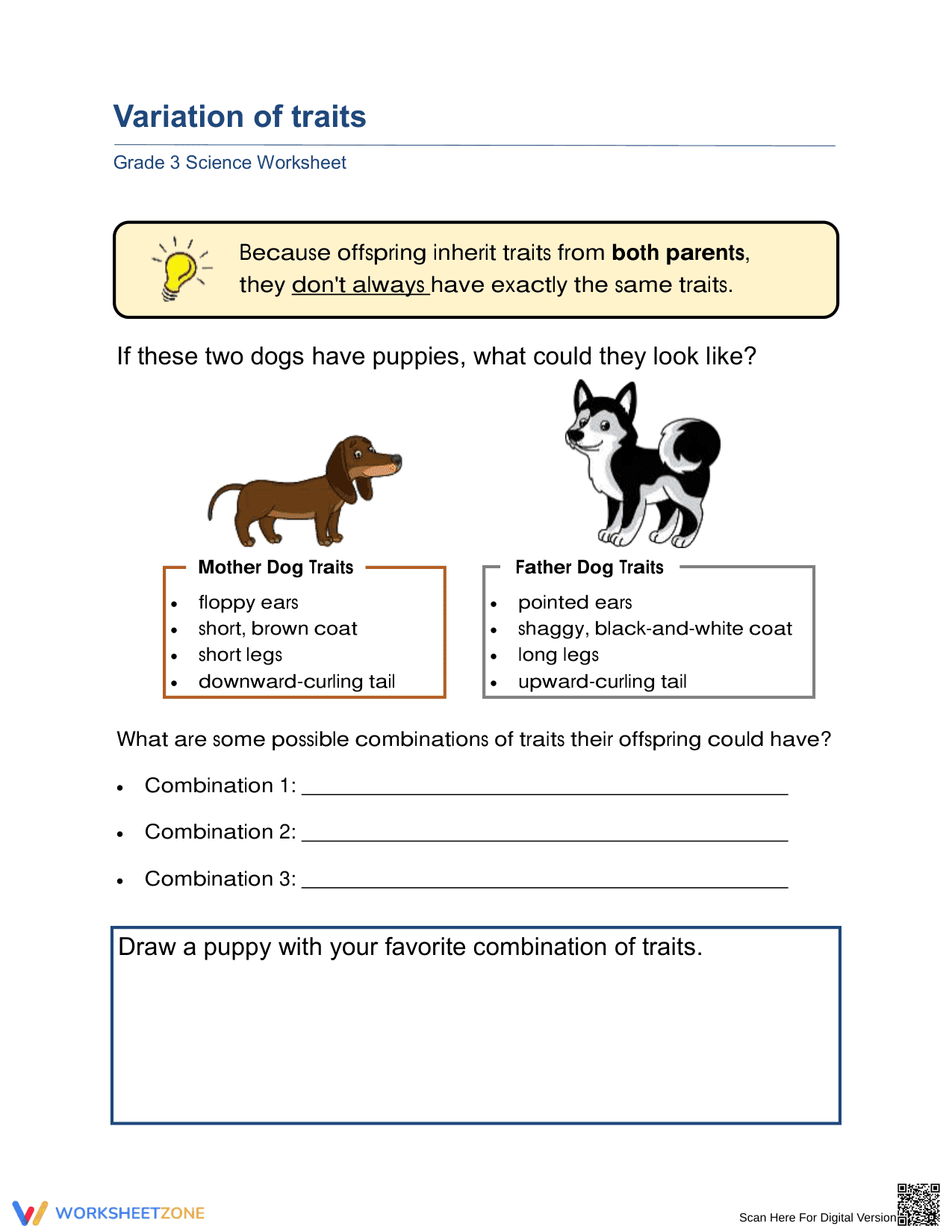
This Grade 3 variation of traits worksheet helps students observe how offspring inherit characteristics from both parents while displaying unique differences. By analyzing dog traits like coat texture and ear shape, learners develop a concrete understanding of inheritance. Students predict possible trait combinations, reinforcing the concept that offspring are similar but not identical to parents.
At a Glance
- Grade: 3 · Subject: Science
- Standard:
3-LS3-1— Analyze evidence that animals inherit traits from parents and variation exists- Skill Focus: Inherited traits and variations
- Format: 1 page · 4 problems · Answer key included · PDF
- Best For: Quick biological inheritance review and assessment
- Time: 15–20 minutes
What's Inside
This focused science resource features an instructional header explaining inheritance. It includes a visual analysis task comparing mother and father dog traits, like ear shape and leg length. Students write three unique trait combinations for potential puppies and create a drawing of their favorite result, allowing for both verbal and visual expression of scientific understanding.
Zero-Prep Workflow
The zero-prep design makes this worksheet ideal for busy classrooms or substitute plans. Teachers follow a simple three-step workflow: Print the single-page PDF, distribute for independent work, and review using the answer key. Total preparation time is under two minutes, requiring only printing access. This efficient structure ensures students stay engaged with core science concepts while minimizing administrative overhead.
Standards Alignment
This resource is directly aligned with 3-LS3-1, which requires students to "analyze and interpret data to provide evidence that plants and animals have traits inherited from parents and that variation of these traits exists in a group of similar organisms." The dog trait comparison provides the necessary data for students to interpret. Both standard codes can be copied directly into lesson plans, IEP goals, or district curriculum mapping tools.
How to Use It
Use this worksheet as a formative assessment after a lesson on inheritance to gauge understanding. It works effectively as an "Exit Ticket" where teachers observe if students logically combine parent traits. Alternatively, use it as a collaborative center activity where pairs discuss likely puppy combinations based on the mother and father dog data.
Who It's For
Designed for third-grade students, this worksheet supports diverse learners through visual aids and structured prompts. It is an excellent resource for English Language Learners who benefit from the clear trait labels and accompanying illustrations. Teachers can naturally pair this activity with a read-aloud about animal families or a digital slideshow showing real-world examples of inherited variation in pets.
The 3-LS3-1 standard emphasizes that variation is a fundamental biological concept that students must master to understand broader evolutionary and ecological patterns. According to the RAND AIRS 2024 report on elementary science education, using familiar domestic animals like dogs to illustrate complex genetic concepts significantly increases student engagement and retention of vocabulary related to inherited traits. This worksheet provides the structured practice necessary for students to transition from simple observation to scientific analysis of biological data. By requiring students to synthesize information from two distinct data sets—the mother and father dog traits—the activity reinforces the cognitive process of interpreting evidence to support scientific claims. Fisher & Frey (2014) highlight that such visual-to-textual tasks are essential for developing disciplinary literacy in young scientists, ensuring they can communicate findings clearly. This resource offers a reliable, evidence-based method for achieving these critical Grade 3 learning objectives.


