


























Views
Downloads

Valentine's Day Odd Numbers | Essential Grade 3 Math
Paste this activity's link or code into your existing LMS (Google Classroom, Canvas, Teams, Schoology, Moodle, etc.).
Students can open and work on the activity right away, with no student login required.
You'll still be able to track student progress and results from your teacher account.
Strengthen foundational number sense with this Valentine's Day theme worksheet. Students practice identifying, skip-counting, and comparing odd numbers through engaging heart-themed activities. This resource ensures learners can confidently distinguish odd from even numbers while building fluency in numeric patterns. It is an ideal supplement for February math centers or homework assignments.
At a Glance
- Grade: 3 · Subject: Math
- Standard:
CCSS.MATH.CONTENT.2.OA.C.3— Determine whether a group of objects has an odd or even number of members- Skill Focus: Odd number identification and skip counting
- Format: 2 pages · 29 problems · Answer key included · PDF
- Best For: Valentine's Day themed math centers
- Time: 20–30 minutes
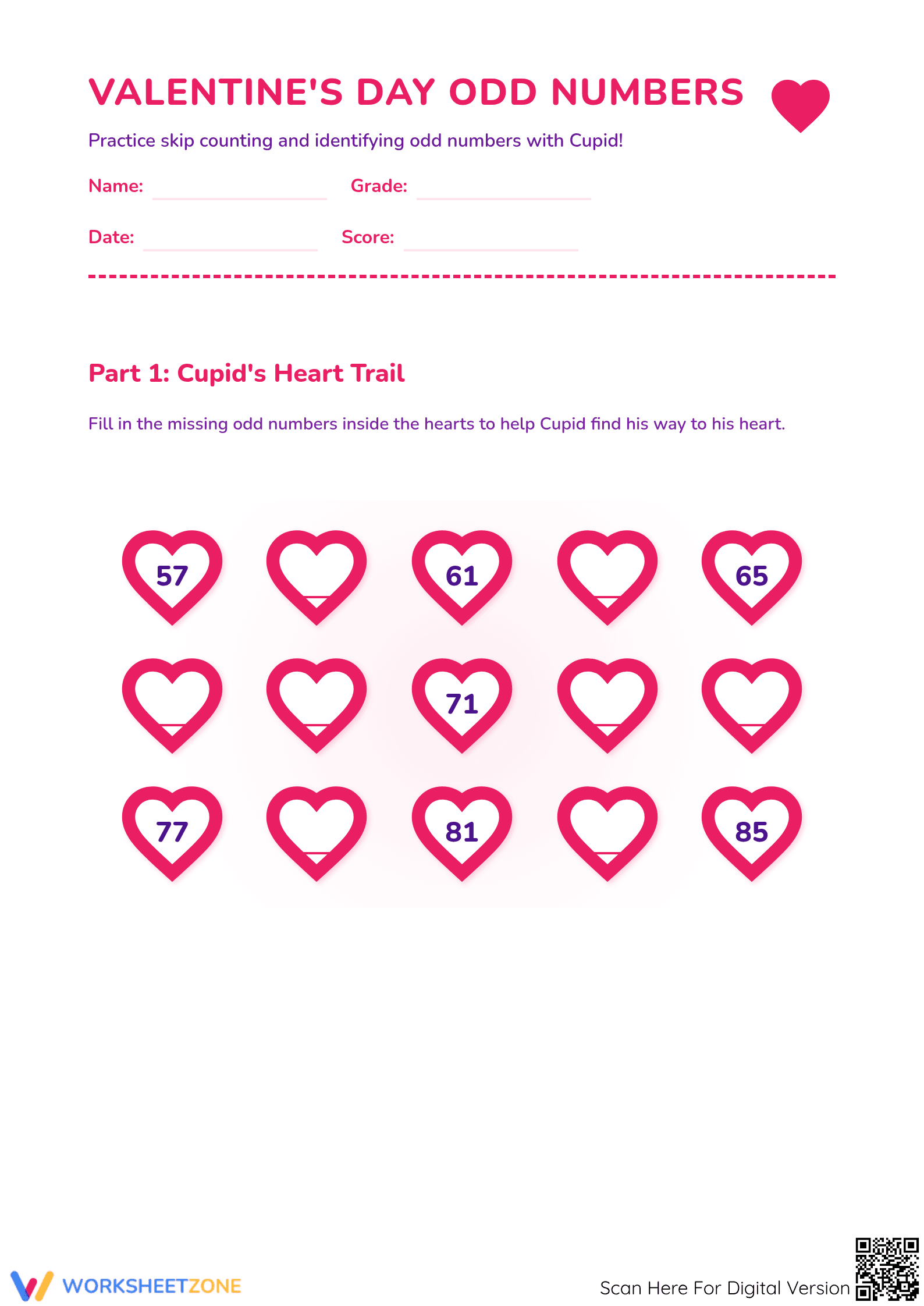
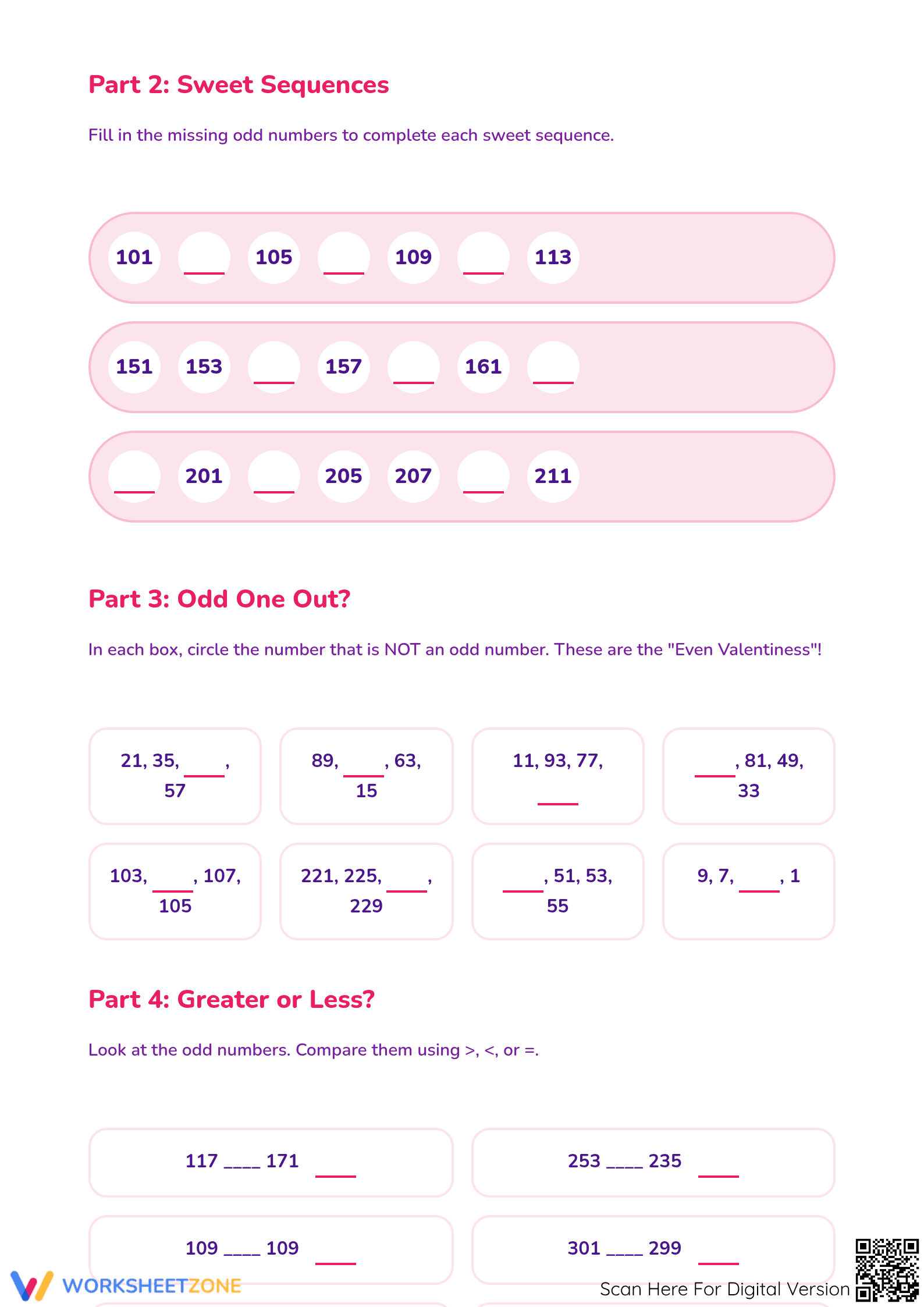
This 2-page PDF features four distinct sections designed to reinforce odd number mastery. Part 1 utilizes "Cupid's Heart Trail" for skip counting, while Part 2 presents "Sweet Sequences" to extend pattern recognition. Part 3 challenges students with "Odd One Out" to find even numbers in a set, and Part 4 introduces numeric comparison. A full answer key is provided for efficient grading.
Skill Progression
- Guided practice: Part 1 provides 15 hearts in a trail, where students fill in 8 missing values to establish the basic pattern of odd integers between 50 and 90.
- Supported practice: Parts 2 and 3 move into sequence completion and identification, requiring students to apply their knowledge of digit endings to identify even values in a group.
- Independent practice: Part 4 concludes with 4 comparison problems using symbols (>, <, =), forcing students to evaluate the relative value of odd numbers up to 300.
This progression follows the gradual-release model, moving from visual trails to abstract comparisons.
Standards Alignment
The primary focus is on CCSS.MATH.CONTENT.2.OA.C.3, which requires students to determine if a group of objects has an odd or even number of members. This worksheet also supports 3.OA.D.9 by asking students to identify and explain arithmetic patterns. Both standard codes can be copied directly into lesson plans, IEP goals, or district curriculum mapping tools.
How to Use It
Use this resource during a Valentine's Day math station to provide thematic practice that maintains academic rigor. Alternatively, assign it as a formative assessment after teaching the concept of odd and even numbers to gauge individual student understanding. Observe if students are skip counting by twos or looking at the ones digit to identify the odd property. Completion typically takes 25 minutes.
Who It's For
This worksheet is tailored for Grade 3 students but provides excellent review for Grade 4 and 5 learners who need to reinforce basic number theory. It supports English Language Learners with clear visual cues and repetitive numeric patterns. Pair this resource with a number line anchor chart or a short passage about the mathematical history of zero to provide a complete instructional block.
Success in higher-level mathematics depends heavily on early fluency with number properties and pattern recognition. This worksheet directly addresses CCSS.MATH.CONTENT.2.OA.C.3 by providing 29 targeted tasks that require students to identify odd numbers and skip count through sequential numeric sets. Research highlighted in the ScienceDirect TpT Analysis suggests that thematic, seasonal resources can increase student engagement and persistence during repetitive practice tasks. By integrating Cupid-themed visuals with rigorous skill work, teachers can effectively bridge the gap between holiday excitement and standards-based instruction. The inclusion of multi-step sequences and numeric comparisons ensures that students are applying their understanding of odd-even parity in various mathematical contexts. This structured approach supports the development of mental math strategies and prepares students for more complex algebraic reasoning. Such practice is foundational for mastery of arithmetic patterns and general number sense in the elementary curriculum.


