


























Views
Downloads
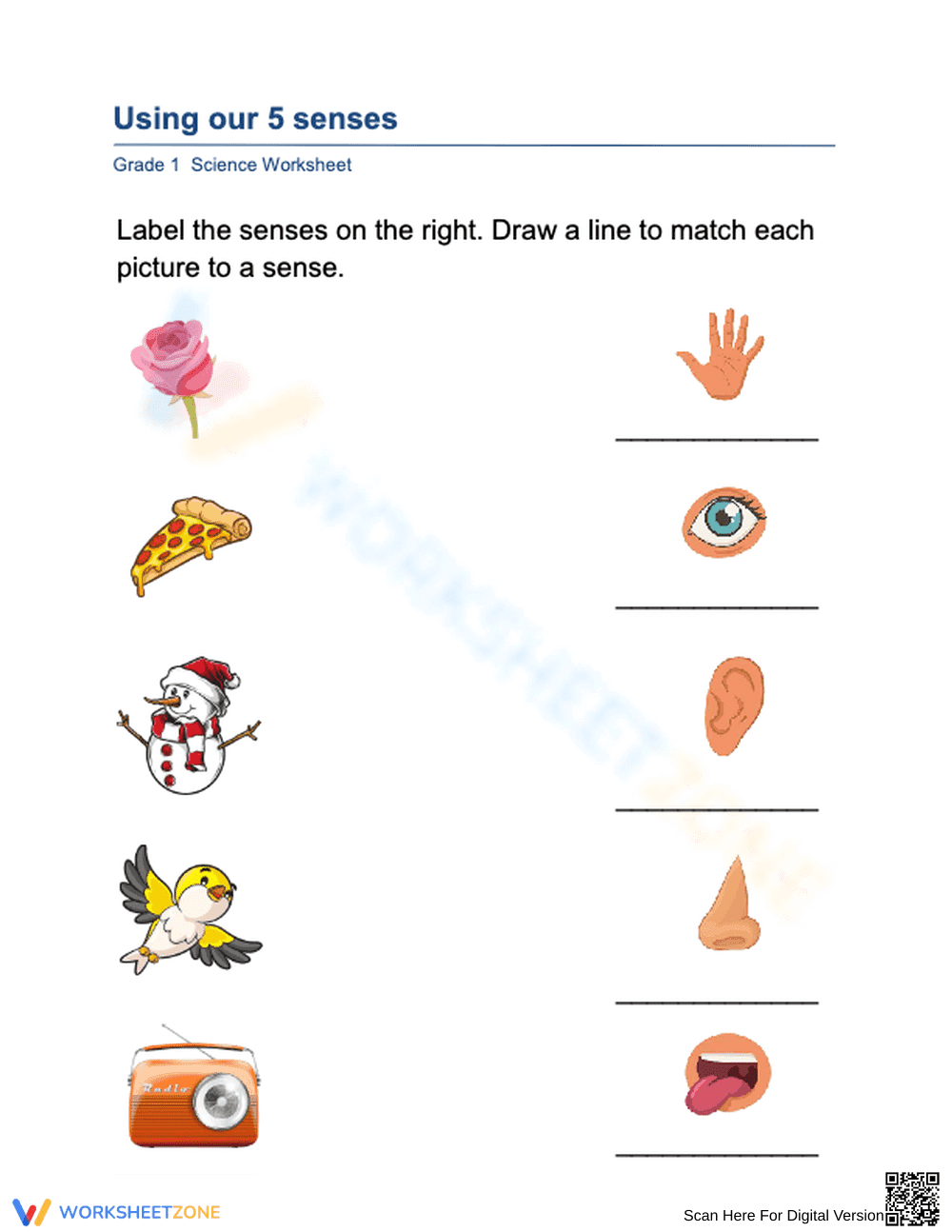

Grade 1 Five Senses — Printable No-Prep Worksheet
Paste this activity's link or code into your existing LMS (Google Classroom, Canvas, Teams, Schoology, Moodle, etc.).
Students can open and work on the activity right away, with no student login required.
You'll still be able to track student progress and results from your teacher account.
This Grade 1 science worksheet helps students identify and apply their knowledge of the five senses by connecting external body parts to everyday objects. By labeling senses and matching them to corresponding items, young learners build foundational observation skills essential for understanding how humans process information from their environment.
At a Glance
- Grade: 1 · Subject: Science
- Standard:
1-LS1-1— Identify external body parts and their sensory functions.- Skill Focus: Identifying the five senses
- Format: 2 pages · 10 problems · Answer key included · PDF
- Best For: Independent practice or morning work
- Time: 10–15 minutes
This resource includes a single-page student activity and a complete answer key. The worksheet features five clear, colorful illustrations of everyday objects alongside five corresponding body parts. Students must complete ten total tasks: writing the correct sense label under each body part and drawing lines to connect the objects to the sense used to perceive them.
Designed for immediate classroom implementation, this activity requires minimal teacher setup:
- Print (1 minute): Generate the single-page PDF for your class roster.
- Distribute (1 minute): Hand out the worksheets along with pencils. No scissors or glue required.
- Review (2 minutes): Use the included visual answer key to quickly check student work or project it for self-correction.
With a total prep time of under two minutes, this worksheet is an excellent addition to emergency sub plans or last-minute science centers.
This activity aligns with 1-LS1-1 by helping students recognize how humans use their external parts to capture information about the world. It also supports K-LS1-1 by reinforcing foundational observation skills. Both standard codes can be copied directly into lesson plans, IEP goals, or district curriculum mapping tools.
Deploy this worksheet during your primary science block after a direct instruction lesson on the five senses. It serves as an effective independent practice activity while the teacher pulls small groups. Alternatively, use it as a formative assessment at the end of the week to verify mastery. As students work, observe whether they can independently read and write the sensory vocabulary words or if they rely solely on the visual matching component. Expect completion within 10 to 15 minutes.
This worksheet is ideal for first-grade general education students, as well as kindergarteners needing extension or second graders requiring review. The strong visual supports make it highly accessible for English Language Learners and students with reading accommodations. Pair this printable with a read-aloud book about the five senses or a hands-on sensory exploration station to reinforce the concepts.
Developing a strong understanding of the five senses is a critical component of early childhood science education. According to a recent ScienceDirect TpT Analysis, instructional materials that combine visual matching with vocabulary labeling significantly improve retention of foundational science concepts in primary grades. When students practice identifying external body parts and their sensory functions, as outlined in 1-LS1-1, they build the necessary cognitive framework for more complex biological studies in later years. Explicit practice with these concepts allows young learners to categorize their environmental observations accurately. By connecting familiar objects like a radio or a pizza to specific sensory organs, students anchor abstract scientific ideas to their daily lived experiences. This targeted reinforcement ensures that foundational knowledge is securely established, supporting both immediate academic requirements and long-term scientific literacy.


