


























Views
Downloads
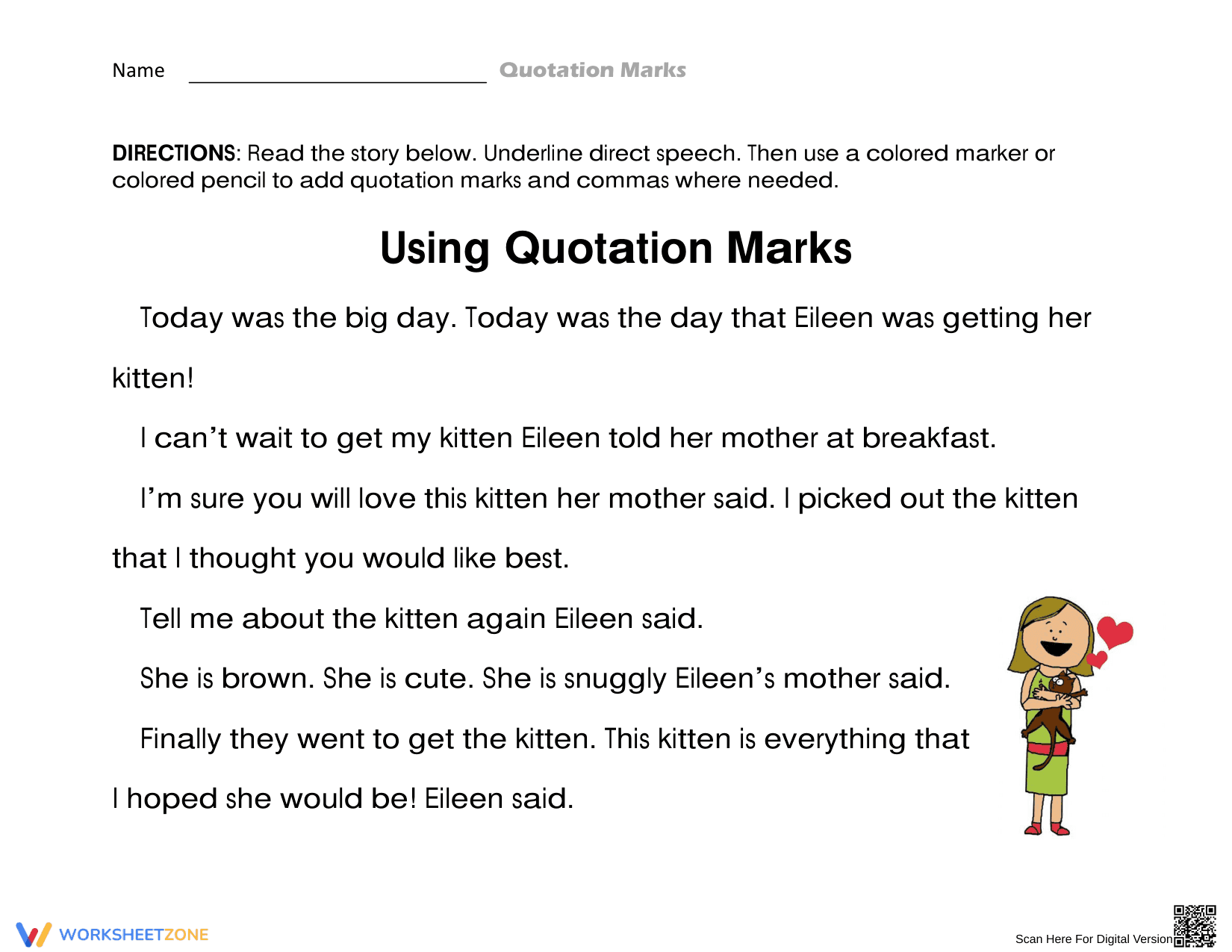

Essential Quotation Marks Worksheet | Grade 3 English
Paste this activity's link or code into your existing LMS (Google Classroom, Canvas, Teams, Schoology, Moodle, etc.).
Students can open and work on the activity right away, with no student login required.
You'll still be able to track student progress and results from your teacher account.
This Grade 3 quotation marks worksheet helps students master punctuating direct speech through an engaging narrative about a kitten. By identifying and punctuating 5 instances of dialogue, learners build essential grammar skills while improving reading fluency. This printable resource ensures students can accurately use commas and quotation marks in their writing.
At a Glance
- Grade: 3 · Subject: English Language Arts
- Standard:
L.3.2.C— Use commas and quotation marks in dialogue to indicate direct speech- Skill Focus: Punctuating direct speech with quotation marks and commas
- Format: 1 page · 5 tasks · Answer key included · PDF
- Best For: Grammar centers, homework, or quick sub plans
- Time: 10–15 minutes
This single-page PDF features a cohesive story titled "Using Quotation Marks" centered on a relatable theme for young learners. The worksheet contains 5 distinct sentences of direct speech that lack punctuation, requiring students to underline the dialogue and insert the correct commas and quotation marks. Its clear layout and charming illustration provide a friendly interface for independent practice or guided instruction.
Teachers can implement this resource using an efficient three-step workflow. First, print the necessary copies for the class (30 seconds). Second, distribute the materials along with colored pencils for the highlighting activity (1 minute). Third, review the five sentences as a group using the provided answer key (30 seconds). With a total preparation time of under two minutes, this worksheet is perfectly suited for emergency sub plans or last-minute grammar practice.
This resource is primarily aligned to L.3.2.C, which requires students to use commas and quotation marks in dialogue. By engaging with these specific tasks, learners demonstrate mastery over conventions of standard English capitalization, punctuation, and spelling when writing. This standard code can be copied directly into lesson plans, IEP goals, or district curriculum mapping tools.
Assign this worksheet as a formative assessment after a direct instruction lesson on dialogue punctuation to observe which students struggle with comma placement inside or outside quotes. Alternatively, place it in a literacy center where students can work in pairs to verify each other's punctuation choices. Students typically complete the 5-task sequence in approximately 12 minutes.
Designed for third-grade students, this worksheet is also appropriate for fourth-grade review or second-grade enrichment. It provides excellent support for English Language Learners (ELLs) by using a high-interest narrative with simple sentence structures. Pair this resource with a short mentor text or an anchor chart displaying dialogue rules for maximum instructional impact.
Effective instruction in punctuation requires targeted practice within meaningful contexts. According to RAND AIRS 2024, providing students with narrative-based grammar tasks increases retention of mechanical rules compared to decontextualized lists. This worksheet addresses L.3.2.C by requiring students to identify direct speech and apply quotation marks and commas accurately across 5 unique prompts. Research from Fisher & Frey (2014) emphasizes that the gradual release of responsibility is most effective when students apply newly learned conventions to short, manageable texts before attempting full compositions. By focusing on these specific punctuation marks within a story about a kitten, this resource bridges the gap between mechanical knowledge and practical application. Educators can utilize this summary to justify the inclusion of the L.3.2.C standard in their weekly curriculum frameworks or individual student progress reports. This task supports the mastery of punctuation conventions through active engagement and clear student outcomes.


