




























Views
Downloads

Seed Growth Stages Worksheet | Grade K-2 Essential

Paste this activity's link or code into your existing LMS (Google Classroom, Canvas, Teams, Schoology, Moodle, etc.).
Students can open and work on the activity right away, with no student login required.
You'll still be able to track student progress and results from your teacher account.
This science worksheet provides a clear, visual introduction to the life cycle of a plant, focusing on the critical stages of seed germination. Students will observe how a seed transforms into a mature plant while identifying the essential environmental factors required for growth. It is designed to build foundational biology knowledge through observation and simple analysis.
At a Glance
- Grade: K-2 · Subject: Science
- Standard:
K-LS1-1— Use observations to describe patterns of what plants need to survive- Skill Focus: Seed germination stages
- Format: 2 pages · 5 problems · Answer key included · PDF
- Best For: Introductory science lessons or nature units
- Time: 15–20 minutes
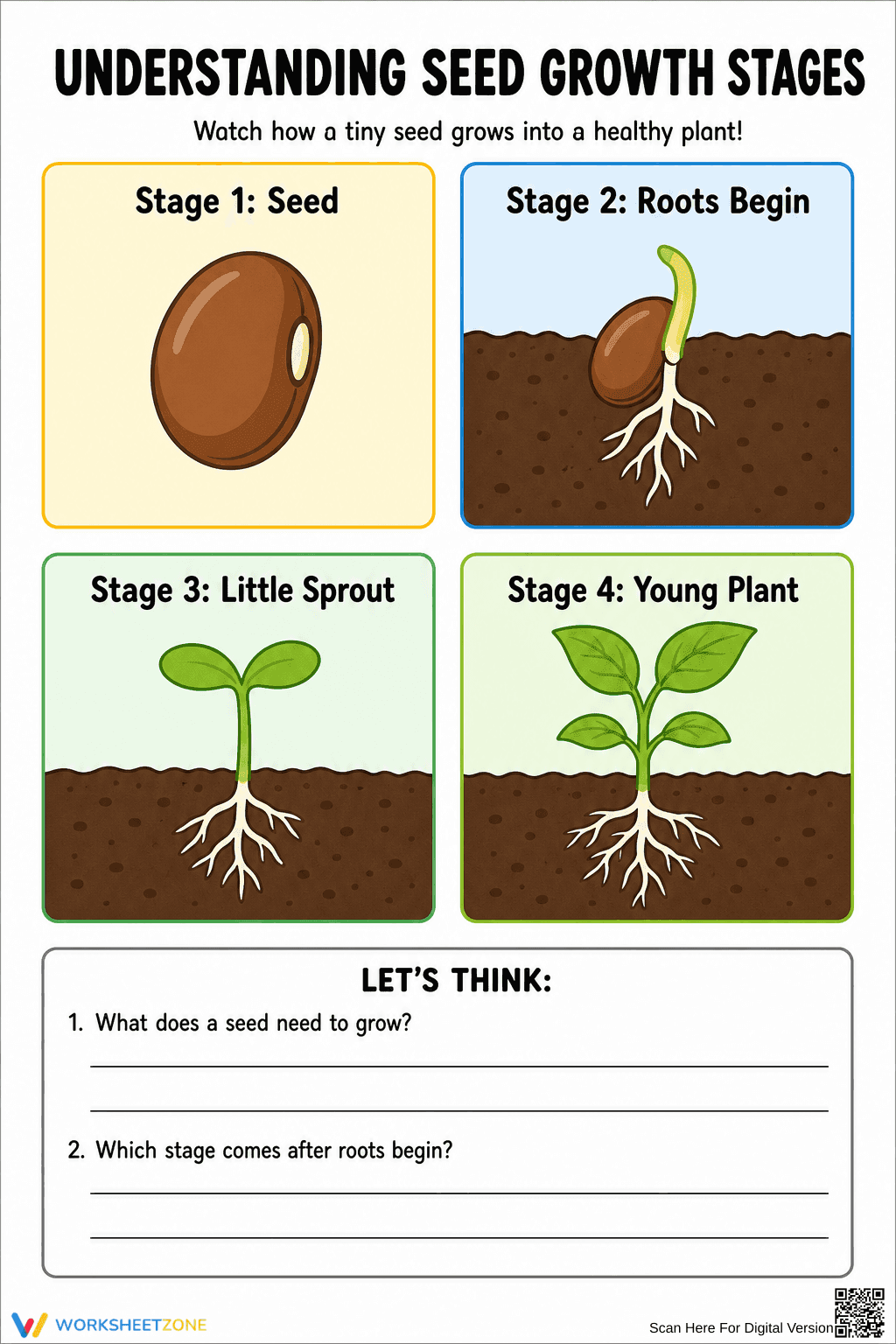
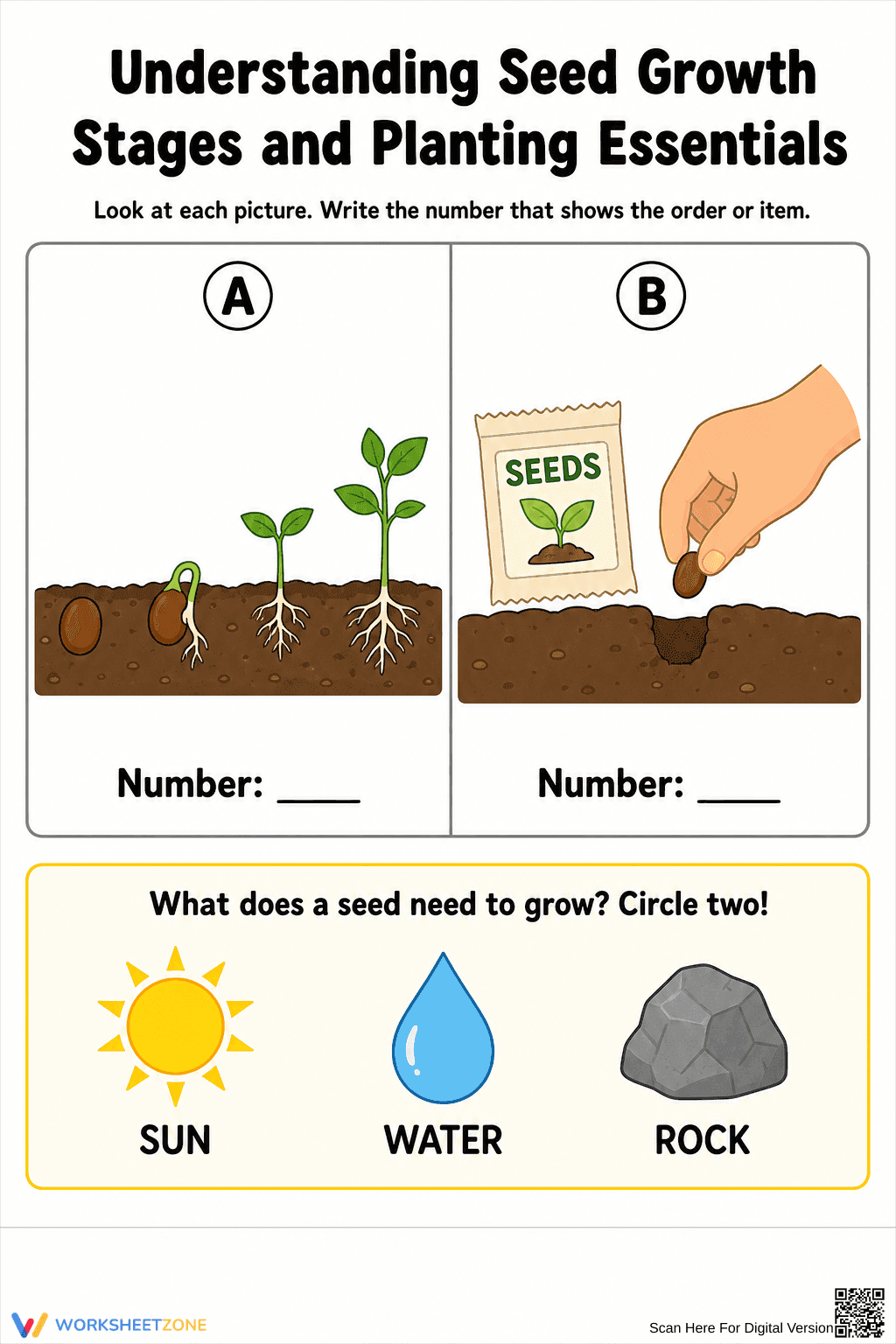
The resource consists of two comprehensive pages. The first page features a high-quality visual guide detailing four stages of growth, followed by a "Let's Think" section with two open-ended questions. The second page reinforces learning through a sequencing task where students number the planting process and a multiple-choice activity to identify plant needs. A full answer key is provided for quick grading.
This resource is designed for a zero-prep classroom workflow. Teachers can print the two-page PDF in under 30 seconds. Distribution takes less than a minute, as the visual instructions are self-explanatory for most Grade 1 and 2 students. Reviewing the answers as a whole group takes approximately 5 minutes, making this an ideal grab-and-go activity for busy mornings or unexpected substitute teacher plans.
Aligned to `K-LS1-1`, students use observations to describe patterns of what plants and animals need to survive. This worksheet specifically targets the plant component of the standard by highlighting the necessity of sun and water. Both standard codes can be copied directly into lesson plans, IEP goals, or district curriculum mapping tools.
Use this worksheet as a mid-unit check after students have planted their own seeds in the classroom. It serves as an excellent bridge between hands-on observation and academic recording. For a formative assessment, observe whether students can correctly identify the "Roots Begin" stage as the first sign of growth beneath the soil. Expected completion time is 15 to 20 minutes.
This resource is ideal for Kindergarten through Grade 2 students, including English Language Learners who benefit from the heavy visual scaffolding. It pairs naturally with a classroom bean-planting experiment or a read-aloud about garden cycles. The simple text and clear icons ensure that even emerging readers can participate in the science curriculum effectively.
This educational resource is specifically designed to align with the Next Generation Science Standards (NGSS), specifically K-LS1-1, which requires students to use observations to describe patterns of what plants need to survive. By breaking down the complex biological process of germination into four distinct, visually supported stages—Seed, Roots Begin, Little Sprout, and Young Plant—the worksheet reduces cognitive load for early learners. Research by Fisher & Frey (2014) emphasizes the importance of visual non-linguistic representations in developing conceptual understanding in young children. This worksheet facilitates that development by pairing clear illustrations with targeted inquiry questions. The inclusion of a "Let's Think" section encourages higher-order thinking by asking students to synthesize their observations about environmental requirements like water and sunlight. Educators can utilize this tool as a reliable formative assessment to gauge student mastery of life science cycles and the fundamental characteristics of living organisms.


