


























Views
Downloads

Grades 5-6 Animal Cells — Printable No-Prep Worksheet
Paste this activity's link or code into your existing LMS (Google Classroom, Canvas, Teams, Schoology, Moodle, etc.).
Students can open and work on the activity right away, with no student login required.
You'll still be able to track student progress and results from your teacher account.
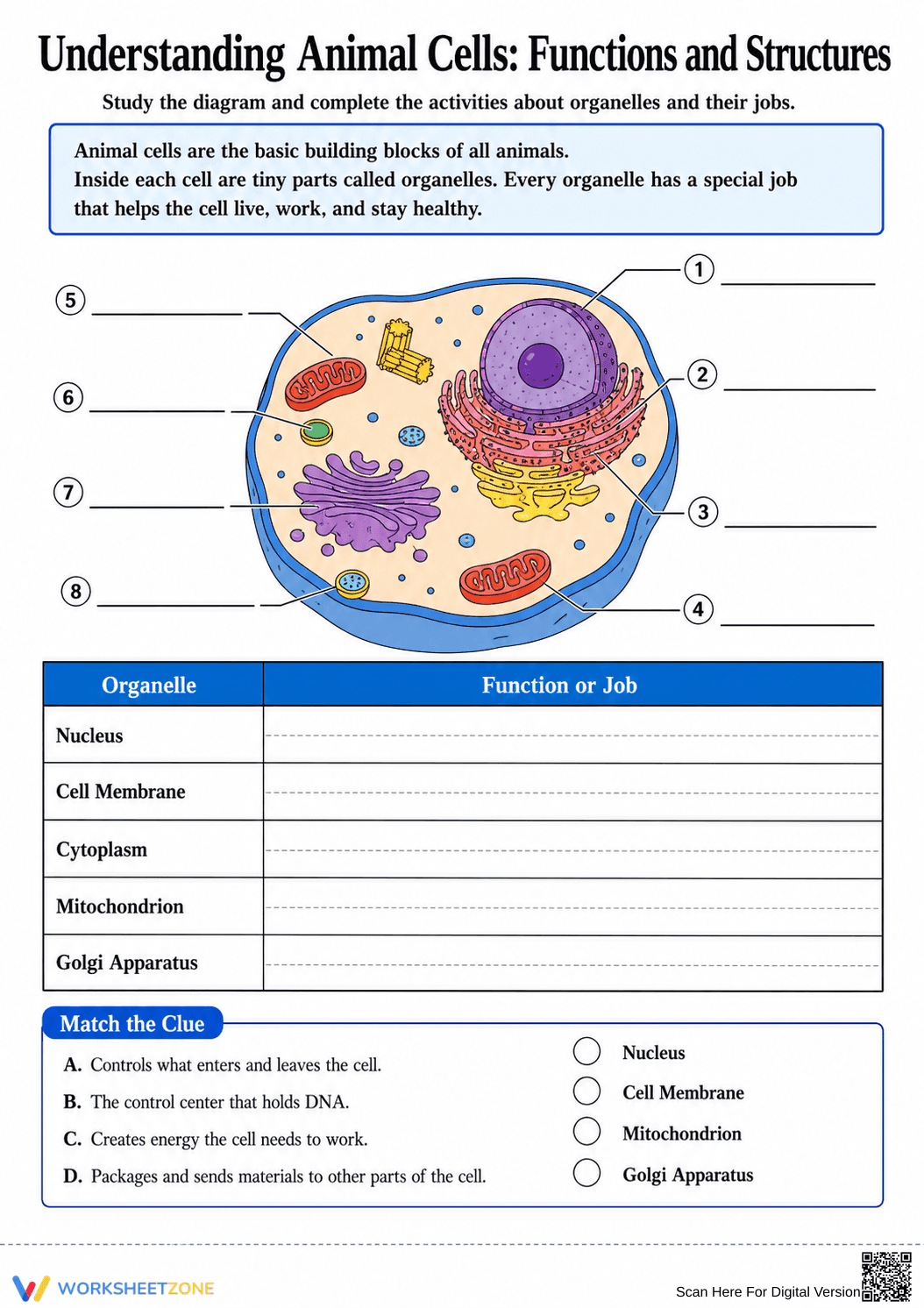
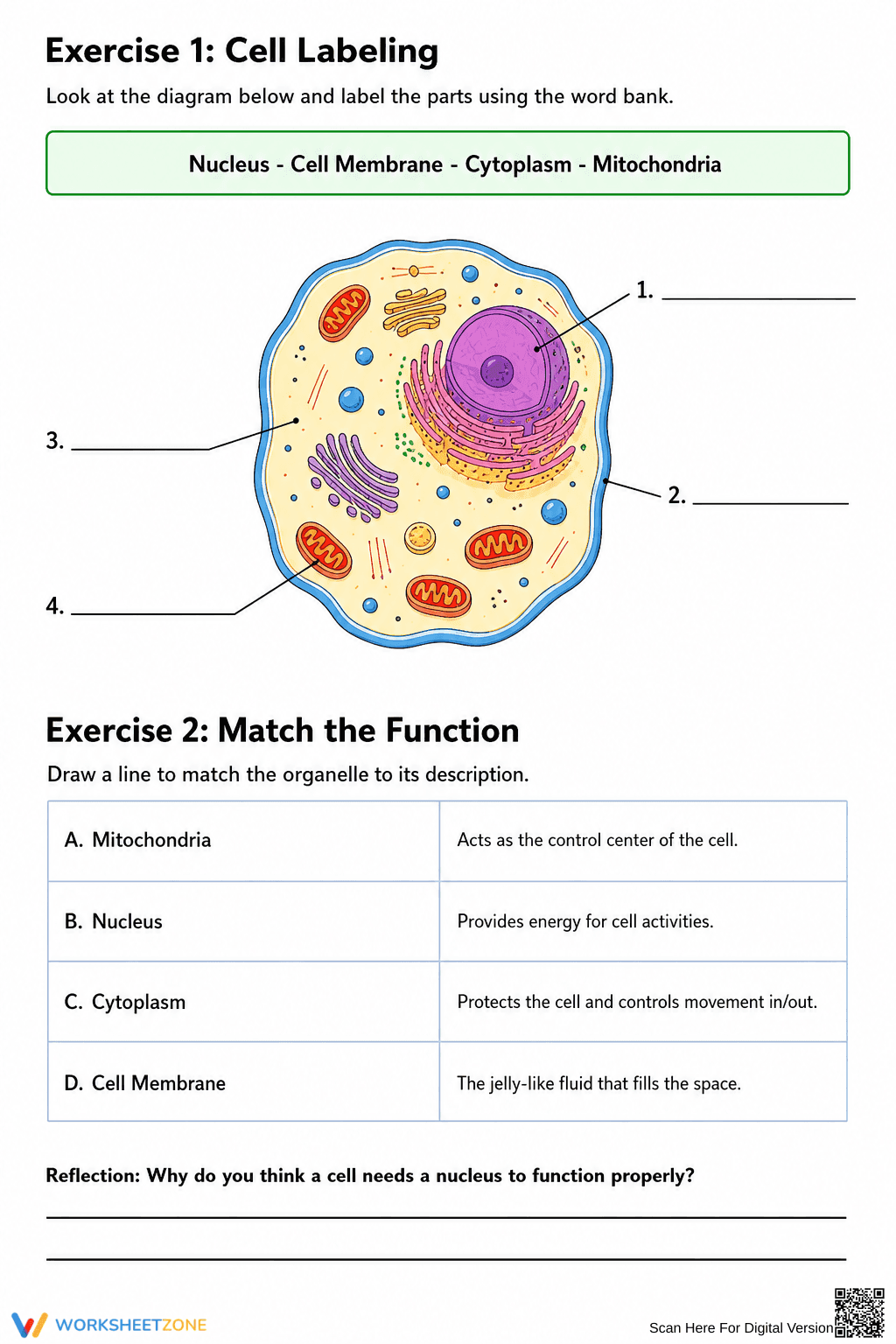
This science worksheet helps students master animal cell structures and organelle functions. By labeling diagrams and matching organelles to their jobs, learners build a strong understanding of biology. The clear visuals ensure students confidently identify how cells operate.
At a Glance
- Grade: 5–6 · Subject: Science
- Standard:
MS-LS1-2— Describe how cell parts contribute to overall function- Skill Focus: Animal cell structure and organelle functions
- Format: 2 pages · 26 problems · Answer key included · PDF
- Best For: Independent practice or sub plans
- Time: 20–30 minutes
This two-page resource features tasks designed to reinforce cell biology. Students label key organelles like the nucleus and mitochondria on full-color animal cell diagrams. A helpful word bank provides scaffolding, while matching sections connect each organelle to its biological function. A reflection question prompts critical thinking, and a complete answer key is provided.
Zero-Prep Workflow
- Print (1 minute): Download the PDF and print the two-page handout. No complex setup required.
- Distribute (1 minute): Hand out the worksheets. Clear instructions and visual diagrams make tasks self-explanatory.
- Review (3 minutes): Use the answer key to quickly check work. Total teacher prep time is under two minutes, ideal for sub plans.
Standards Alignment
This resource is directly aligned to MS-LS1-2: Develop and use a model to describe the function of a cell as a whole and ways parts of cells contribute to the function. The labeling and matching exercises specifically target the requirement for students to understand how individual organelles support the cell's survival. Both standard codes can be copied directly into lesson plans, IEP goals, or district curriculum mapping tools.
How to Use It
This worksheet is highly versatile and fits perfectly into the independent practice phase of a lesson, immediately following direct instruction on cell biology. Alternatively, it serves as an excellent homework assignment to reinforce classroom learning. As a formative assessment tip, observe which organelles students struggle to match with their functions; confusion between the cell membrane and cytoplasm often indicates a need for a quick reteach. Students should be able to complete the entire packet within 20 to 30 minutes.
Who It's For
This resource is designed primarily for fifth and sixth-grade science students learning about living things. The inclusion of a word bank and clear, distinct diagrams provides built-in differentiation for visual learners and students who need vocabulary support. It pairs wonderfully with a 3D cell model activity or an introductory direct instruction lesson on the differences between plant and animal cells.
Mastering cellular biology requires students to move beyond rote memorization and understand the interconnected systems within living organisms. Aligning with MS-LS1-2, this resource challenges learners to describe how cell parts contribute to overall function through visual modeling and targeted vocabulary practice. According to ScienceDirect TpT Analysis, integrating visual diagrams with matching exercises significantly improves retention of complex biological terms in middle school science classrooms. By requiring students to label an animal cell and immediately apply that knowledge to functional descriptions, the worksheet reinforces the critical relationship between structure and function. This dual-approach ensures that students do not just learn the names of organelles, but truly comprehend their essential roles in keeping the cell alive and healthy. The structured format supports cognitive processing, making abstract microscopic concepts accessible and engaging for young learners.


