




























Views
Downloads
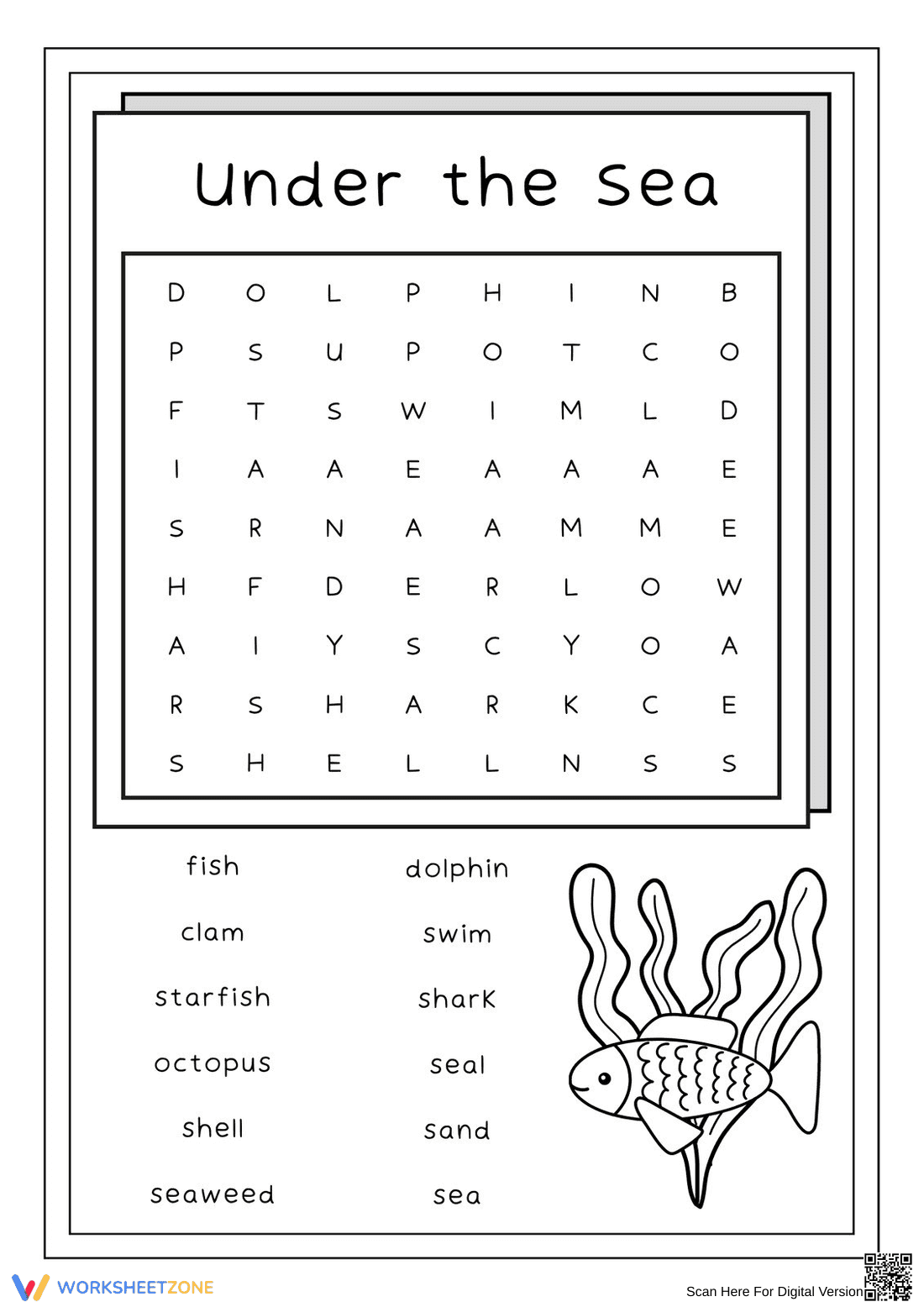

Under the Sea Word Search | Grade 1 Printable

Paste this activity's link or code into your existing LMS (Google Classroom, Canvas, Teams, Schoology, Moodle, etc.).
Students can open and work on the activity right away, with no student login required.
You'll still be able to track student progress and results from your teacher account.
This Grade 1 ocean vocabulary worksheet builds essential word recognition and spelling skills through an engaging visual scanning activity. Students locate and circle twelve thematic words hidden within a letter grid, reinforcing letter-sound correspondence and familiarizing early readers with common marine biology terms.
At a Glance
- Grade: 1 · Subject: ELA
- Standard:
CCSS.ELA-LITERACY.RF.1.3— Apply grade-level phonics and word analysis skills- Skill Focus: Vocabulary Recognition
- Format: 1 page · 12 problems · Answer key included · PDF
- Best For: Independent practice and morning work
- Time: 10–15 minutes
This single-page resource features a clear, primary-friendly letter grid containing twelve hidden ocean-themed words, such as "dolphin," "starfish," and "seaweed." A supportive word bank is provided at the bottom alongside a marine life illustration students can color. The straightforward layout minimizes visual clutter, allowing young learners to focus on spelling patterns. A complete answer key is included to facilitate rapid grading.
Zero-Prep Workflow
- Print (1 minute): Simply download the PDF and print the required number of copies. The black-and-white design ensures minimal ink usage.
- Distribute (1 minute): Hand out the activity during morning arrival or literacy centers. The clear instructions and word bank mean students can begin immediately.
- Review (1 minute): Use the provided answer key to quickly check student work or project it on a smartboard for self-correction.
Total teacher preparation time is under two minutes, making this an ideal option for emergency substitute plans.
Standards Alignment
This activity aligns with CCSS.ELA-LITERACY.RF.1.3: Know and apply grade-level phonics and word analysis skills in decoding words. By searching for specific letter sequences, students reinforce their understanding of spelling patterns and sight word recognition. It also supports general vocabulary development by introducing thematic nouns. Both standard codes can be copied directly into lesson plans, IEP goals, or district curriculum mapping tools.
How to Use It
Deploy this word search during morning work to establish a calm, focused environment as students arrive. It serves as an excellent transition activity before a broader science lesson on ocean habitats. As a formative assessment observation tip, watch how students locate words: do they scan row by row, or do they look for the first letter and check adjacent squares? This reveals their developing visual tracking strategies. Expected completion time ranges from ten to fifteen minutes.
Who It's For
This resource is designed for first-grade students mastering early reading and spelling skills. The inclusion of a word bank provides necessary scaffolding for developing readers, while the visual scanning challenge keeps advanced learners engaged. It pairs perfectly with an introductory read-aloud about marine life or a classroom anchor chart detailing different types of ocean animals.
Integrating thematic vocabulary activities supports foundational literacy development. According to a recent ScienceDirect TpT Analysis, incorporating visual scanning tasks alongside traditional reading exercises significantly improves early learners' orthographic mapping capabilities. When students actively search for letter sequences to satisfy CCSS.ELA-LITERACY.RF.1.3, they apply grade-level phonics and word analysis skills in a highly focused context. This active engagement with spelling patterns helps solidify the mental representation of words, moving them into long-term sight vocabulary. The structured nature of a word search provides a low-stakes environment where students can practice decoding skills independently. By combining thematic content with rigorous phonics application, educators can effectively bridge the gap between isolated skill practice and broader reading comprehension.


