




























Views
Downloads


Printable Turtles Reading Comprehension Worksheet | Grade 3

Paste this activity's link or code into your existing LMS (Google Classroom, Canvas, Teams, Schoology, Moodle, etc.).
Students can open and work on the activity right away, with no student login required.
You'll still be able to track student progress and results from your teacher account.
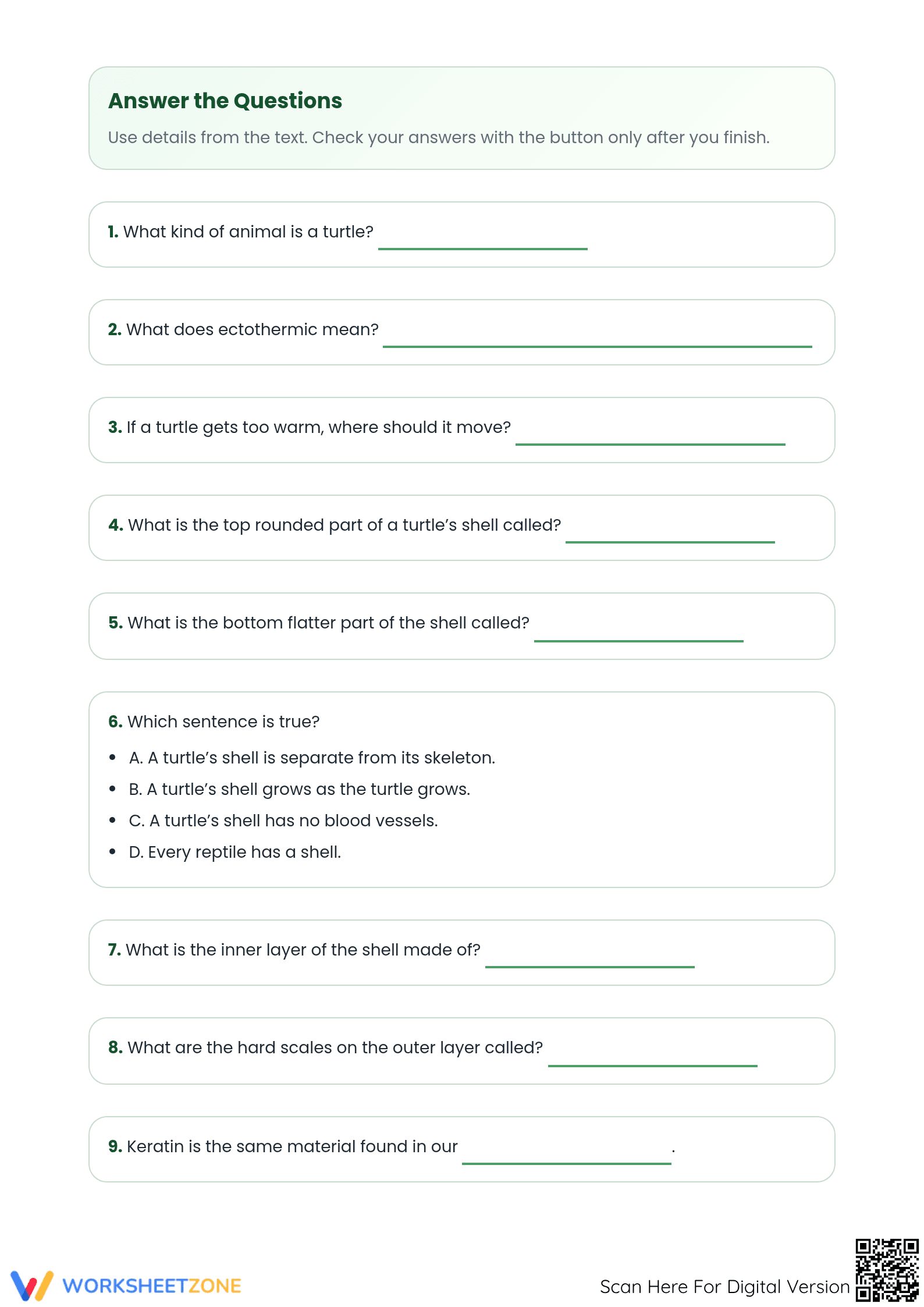
This printable informational reading passage provides a focused look at the biological features of turtles, specifically their classification as ectothermic reptiles and the unique structure of their skeletons. Students read a detailed text adapted from Guy Belleranti and answer 10 targeted comprehension questions to demonstrate their ability to locate specific details within a nonfiction text.
At a Glance
- Grade: 3 · Subject: ELA Literature - Reading Comprehension
- Standard:
CCSS.ELA-LITERACY.RI.3.1— Ask and answer questions to demonstrate understanding of a text, referring explicitly to the text.- Skill Focus: Identifying key details and scientific vocabulary
- Format: 3 pages · 10 problems · Answer key included · PDF
- Best For: Independent practice or formative science-integrated literacy
- Time: 25–35 minutes
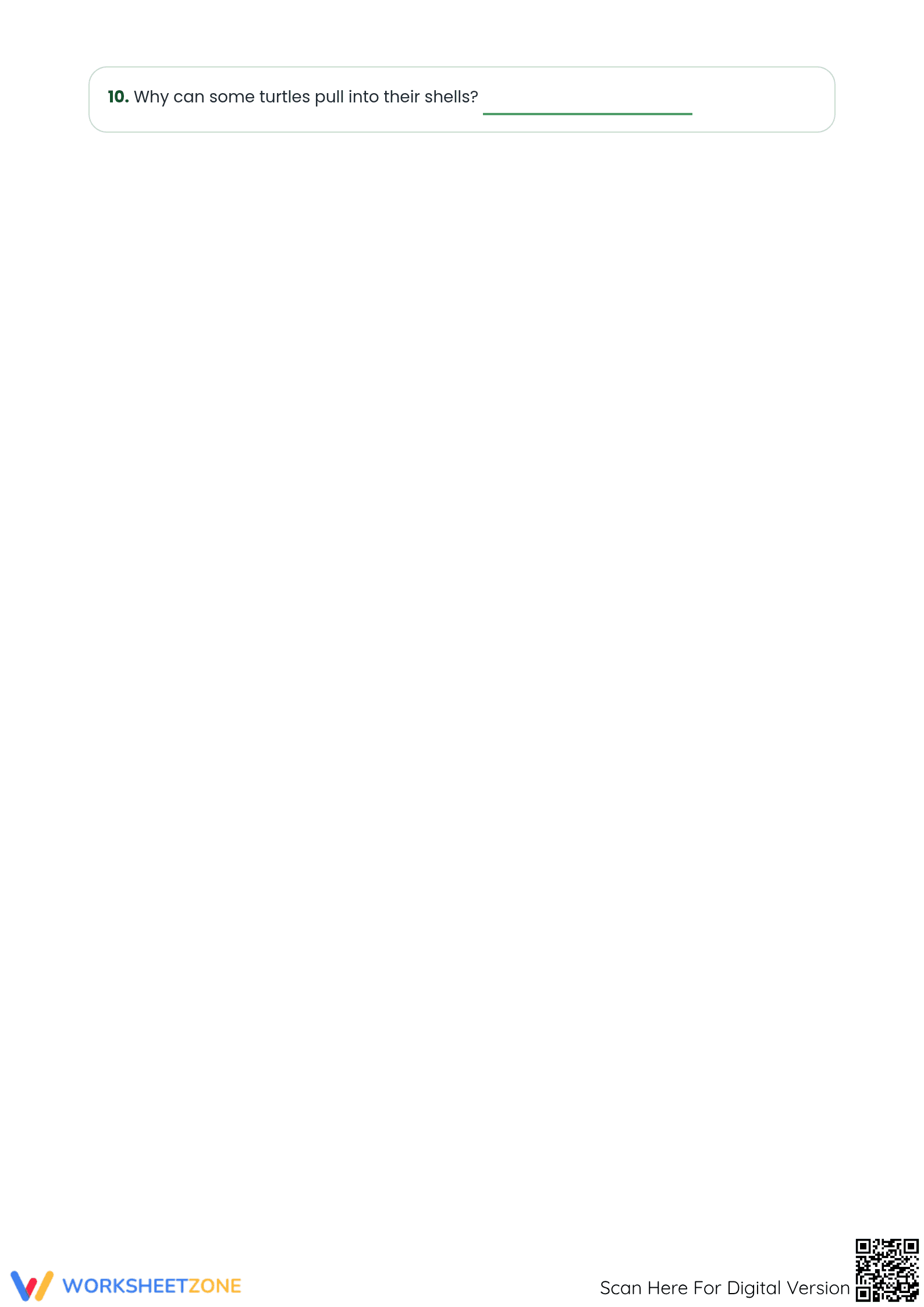
The worksheet consists of a one-page reading passage followed by two pages of assessment questions. The text introduces specialized vocabulary such as ectothermic, carapace, plastron, and keratin, providing clear definitions in context. The 10 questions include nine fill-in-the-blank short responses and one multiple-choice question, ensuring students interact with every section of the provided information. A full answer key is included for rapid grading.
This resource follows a clear skill progression designed to move students from basic recall to synthesized understanding. First, Guided practice involves identifying the basic characteristics of reptiles through the first three questions. Next, Supported practice requires students to distinguish between the various parts of the turtle shell (carapace versus plastron) using the middle section of the text. Finally, Independent practice challenges students to evaluate true/false statements and explain the biological function of the shell in their own words, completing the gradual release of responsibility.
This resource is strictly aligned to CCSS.ELA-LITERACY.RI.3.1. By requiring students to answer questions like "What is the inner layer of the shell made of?" using explicit evidence from the passage, the worksheet reinforces the foundational skill of citing textual support. Both standard codes can be copied directly into lesson plans, IEP goals, or district curriculum mapping tools to ensure instructional compliance.
To use this worksheet effectively, assign it during a literacy block after a brief introduction to nonfiction text features. During the activity, circulate and observe if students are flipping back to the first page to verify their answers; this is a key formative-assessment indicator of text-referencing behavior. Most Grade 3 students will complete the reading and all 10 questions within 30 minutes, making it an excellent fit for a standard instructional period or a detailed sub-plan.
This resource is primarily intended for Grade 3 students but is highly appropriate for Grade 4 review or Grade 2 enrichment. It pairs naturally with a life science unit on animal adaptations or a specific lesson on reptiles. Teachers can differentiate by providing highlighters for students to mark the definitions of scientific terms directly in the text before beginning the question set.
Research from EdReports 2024 emphasizes that students demonstrate significantly higher retention of scientific concepts when those concepts are embedded within structured literacy tasks. This CCSS.ELA-LITERACY.RI.3.1 worksheet facilitates that integration by focusing on the plain-English skill of answering questions to demonstrate understanding of a text. By requiring students to engage with 10 specific evidence-based tasks, the resource ensures that learners do more than just skim the surface of the informational passage. The inclusion of complex vocabulary like ectothermic and carapace within a scaffolded format aligns with modern pedagogical standards for building background knowledge through complex text. This approach is supported by the ScienceDirect TpT Analysis, which highlights the efficiency of zero-prep, high-alignment resources in reducing teacher burnout while maintaining high academic rigour for diverse student populations across different grade levels.


