


























Views
Downloads

Printable Reading Response Worksheet | Grade 3
Paste this activity's link or code into your existing LMS (Google Classroom, Canvas, Teams, Schoology, Moodle, etc.).
Students can open and work on the activity right away, with no student login required.
You'll still be able to track student progress and results from your teacher account.
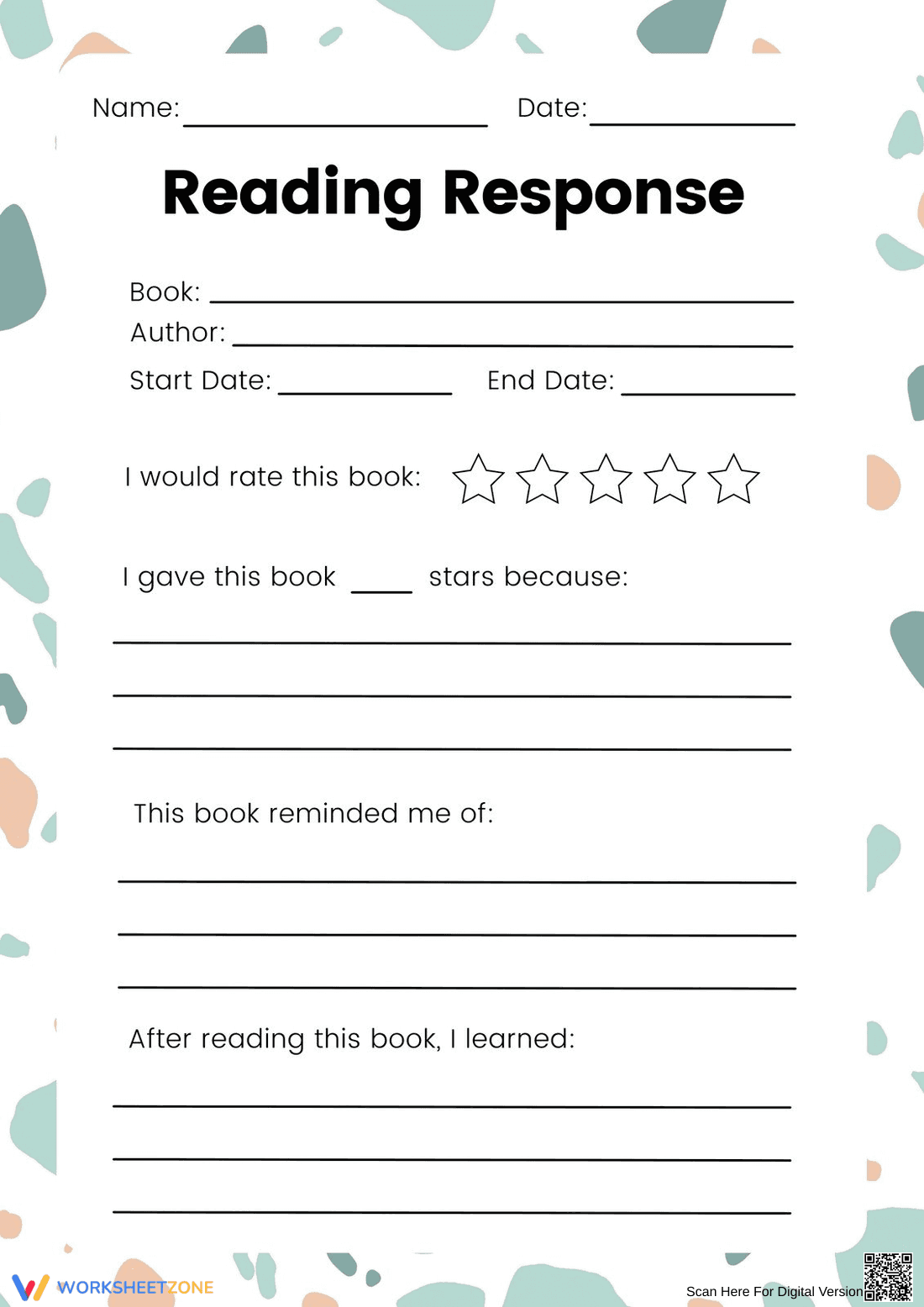
This reading response worksheet helps students articulate their thoughts and opinions after finishing a book. By prompting learners to rate the text, explain their reasoning, make personal connections, and summarize what they learned, this resource builds foundational comprehension skills. It provides a structured space for meaningful reflection.
At a Glance
- Grade: 3 · Subject: ELA
- Standard:
CCSS.ELA-LITERACY.RL.3.1— Ask and answer questions to demonstrate understanding.- Skill Focus: Reading Comprehension and Reflection
- Format: 1 page · 4 problems · No answer key · PDF
- Best For: Independent reading accountability
- Time: 15–20 minutes
Inside this single-page resource, educators will find a visually appealing, terrazzo-themed graphic organizer. The page features four distinct response areas: a five-star rating scale, a section to justify the rating, a prompt for connections, and a space to state the main takeaway. Because prompts are open-ended, an answer key is not required.
This resource is designed for immediate classroom implementation:
- Print (1 minute): The single-page PDF format means you can quickly run off copies for the whole class without worrying about collating or stapling.
- Distribute (1 minute): Hand out the sheets as students transition into their independent reading block or visit the classroom library.
- Review (3 minutes): Quickly scan completed sheets to check for basic comprehension and completion.
With under two minutes of total teacher prep time, this worksheet is an excellent addition to any emergency sub plan or daily literacy center rotation.
This activity aligns with CCSS.ELA-LITERACY.RL.3.1, requiring students to ask and answer questions to demonstrate understanding of a text, referring explicitly to the text as the basis for the answers. It also supports basic opinion writing by asking students to justify their star rating with a clear reason. Both standard codes can be copied directly into lesson plans, IEP goals, or district curriculum mapping tools.
Teachers can utilize this worksheet during independent reading time as a weekly accountability check. After students finish a book, they complete the organizer before selecting a new text. It also works well as a post-read-aloud activity. As a formative assessment tip, observe whether students pull specific details from the book to explain their rating. Expect students to complete this task in 15 to 20 minutes.
This resource is primarily designed for third-grade students, though it easily adapts to second or fourth-grade classrooms depending on reading levels. It is particularly helpful for reluctant writers who benefit from short, targeted prompts rather than a blank page for a book report. Pair this worksheet with a classroom anchor chart on making text-to-self connections to provide additional scaffolding for students who need help expanding their thoughts.
Integrating structured reflection tools like this reading response worksheet is essential for developing strong literacy habits. Aligned with CCSS.ELA-LITERACY.RL.3.1, the activity requires students to ask and answer questions to demonstrate understanding. According to Fisher & Frey (2014), providing students with consistent, low-stakes opportunities to write about what they read significantly increases both reading comprehension and retention of vocabulary. When learners are asked to justify a book rating or articulate a personal connection, they move beyond passive decoding and engage in active, critical thinking. This single-page format removes the cognitive load of structuring a formal essay, allowing young readers to focus entirely on their immediate reactions and textual evidence. By making this a regular part of the literacy block, educators can foster a deeper, more personal engagement with texts while simultaneously gathering valuable formative data on student comprehension levels.


