































Turkey Feathers Make 10 Number Bonds | Kindergarten

Paste this activity's link or code into your existing LMS (Google Classroom, Canvas, Teams, Schoology, Moodle, etc.).
Students can open and work on the activity right away, with no student login required.
You'll still be able to track student progress and results from your teacher account.
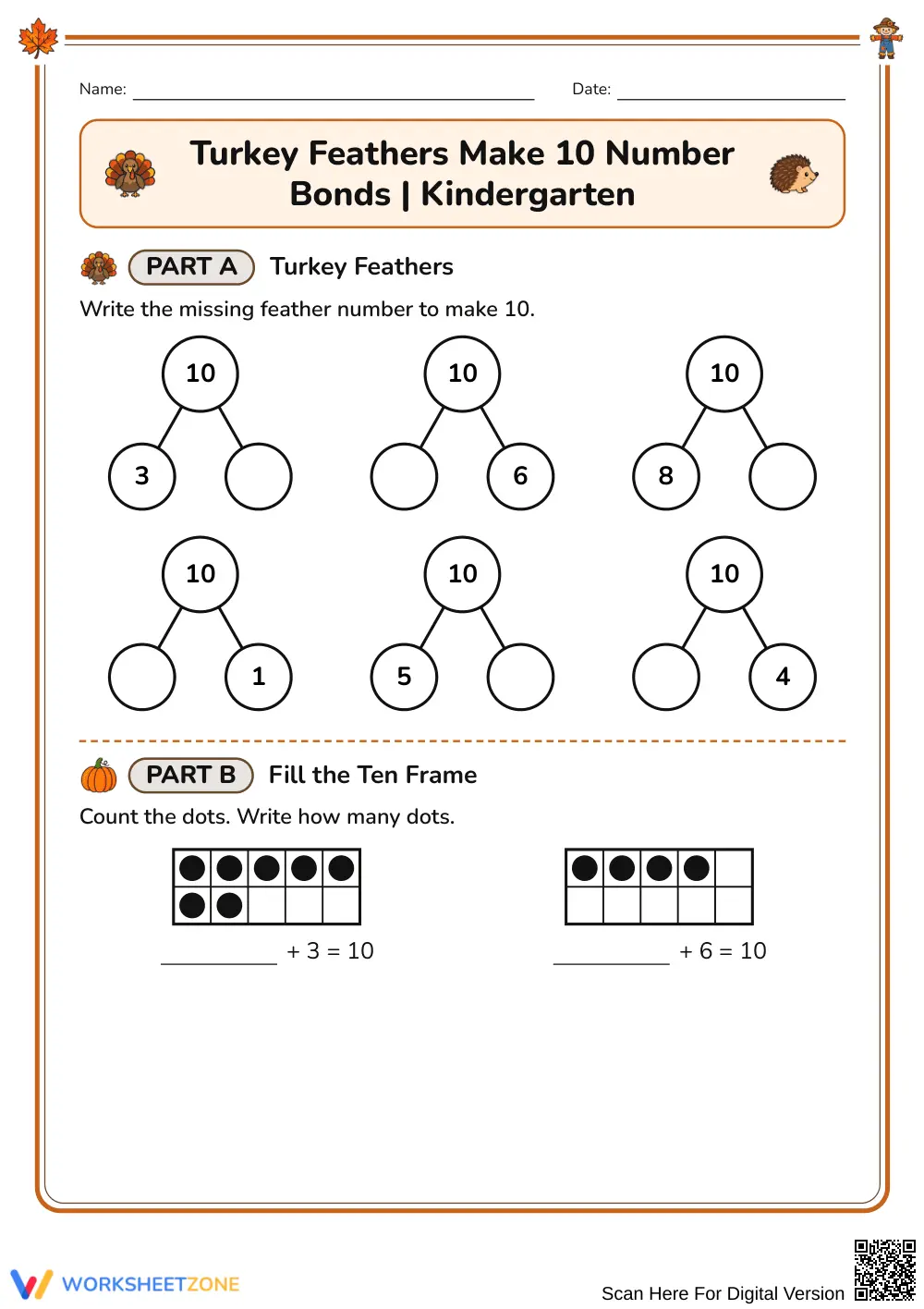
This Kindergarten addition worksheet builds foundational fluency in partners of 10 through number bonds and ten frames. Students determine missing numbers to make ten across eight structured problems, strengthening early part-whole reasoning. By combining themed feather bonds with dot arrays, learners develop mental math confidence.
At a Glance
- Grade: Kindergarten · Subject: Early Math
- Standard:
K.OA.A.4— Find the number that makes 10 when added to any given number- Skill Focus: Number bonds and making 10
- Format: 1 printable page · 8 problems · Answer key included · PDF
- Best For: Independent math centers or guided small groups
- Time: 15–20 minutes
What's Inside
This single-page printable contains eight focused practice items across two parts. Part A provides six turkey feather number bonds prompting students to complete missing addends for 10. Part B features two ten-frame dot counting tasks paired with addition equations. A complete one-page answer key enables rapid grading.
Skill Progression
- Guided practice (Problems 7–8): Visual ten frames provide concrete dot arrangements (7 and 4) to support identifying missing addends.
- Supported practice (Problems 1–3): Number bonds use familiar addends (3, 4, 8) within clear part-whole diagrams.
- Independent practice (Problems 4–6): Abstract bonds test doubles (5 + 5) and extreme pairs (9 + 1) without visual cues.
This progression applies gradual release to move learners from visual arrays to symbolic fact recall.
Standards Alignment
This worksheet aligns directly with standard K.OA.A.4: For any number from 1 to 9, find the number that makes 10 when added to the given number. It also supports K.OA.A.1 by having students represent addition using ten frames and equations. Both standard codes can be copied directly into lesson plans, IEP goals, or district curriculum mapping tools.
How to Use It
Use this page during independent practice after whole-group ten-frame modeling, or place it in a seasonal math center. For formative assessment, observe whether students subitize the dots or count each one manually to determine make-ten combinations. Expected completion time is 15 to 20 minutes.
Who It's For
This resource serves Kindergarten general education students mastering sums to 10, as well as Grade 1 students needing Tier 2 addition intervention. Differentiate by providing physical counters for struggling learners. Pair this printable with a classroom ten-frame anchor chart during direct instruction.
Mastering early number combinations under standard K.OA.A.4 requires systematic exposure to both visual arrays and abstract part-whole representations. According to Fisher & Frey (2014), purposeful instructional materials that scaffold students from graphic models to independent numerical operations significantly improve foundational math retention and schema formation. This worksheet equips kindergarten learners with eight targeted opportunities to find the missing addend that makes ten, reinforcing flexible arithmetic thinking. By integrating structured ten frames with turkey feather number bonds, the task supports conceptual understanding while advancing procedural fluency. Students visually quantify known quantities before deducing the complement required to reach a total of ten. This deliberate transition from visual counting to symbolic problem-solving establishes the critical mathematical automaticity required for subsequent place-value concepts and multidigit arithmetic operations across early elementary grade bands. Early educators can utilize this resource to track numeracy milestones effectively.


