




























Views
Downloads

Living and Non-Living Things Printable Worksheet | Grade 3

Paste this activity's link or code into your existing LMS (Google Classroom, Canvas, Teams, Schoology, Moodle, etc.).
Students can open and work on the activity right away, with no student login required.
You'll still be able to track student progress and results from your teacher account.
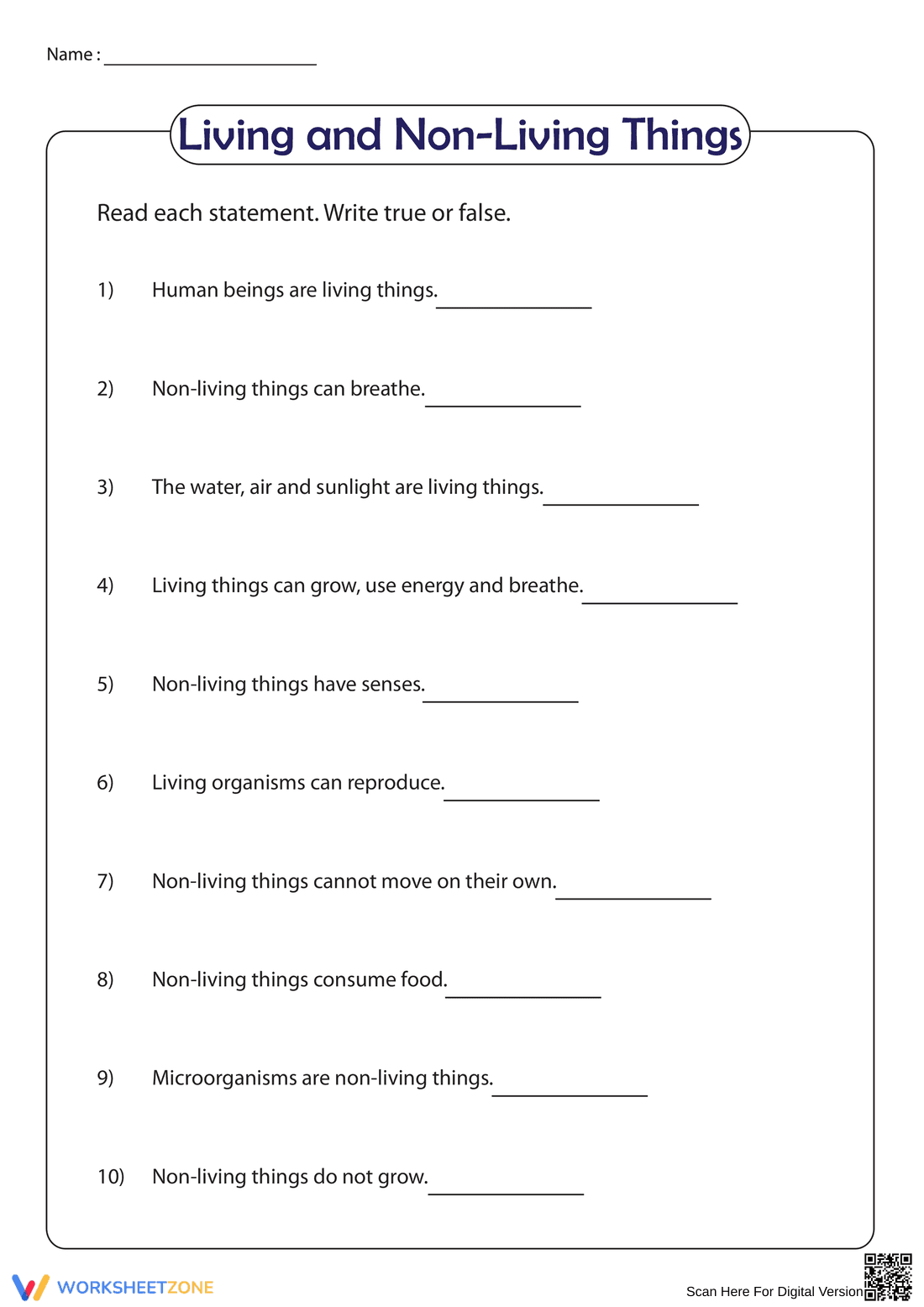
This Grade 3 science worksheet helps students distinguish between living and non-living things by evaluating biological characteristics. Students analyze 10 specific statements to determine if they accurately describe life processes like growth, reproduction, and energy use. It provides a clear, structured way to assess foundational biology concepts in any elementary classroom setting.
At a Glance
- Grade: 3 · Subject: Science
- Standard:
3-LS1-1— Describe commonalities in organisms including growth, reproduction, and basic life needs- Skill Focus: Identifying characteristics of life
- Format: 1 page · 10 problems · Answer key included · PDF
- Best For: Quick formative assessment or sub plans
- Time: 10–15 minutes
Inside this resource, you will find a single-page student activity featuring 10 True or False statements. The worksheet covers essential concepts such as respiration, movement, and the classification of microorganisms. A comprehensive answer key is provided on the second page, allowing for rapid grading or student self-correction during independent work time.
The zero-prep workflow is designed for maximum efficiency. First, print the single-page PDF (30 seconds). Next, distribute the sheets to your students for independent or guided practice (1 minute). Finally, use the included answer key to review responses as a whole group or grade the set (under 1 minute). Total teacher preparation time is less than two minutes.
This resource is aligned to `3-LS1-1`, which requires students to understand that while organisms are diverse, they share common traits like growth and reproduction. It also supports foundational literacy in science by requiring students to evaluate the truth of technical statements. Both standard codes can be copied directly into lesson plans, IEP goals, or district curriculum mapping tools.
Use this worksheet as a "ticket out the door" after a lesson on the characteristics of life to gauge student understanding. Alternatively, assign it as a quick warm-up activity to activate prior knowledge before starting a biology unit. Observe if students struggle with the classification of microorganisms (Item 9) to identify specific misconceptions.
This activity is ideal for third-grade students or second graders ready for a challenge. It serves as an excellent resource for English Language Learners due to its clear, concise sentence structure. Pair this worksheet with a living vs. non-living sorting tray or a digital slide deck introducing the seven life processes.
This Grade 3 science resource focuses on the 3-LS1-1 standard, requiring students to identify the essential characteristics that define living organisms. By evaluating 10 distinct statements regarding growth, energy consumption, and reproduction, students build the cognitive framework necessary for more complex biological studies. Research from Fisher & Frey (2014) emphasizes that structured independent practice with immediate feedback—facilitated here by the included answer key—is critical for moving scientific concepts from short-term memory to long-term mastery. The worksheet's design minimizes cognitive load by using a familiar True/False format, allowing students to focus entirely on the content rather than complex instructions. This alignment ensures that 100% of the tasks directly support the mastery of life science fundamentals. Such targeted practice is a staple of high-quality curriculum as noted in recent EdReports 2024 evaluations of elementary science materials.


