




























Views
Downloads


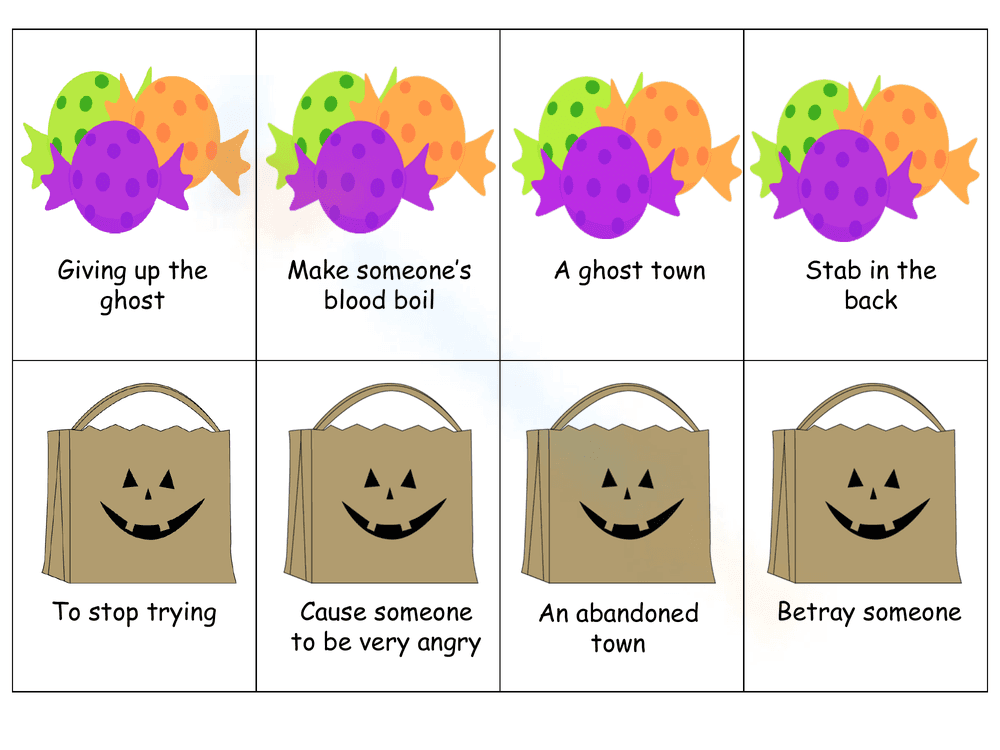

Printable Halloween Idiom Matching Cards | Grade 3 ELA

Paste this activity's link or code into your existing LMS (Google Classroom, Canvas, Teams, Schoology, Moodle, etc.).
Students can open and work on the activity right away, with no student login required.
You'll still be able to track student progress and results from your teacher account.
This engaging Halloween idiom matching activity helps students master nonliteral language by pairing spooky phrases with their actual meanings. By connecting colorful candy and trick-or-treat bag cards, young learners build essential vocabulary and reading comprehension skills in a fun, hands-on format perfect for the fall season.
At a Glance
- Grade: 3 · Subject: English
- Standard:
CCSS.ELA-LITERACY.L.3.5.A— Distinguish literal and nonliteral meanings of phrases- Skill Focus: Idioms and Figurative Language
- Format: 3 pages · 12 matching pairs · Printable PDF
- Best For: Literacy centers and small groups
- Time: 15–20 minutes
This printable resource includes three pages of vibrant, Halloween-themed matching cards. Students will find 12 candy-shaped cards featuring common idioms like "blind as a bat" or "a skeleton in the closet," alongside 12 trick-or-treat bag cards displaying the literal definitions. The visual cues and thematic design keep students highly engaged while they practice decoding figurative language.
Skill Progression
- Guided practice: Introduce the cards in a small group setting, discussing the literal versus nonliteral meaning of one or two idioms together.
- Supported practice: Allow students to work in pairs to match the remaining candy cards to their corresponding trick-or-treat bags, encouraging peer discussion.
- Independent practice: Have individual students complete the matching game on their own as a center activity to demonstrate mastery.
This gradual-release approach ensures students confidently transition from guided instruction to independent application.
Standards Alignment
This activity is directly aligned to CCSS.ELA-LITERACY.L.3.5.A: Distinguish the literal and nonliteral meanings of words and phrases in context. By matching idioms to their true definitions, students actively practice decoding figurative language. Both standard codes can be copied directly into lesson plans, IEP goals, or district curriculum mapping tools.
How to Use It
These matching cards are perfect for October literacy centers or as a festive fast-finisher activity. Before independent use, teachers can use the cards during whole-class instruction to introduce the concept of idioms. As a formative assessment tip, observe students as they sort the cards; listen to their reasoning to ensure they understand why a phrase like "scared stiff" does not mean literally turning into wood. Expected completion time is 15 to 20 minutes.
Who It's For
This resource is primarily designed for third-grade students developing their understanding of figurative language, but it also serves as an excellent review for fourth graders or a challenge for advanced second graders. English Language Learners (ELLs) will particularly benefit from the explicit pairing of idioms with clear, literal definitions. Pair these cards with a Halloween-themed read-aloud to spot idioms in context.
Mastering figurative language is a critical milestone in reading comprehension. According to Fisher & Frey (2014), explicit instruction in nonliteral language significantly improves students' ability to infer meaning from complex texts. This activity targets CCSS.ELA-LITERACY.L.3.5.A, requiring students to distinguish literal and nonliteral meanings of phrases. By physically manipulating the cards to match idioms with their definitions, learners engage multiple cognitive pathways, reinforcing memory retention. The thematic Halloween elements further increase task persistence and motivation. Providing structured opportunities to decode phrases like "pale as a ghost" ensures students do not become stuck on literal interpretations, which is essential for advancing to higher-level literary analysis. This hands-on approach bridges the gap between abstract linguistic concepts and concrete understanding.


