


























Views
Downloads

Triangles with Extended Angles Worksheet | Grade 7 Essential
Paste this activity's link or code into your existing LMS (Google Classroom, Canvas, Teams, Schoology, Moodle, etc.).
Students can open and work on the activity right away, with no student login required.
You'll still be able to track student progress and results from your teacher account.
This Grade 7 geometry worksheet helps students master the relationship between interior and exterior angles of triangles. By applying the Exterior Angle Theorem and Triangle Sum Theorem, learners solve multi-step problems to find missing variables. It provides a clear path toward geometric reasoning and algebraic application in a structured format.
At a Glance
- Grade: 7 · Subject: Math
- Standard:
CCSS.MATH.CONTENT.7.G.B.5— Use angle facts to solve for unknown angles in geometric figures- Skill Focus: Exterior and Interior Angles
- Format: 2 pages · 4 problems · Answer key included · PDF
- Best For: Independent practice or formative assessment
- Time: 20–30 minutes
What's Inside
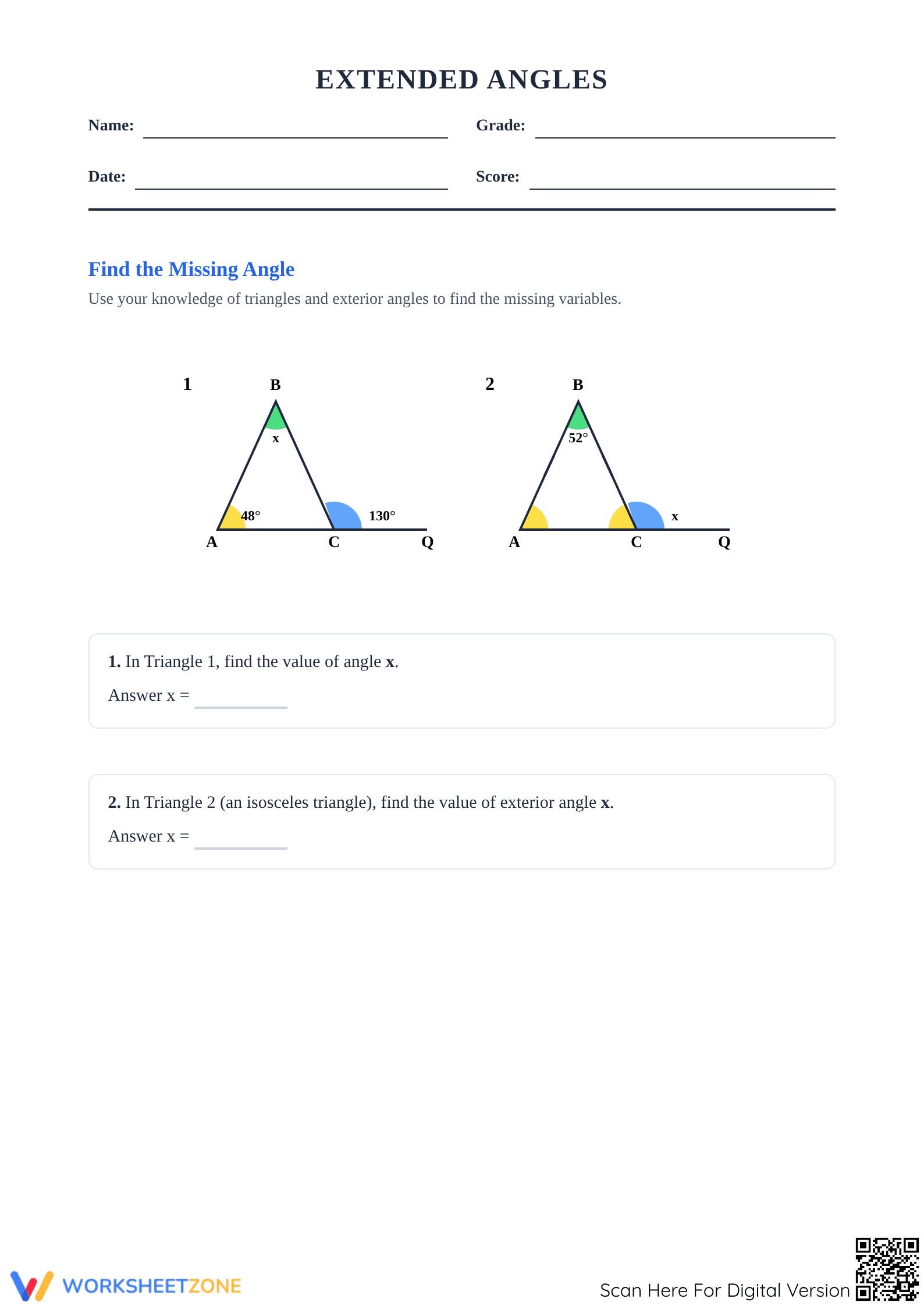
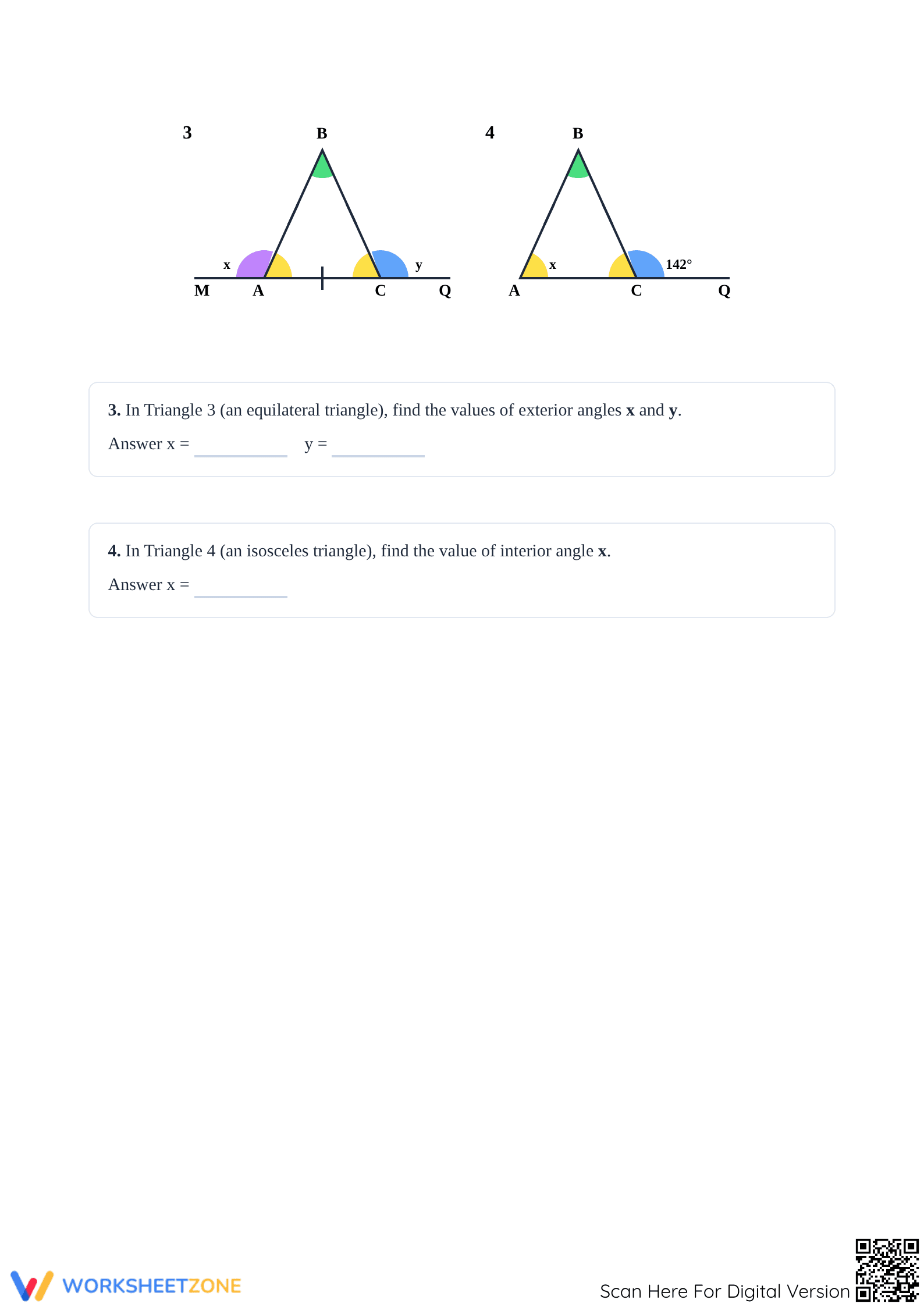
This 2-page PDF features 4 comprehensive geometric diagrams involving general, isosceles, and equilateral triangles. Each problem requires students to identify angle relationships, such as supplementary angles on a straight line or the sum of interior angles. A complete answer key is provided, showing the final values for all variables and ensuring students can self-correct during independent work.
Zero-Prep Workflow
- Print: Select the two problem pages and the answer key for your class in under 30 seconds.
- Distribute: Hand out the sheets as a warm-up, bell-ringer, or main lesson activity.
- Review: Use the included answer key to provide immediate feedback or facilitate peer-grading.
Total teacher prep time is under 2 minutes, making this an ideal sub plan or last-minute resource for busy educators.
Standards Alignment
This resource is aligned to `CCSS.MATH.CONTENT.7.G.B.5`, which focuses on using facts about supplementary, complementary, vertical, and adjacent angles to solve for unknowns. It also supports 8.G.A.5 regarding the exterior angle of triangles. Both standard codes can be copied directly into lesson plans, IEP goals, or district curriculum mapping tools.
How to Use It
Assign this worksheet during the independent practice phase of a lesson on triangle properties. It works effectively as a formative assessment to check if students can distinguish between interior and exterior angle sums. Expect students to spend 20 to 30 minutes completing the calculations and checking their logic. You can also use it as a quick exit ticket by assigning just one of the complex diagrams.
Who It's For
Designed for Grade 7 math students, this resource is also suitable for Grade 8 review or advanced Grade 6 learners. It pairs naturally with a protractor demonstration or an anchor chart detailing the Exterior Angle Theorem. The clear diagrams support English Language Learners by providing visual context for the mathematical vocabulary.
According to the RAND AIRS 2024 report, high-quality curriculum-aligned practice is essential for developing spatial reasoning in middle school geometry. This worksheet targets CCSS.MATH.CONTENT.7.G.B.5 by requiring students to synthesize multiple geometric rules—such as the fact that an exterior angle equals the sum of the two remote interior angles—into a single solution. By engaging with these 4 multi-part problems, students move beyond rote memorization toward conceptual mastery of angle relationships. Research from Fisher & Frey (2014) emphasizes that structured independent practice with immediate feedback via answer keys significantly improves retention of geometric theorems. This resource provides that exact bridge between direct instruction and independent mastery, ensuring students are prepared for high school coordinate geometry and trigonometry. The inclusion of isosceles and equilateral triangles adds a layer of complexity that challenges students to recall side-angle relationships alongside their algebraic work.


