




























Views
Downloads

Essential Grade 2 Traits of Animals and Offspring Worksheet

Paste this activity's link or code into your existing LMS (Google Classroom, Canvas, Teams, Schoology, Moodle, etc.).
Students can open and work on the activity right away, with no student login required.
You'll still be able to track student progress and results from your teacher account.
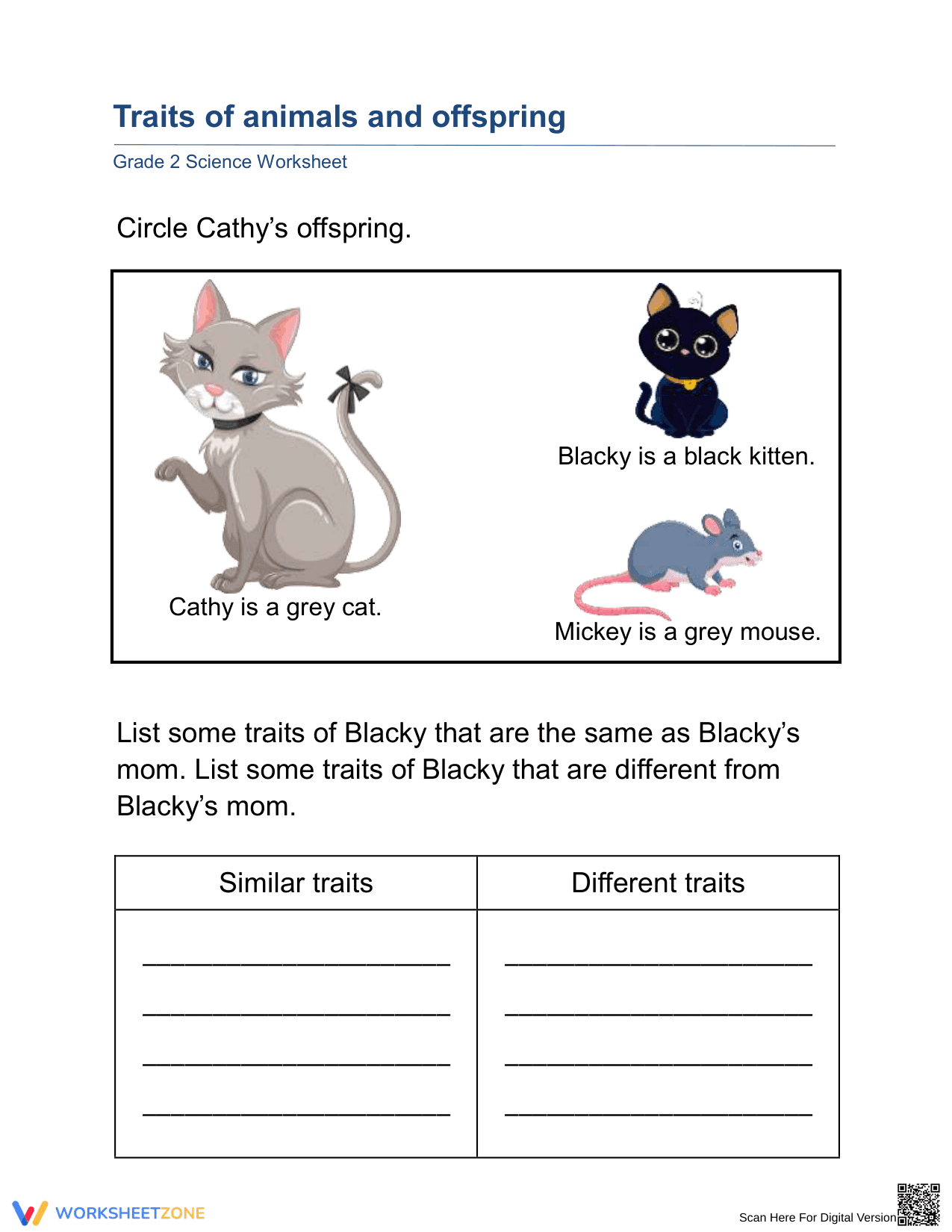
Students explore the biological connection between parents and their young with this focused science resource. This worksheet helps learners identify how animals inherit specific physical characteristics while recognizing natural variations. By comparing a cat to its offspring, students develop the foundational observational skills necessary to understand heredity and life cycles in the natural world.
At a Glance
- Grade: 2 · Subject: Science
- Standard:
1-LS3-1— Make observations to show how young animals are like their parents- Skill Focus: Inherited traits and animal offspring
- Format: 1 page · 2 problems · Answer key included · PDF
- Best For: Independent practice or quick science assessment
- Time: 10–15 minutes
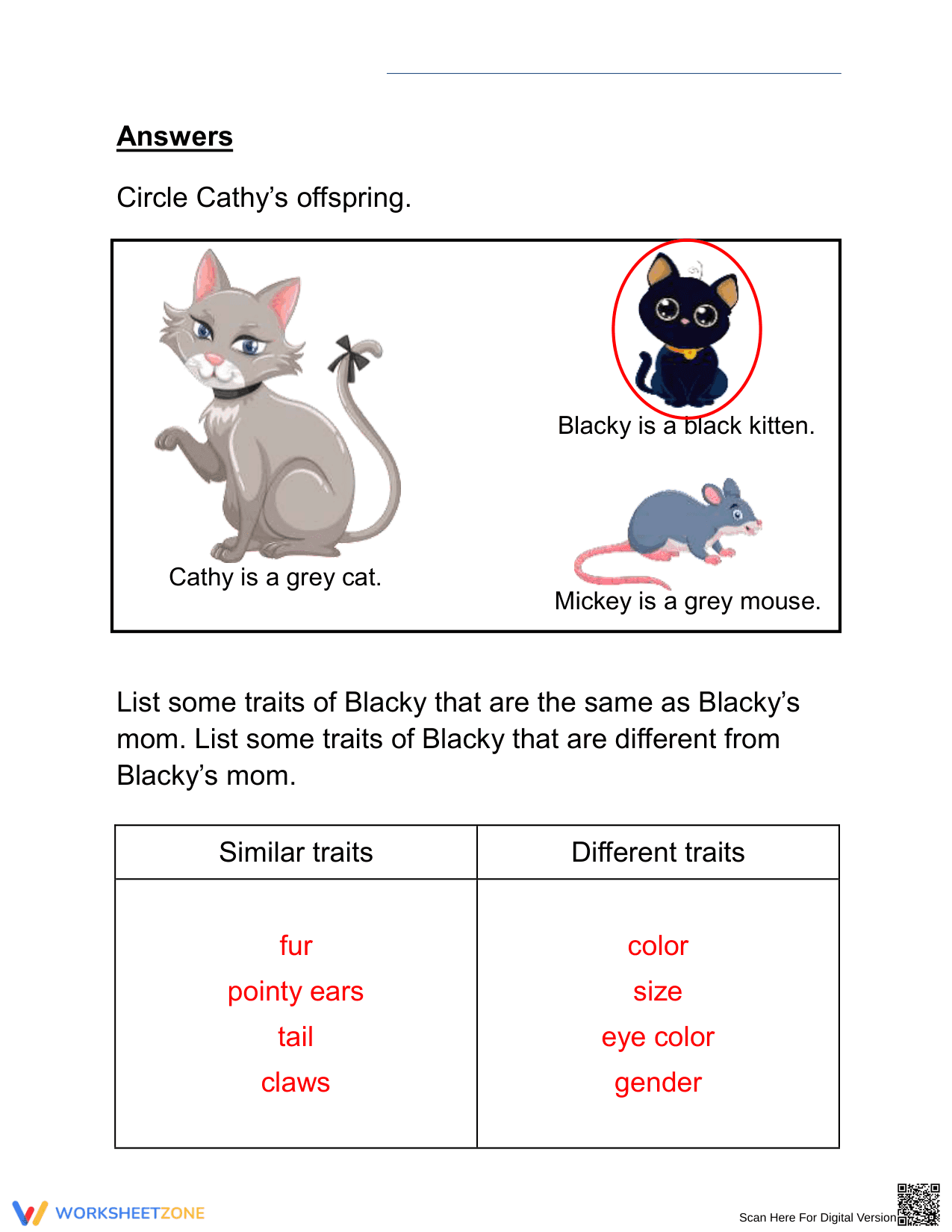
The single-page PDF features two distinct tasks designed to build analytical depth. First, a visual identification prompt requires students to differentiate between offspring and unrelated species. Second, a structured "Similar traits" and "Different traits" table provides ample space for students to list physical attributes. The clear layout and large font ensure readability for young learners, and a comprehensive answer key is included.
The zero-prep design allows teachers to implement this lesson in under two minutes. Print the single-page PDF (30 seconds). Distribute the worksheets and read the prompt aloud to ensure students understand the comparison between the cat and kitten (60 seconds). Review the completed tables as a group to clarify inherited traits (60 seconds). This structure is perfect for substitute plans or sudden schedule changes.
Standards Alignment
This resource is directly aligned to the Next Generation Science Standard 1-LS3-1: "Make observations to construct an evidence-based account that young plants and animals are like, but not exactly like, their parents." It specifically addresses the disciplinary core idea regarding heredity and the inheritance of traits. Both standard codes can be copied directly into lesson plans, IEP goals, or district curriculum mapping tools.
How to Use It
Use this worksheet as a formative assessment during a unit on life cycles. It works best after direct instruction on how animals grow and change. Teachers can observe students as they complete the table to identify those who may struggle with distinguishing between color, size, and body structure. It is an ideal follow-up to a classroom read-aloud about animal families.
Who It's For
This resource is designed for Grade 2 students but serves as an excellent reinforcement for Grade 1 or a review for Grade 3. It provides scaffolds for English Language Learners through visual cues and clear categorization tasks. It pairs naturally with an anchor chart showing different animal families or a short video clip of animals in their natural habitats.
The study of heredity in early childhood science curricula emphasizes the foundational concept that young organisms resemble their biological parents while maintaining distinct individual variations. According to the RAND AIRS 2024 report on elementary science achievement, structured observation tasks that require students to categorize physical characteristics—such as the number of limbs, fur color, or body shape—significantly improve scientific literacy and analytical reasoning in primary grades. This worksheet aligns with standard 1-LS3-1 by providing a concrete framework for students to compare animals and offspring. By documenting similar traits and different traits in a comparative table, learners move beyond simple identification toward evidence-based explanation. This approach supports the development of crosscutting concepts related to patterns and cause-and-effect in biological systems. Educators can rely on this vetted resource to provide rigorous, age-appropriate practice that builds the observational stamina required for advanced life science inquiry and mastery of standard-aligned learning objectives.


